























How Many Stools Fit at a Kitchen Island? Spacing and Size Guide

The number of stools that fits at a kitchen island depends on the usable seating edge and the stools you choose. Start with a person-by-person space allowance, then check the furniture itself. The result should leave room to sit down, eat, turn, and get up.
Measure the usable seating edge
Measure the continuous length where people can actually sit. Exclude sections blocked by supports, side panels, cabinets, or an overhang with insufficient knee space. Write down each usable side separately.
Also measure the counter height, the clear space beneath it, and the area behind the seats. A long edge can still be unsuitable for extra stools if a door or circulation route needs that space.

Estimate stool count from space per person
Let L be the usable seating length and S the width you plan for each person. Your initial count is L ÷ S, rounded down.
The NKBA's Kitchen Planning Guidelines, in the linked pre-2023 edition, use 24 inches of seating width per diner as a planning reference. A wider stool or a preference for more elbow room can call for a larger allowance. The table below also shows a 30-inch planning example.
| Usable edge | At 24 inches per person | At 30 inches per person |
|---|---|---|
| 48 inches / 4 feet | 2 | 1 |
| 60 inches / 5 feet | 2 | 2 |
| 72 inches / 6 feet | 3 | 2 |
| 84 inches / 7 feet | 3 | 2 |
| 96 inches / 8 feet | 4 | 3 |
| 120 inches / 10 feet | 5 | 4 |
These are calculated starting counts for one straight, unobstructed seating edge. Check the actual stool dimensions and the checks below before choosing a quantity.
Check stool width and the gaps between seats
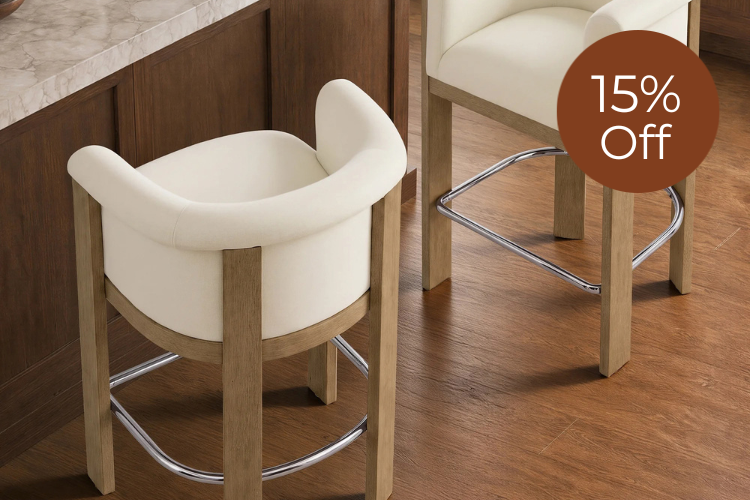
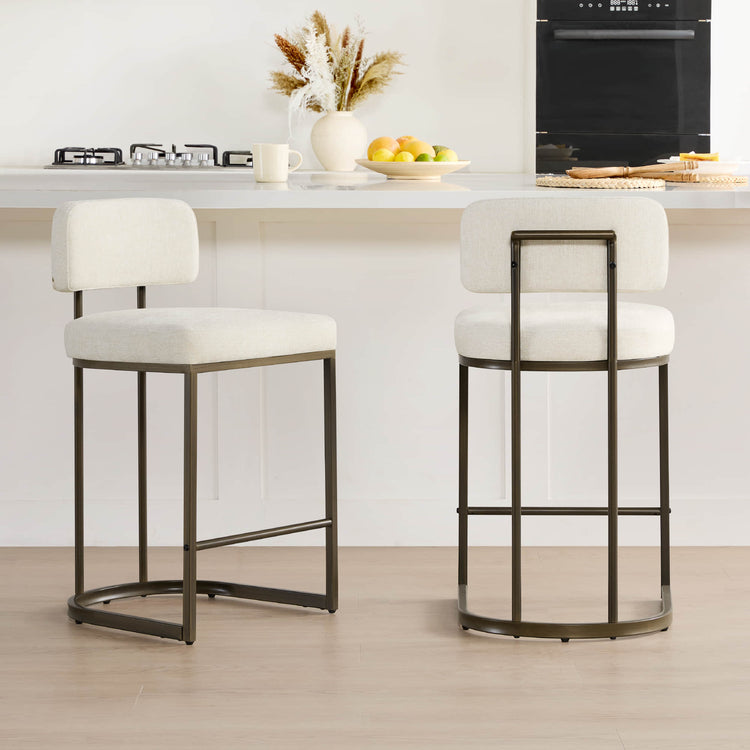
Measure a stool at its widest point, including arms or a wider base. For identical stools, use this second check: Our Nova bar and counter stool lists separate height options, so use the dimensions for the option you plan to order.
Required length = number of stools × stool width + gaps between neighboring stools + clearance at both ends.
For example, four stools that are each 20 inches wide occupy 80 inches before any gaps are added. If you choose a 6-inch gap between neighboring stools and 3 inches at each end, the calculation is 4 × 20 + 3 × 6 + 2 × 3 = 104 inches. Those gap choices are the assumptions in this example.
Center-to-center spacing measures from the middle of one stool to the middle of the next. Two 20-inch-wide stools with a 6-inch gap have 26-inch centers. Lay out the selected width and gaps on the floor, then test sitting and turning positions. Our swivel and stationary counter stool comparison explains why the turning path needs a separate check.

Match seat height and knee space
Choose seat height for the counter section where the stool will be used. A two-level island can need different seat heights for its two counter levels. For one level, compare stools designed for that same height. Test the footrest as well: your feet should have support while seated. The Canadian Centre for Occupational Health and Safety's seated-work chair guidance recommends a footrest when feet cannot reach the floor; this is especially relevant when the island doubles as a work spot.
Measure the actual clear space under the countertop, including any apron or support. Our bar stool height guide covers the measurements to compare.
The linked NKBA planning reference pairs a 36-inch-high counter with 15 inches of knee-space depth, and a 42-inch-high counter with 12 inches. Check the available knee space at the actual seating position and allow for the needs of the people using it.

Check corners and the route behind the seats
For stools on adjacent sides, mark the seated positions at the corner before adding the two counts. The same corner area may be needed by both diners' knees or by a stool as it turns.
Test the arrangement with the stools pulled out and occupied. Check whether someone can pass, whether the dishwasher opens, and whether a stool blocks a drawer. Leave the route suited to the actual household, including any mobility aid in use. If the island needs a wheelchair-accessible place, plan a lower surface and an unobstructed forward approach. The U.S. Access Board's accessible dining-surface reference specifies a 28–34-inch surface height together with knee and toe clearance.
Compare the full dimensions of our bar and counter stools with your layout. Save the measurements and intended quantity with your order. If storing stools under the overhang matters, compare backed and backless stool tuck-in requirements before settling on the quantity.
Kitchen island stool questions
Can a 6-foot island fit three stools?
Yes, if all 72 inches are usable for seating and the stools, gaps, and end clearances fit within that length. For example, three 18-inch-wide stools plus two 6-inch gaps and 3 inches at each end use exactly 72 inches. Those are example dimensions, so substitute the measurements of your chosen stools. With wider stools or an obstructed end, two seats may be the more workable arrangement.
How much room do four stools need?
Use 96 inches as an initial estimate at 24 inches per diner, then check the stools and gaps. Four 20-inch-wide stools with three 6-inch gaps and 3 inches at each end need 104 inches: 80 inches of stools, 18 inches between them, and 6 inches at the ends. Choose the larger allowance when your stool layout needs it, and check knee space and the route behind occupied seats separately.
Should I count the entire island length?
No. Count only the edge where a person can sit with usable knee space. Subtract sections blocked by supports, side panels, or cabinets before dividing by the space per diner. For example, a 96-inch edge with 12 inches blocked leaves 84 inches to assess. At a corner, mark both diners' knee positions together so the same corner space is not counted twice.
Recommended Products

More to Read
 7 Sofa Trends That Actually Improve Comfort in 2026
Upgrade your living room with furniture that supports your body. Here are 7 modern sofa features designed to maximize your daily comfort...
7 Sofa Trends That Actually Improve Comfort in 2026
Upgrade your living room with furniture that supports your body. Here are 7 modern sofa features designed to maximize your daily comfort...
 Mother's Day Gift Guide: Cozy and Stylish Furniture Picks for Modern Moms
Make Mother's Day more meaningful with furniture gifts that bring comfort, smart features, storage, and quiet luxury into her everyday routine.
Mother's Day Gift Guide: Cozy and Stylish Furniture Picks for Modern Moms
Make Mother's Day more meaningful with furniture gifts that bring comfort, smart features, storage, and quiet luxury into her everyday routine.
 Performance Fabric Reality Check: Does It Really Repel Pet Hair and Stains?
Performance fabric is often marketed as a miracle solution for homes with pets and kids, but the reality is more nuanced. It...
Performance Fabric Reality Check: Does It Really Repel Pet Hair and Stains?
Performance fabric is often marketed as a miracle solution for homes with pets and kids, but the reality is more nuanced. It...
1 comment
Need 3