








































Floating a Power Reclining Sofa: How to Manage Electrical Cords Without Wall Outlets

A power reclining sofa that floats away from the wall needs a planned route to an approved power point, not a hidden cord. Before you settle on a layout, check two things: does the path stay clear of foot traffic, and does it stay clear of the sofa's full reclining movement? If both are true, you have a workable route. If either fails, change the sofa's position or the power source before you plug in. This guide walks through mapping that route, testing the recline path, choosing the cleanest option for hardwood or rugs, and knowing when an extension cord is not the fix. A reclining loveseat or full-size sofa in an open floor plan can look clean and still operate safely when the route is planned first.

Start With a Safe Power Route for a Floating Recliner
Use a route that keeps a floating powered sofa out of foot traffic and outside its reclining path. ESFI extension-cord guidance covers temporary use and routes to avoid. Separately, keep the path clear of traffic as a conservative setup check, then confirm the sofa's own instructions for model-specific connection questions.

Map the outlet-to-sofa path
- Identify the nearest power point that can reasonably reach the sofa's final position, whether that's a wall outlet, a floor outlet, or an outlet behind adjacent furniture.
- Mark every walking path and the full swing zone the sofa's footrest and frame need when reclining.
- Choose the shortest route that avoids both zones and stays visible enough to inspect at a glance.
Separate a clean look from hidden wiring
A route that looks tidy is not automatically a safe one. Running a cord through a wall cavity, under flooring, or behind built-ins is an electrical modification, not a cord-management trick, and this guide does not cover that kind of work. If your layout seems to require it, treat that as a signal to change the furniture position or check the sofa's current product manual for a supported power option before doing anything permanent.
Floating Recliner Power-Route Decision
Qualitative decision guide: proceed only when the route stays accessible and clear of traffic and moving parts. Stop or escalate when the route crosses a walking path, contacts the reclining frame, or requires concealed permanent wiring. Based on ESFI extension-cord guidance and UL Solutions electrified-furniture risk framing.
View chart data
| Route scenario | Outcome |
|---|---|
| Accessible route, clear of traffic and moving parts | Proceed |
| Route crosses a walking path | Stop or escalate |
| Route contacts the reclining frame during movement | Stop or escalate |
| Route requires concealed permanent wiring | Stop or escalate |
Check the Sofa's Full Reclining Movement Before Hiding the Cord
Confirm the cord stays clear by running the sofa through its complete powered range before you tuck anything away. A cord that looks fine while the sofa is upright can still get pulled toward the frame once the footrest extends.
Observe the entire movement envelope
- Cycle the sofa from fully upright to fully reclined, watching the cord the entire time.
- Watch where the plug meets the outlet for strain as the sofa shifts position.
- Check the footrest, hinges, and the underside of the frame for any point where the cord could get pinched.
- Look at the rear travel path if the sofa moves backward during recline, since that's where clearance is easiest to misjudge.
Use a stop condition, not a guess
Overheating is a recognized concern for electrified furniture, and entrapment and stability are among the areas UL 962 evaluates for applicable furniture with moving, powered parts. That's the reason the cord needs its own movement check, separate from how the sofa looks when parked. Don't assume a zero-wall or low-clearance design automatically means the cord is safe from contact; that spec describes wall distance, not cord routing. If the cable tightens, rubs against the frame, or disappears into a gap at any point in the recline cycle, stop and adjust the route before using that position again.
Choose a Cleaner Route for Hardwood, Rugs, and Nearby Outlets
The best-looking route depends on your floor and outlet setup, but every option still has to pass the traffic and movement checks from the sections above. Pick the scenario below that matches your room.
Hardwood or uncovered floors
- Prefer a route that runs along a low-traffic perimeter, such as behind a side table or along a wall the sofa doesn't block.
- Keep the cord visible enough that you can glance at it and confirm it's undamaged, rather than tucking it somewhere you'd need to move furniture to check.
- Don't solve a path that has to cross open floor by hiding an extension cord under a runner or floor cover; concealment doesn't remove the traffic or heat concern.
Rugs and nearby outlets
- An extension cord is not a safe item to route underneath a rug. Covering it can hide wear you'd otherwise notice.
- When the nearest outlet sits along a side wall or behind an adjacent piece, a perimeter route can work as long as the plug stays reachable and the cable stays clear of anything that moves.
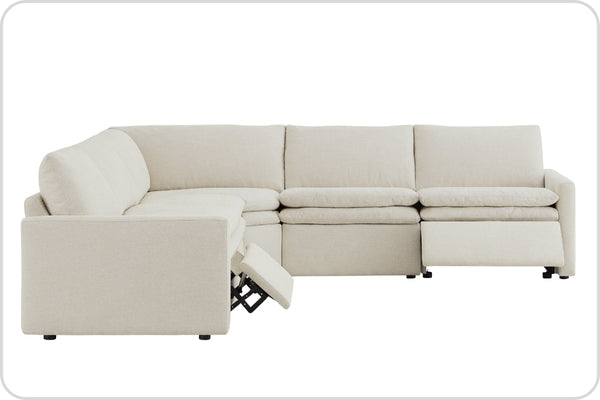
- Treat a sofa's listed cord length and wall clearance as planning inputs, not proof that a given layout is automatically safe. Our Haley power reclining sofa lists an 8.2-foot cord and reclines forward without needing rear wall clearance, which can help if your outlet sits to the side rather than directly behind the piece. For a smaller footprint, the Diya two-seater reclining sofa needs only about 1.6 inches of wall clearance and also ships with an 8.2-foot cord, which gives more flexibility in tight rooms. Either way, confirm the actual route against the sofa's full movement path once it's in place, since cord length alone doesn't guarantee clearance.
Know When a Cord Workaround Is Not the Answer
An extension cord can bridge a short gap, but only as a temporary, visible connection, never as a stand-in for permanent wiring. If your layout can't meet that bar, it's time to change the plan instead of improvising further.
Treat an extension cord as temporary
- Match the cord's rating and capacity to the sofa's power draw and check the sofa's own instructions before connecting anything.
- Keep the connection somewhere you can see and reach it, not tucked behind furniture where damage would go unnoticed.
- Never use a cord that feels hot or shows any damage, and never remove the grounding prong to force a fit. Extension cords are temporary, not permanent wiring, and they should never run through walls, doorways, ceilings, floors, or under rugs, since covering a cord traps heat that would otherwise escape.
Know the professional-help trigger
Permanent or concealed wiring falls outside what a cord-management plan can safely solve. If the only way to power the sofa in its current spot is to run wiring through a wall or floor, or if you can't confirm the connection is compatible with your sofa's specific power requirements, stop there. Check the sofa's current product documentation for supported power options, or bring in a qualified electrician before you plug anything in. Don't operate the sofa in that position until the power question is actually resolved.
Use This Final Safe Cord-Management Checklist
The sofa is ready only after the route, cord condition, plug access, and full movement checks all pass. If one fails, stop and adjust the layout or get qualified help before use.
- Confirm the route from outlet to sofa avoids every walking path in the room.
- Inspect the cord and plug for damage, heat, or a missing grounding prong.
- Run the sofa through its full recline range and watch the cord for contact or tension.
- Confirm the plug stays reachable without moving furniture to get to it.
- If any step fails, stop. Adjust the layout or get qualified help before using that position.
FAQ
Can I use extension cords with a power recliner?
Only as a temporary, properly rated connection that matches your sofa's power needs and stays visible and protected. Don't run one under a rug, through a wall, doorway, ceiling, or floor. If your layout depends on a permanent extension-cord connection, check the sofa's current product guidance or plan for a different power source instead.
How do I hide cords on hardwood floors?
Hardwood doesn't make a cord safe to hide under a rug or floor cover. Choose a route along a low-traffic perimeter or beside furniture where the cord stays visible and protected from foot traffic, or adjust the sofa's position so the path doesn't cross open floor at all.
What if the recliner cord reaches the moving frame?
Stop using that layout. Reposition the sofa or reroute the cord until it stays slack and clear through the sofa's entire recline range, then run the movement check again before using that spot regularly. If you can't get clearance without altering the wiring, check current product guidance or get qualified help.
When should I call an electrician for a floating power sofa?
Call one when the only workable power route would require permanent or concealed wiring, or when you can't confirm the connection matches your sofa's specific power requirements. A missing nearby outlet is a layout problem to solve with placement first; it isn't a reason to run a hidden, permanent extension-cord connection instead.
Sources
- Electrical Safety Foundation International (2020). Extension Cord Safety Tips.
- UL Solutions (2022). Electrical Safety in the Furniture Industry FAQ.
Recommended Products




More to Read
 7 Sofa Trends That Actually Improve Comfort in 2026
Upgrade your living room with furniture that supports your body. Here are 7 modern sofa features designed to maximize your daily comfort...
7 Sofa Trends That Actually Improve Comfort in 2026
Upgrade your living room with furniture that supports your body. Here are 7 modern sofa features designed to maximize your daily comfort...
 Mother's Day Gift Guide: Cozy and Stylish Furniture Picks for Modern Moms
Make Mother's Day more meaningful with furniture gifts that bring comfort, smart features, storage, and quiet luxury into her everyday routine.
Mother's Day Gift Guide: Cozy and Stylish Furniture Picks for Modern Moms
Make Mother's Day more meaningful with furniture gifts that bring comfort, smart features, storage, and quiet luxury into her everyday routine.
 Performance Fabric Reality Check: Does It Really Repel Pet Hair and Stains?
Performance fabric is often marketed as a miracle solution for homes with pets and kids, but the reality is more nuanced. It...
Performance Fabric Reality Check: Does It Really Repel Pet Hair and Stains?
Performance fabric is often marketed as a miracle solution for homes with pets and kids, but the reality is more nuanced. It...