

































How to Judge Dresser Drawer Quality Before You Buy

Judge dresser drawer quality by checking five things together: the drawer box and its joinery, what the drawer is made from, how the slide behaves, how smoothly it moves, and whether it sits square in the opening. No single feature proves the whole story. A dovetail joint, a soft-close slide, or a solid wood label is useful evidence, but only when the rest of the drawer system checks out too. In a showroom, you can test all five directly. Shopping online, you have to verify them through specifications, photos, and seller questions instead.

Use Five Checks to Judge Dresser Drawer Quality
Run through these five checks before you decide, whether you are standing in a showroom or reading a listing on your phone.
- Joinery: Look at how the front, sides, and back connect. Dovetails, box joints, and lock-rabbet joints are all legitimate methods when cut and fitted well.
- Materials: Identify where solid wood, veneer, MDF, particleboard, or plywood appears, not just what the front panel looks like.
- Slide behavior: Note how far the drawer opens and whether it closes on its own, catches, or slams.
- Movement: Open and close the drawer a few times. It should glide without binding, dropping, or rocking side to side.
- Alignment: Check that the drawer sits square in its opening with even gaps on both sides.
If all five hold up, you can keep considering the dresser. If one detail is missing, ask a specific question before you buy. If several checks fail or the seller cannot answer, compare another model instead.
Inspect the Drawer Box and Joinery in Person
Open every drawer you can reach and inspect the corners where the front meets the sides. Look for tight corners, a properly captured or securely fastened bottom, square geometry, and no visible separation.
What Dovetails Can and Cannot Tell You
According to WOOD Magazine's guide to drawer construction, drawer joints can have different construction trade-offs, and dovetails, box joints, and lock-rabbet joints each balance strength, appearance, and manufacturing cost differently. Dovetails mechanically interlock the front and side panels, so they resist pulling apart in normal use. That makes a clean dovetail a recognizable, useful construction signal, but the joint name alone is not a final verdict.
A dovetail does not tell you anything about the drawer bottom, the slide hardware, or how carefully the rest of the piece was assembled. A dresser can have attractive dovetails and still bind on its track if the slide was installed poorly. Judge the whole drawer box, including whether the sides run parallel.
How Alternative Joints Fit the Decision
Box joints and lock-rabbet joints can be functional alternatives to dovetails when they are cut accurately and glued properly. Neither should be treated as an automatic downgrade. Instead of rejecting a dresser because it lacks dovetails, inspect the fit: are the corners tight, does the bottom sit flush, and does the drawer move the same way on both sides?
If the joint is hidden behind a closed drawer front, ask the seller for a close-up photo or a written specification before you decide. This question is especially useful when the drawer cannot be removed for inspection.
Compare Drawer Slides by Access and Everyday Use
Choose a slide type based on how you plan to use the drawer, not on the feature label alone. Partial-extension slides limit how far the drawer opens, full-extension slides open the whole box for easier access to the back, and soft-close slides control the final inches of motion so the drawer settles quietly instead of slamming.
| Slide feature | Shopper-visible result | Best fit | Verify before buying |
|---|---|---|---|
| Partial extension | Drawer opens partway; back corners stay harder to reach | Shoppers who rarely need the very back of the drawer | Ask how far the drawer actually opens |
| Full extension | Drawer opens its full length for full access | Shoppers who store items toward the back and want easy reach | Confirm it applies to every drawer, not just the top one |
| Soft close | Drawer settles gently instead of slamming shut | Bedrooms, nurseries, or homes where quiet closing matters | Test the actual motion; a label does not guarantee smooth action |
Woodworking guidance on mounting full-extension drawer slides frames full extension as an access feature that helps reach items stored toward the back. That guidance covers access, not a durability or performance ranking, so treat it as one factor among the five checks rather than a stand-alone reason to buy. Confirm the actual slide behavior and scope on the specific dresser you are considering.
Interpret Solid Wood, Veneer, and Engineered Wood
Read a material description as a map of where each material is used, not as a single durability score. Solid wood, veneer, MDF, particleboard, and plywood can all appear on the same dresser, each doing a different job.
Read the Material List as a Map
Separate the surface, the body, the drawer box, the drawer bottom, and the hardware when you look at a material list. A solid wood exterior does not mean the drawer box or every internal component is solid wood too. A veneer surface over an engineered-wood core is a composition choice, not automatically a lower-quality one. Look for a listing that names each part instead of relying on one general word like premium.
Add the Compliance Question for Composite Wood
If a listing names MDF, particleboard, hardwood plywood, or another composite-wood component, ask a separate question: is the finished product labeled TSCA Title VI compliant? Under EPA formaldehyde emission standards for composite wood products, composite wood products and finished goods containing them must carry TSCA Title VI compliance labeling. That labeling addresses formaldehyde emissions, not drawer strength or expected lifespan, so keep it as its own question rather than folding it into your construction judgment.
Verify the Dresser Online Before You Buy
Split your verification into a showroom path and an online path, and treat any detail you cannot confirm as unverified rather than assumed.
Showroom Path
- Open and close every accessible drawer several times to feel for binding or dropping.
- Check gaps between drawers, front looseness, rattling bottoms, and visible joint or bottom construction.
- Ask which slide and joint features apply to every drawer, not just the display unit.
Online Path
- Confirm the body and drawer-box materials, assembly status, dimensions, and drawer count listed in the specifications.
- Request the joint method, slide type, extension, soft-close scope, and a close-up construction photo if none is shown.
- Check the anti-tip information along with the return window and warranty terms before you place an order.
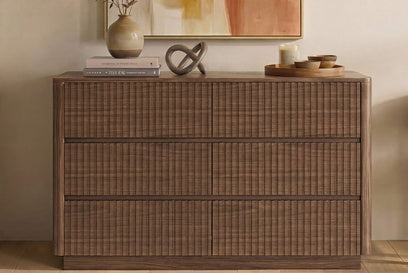
A transparent listing makes this easier. Our Blake dresser specifications name the oak veneer and MDF body, fully assembled construction, three-drawer count, and included anti-tip accessory. Those facts are useful for logistics and material composition, but they do not state the drawer-joint method or slide type, so we would still expect a shopper to ask about those separately if that detail matters to them.

Know When to Ask Questions or Walk Away
Treat a red flag as useful only when it changes your next move: ask a question, inspect another unit, compare another model, or pass entirely.
Drawer-Quality Red Flags
- A drawer binds, scrapes, drops, or shifts side to side when opened. Ask to inspect another unit or pass.
- Gaps change noticeably between drawers, a corner is visibly out of square, or you see separation at a joint. Compare a different model.
- The drawer front is loose, the bottom rattles, or the drawer closes inconsistently. Ask whether the issue can be corrected; compare or pass if it cannot.
- The seller uses a feature label like "premium slides" or gives specifications that conflict with the product details. Ask for the specific slide type, joint method, and feature scope before buying. If the answer remains unclear, compare another model.
Keep Safety as a Separate Stop
Drawer smoothness and construction are one decision. Tip-over safety is a separate one, and a good result in one does not answer the other. For a qualifying free-standing clothing-storage unit, meaning one that is at least 27 inches tall, weighs at least 30 pounds, and has at least 3.2 cubic feet of enclosed storage, the CPSC guidance on clothing storage units calls for verifying the anti-tip device and required warnings for a qualifying dresser. Confirm that separately, even if the drawers move perfectly.
Use these five checks to judge dresser drawer quality: confirm the joinery, materials, slides, movement, and alignment, then resolve any missing detail with a direct question. Keep considering when the drawer system checks out, ask when a key fact is unlisted, compare when problems repeat, and pass when a material issue remains unresolved.
If you want to browse options while you weigh these checks, our Bedroom furniture collection is a reasonable place to compare dressers side by side.
FAQs
What Is the Best Type of Drawer Joint?
There is no single best joint. Dovetails are a recognizable, credible construction signal, but well-made box joints and lock-rabbet joints are legitimate alternatives too. Judge the joint alongside the fit, squareness, drawer bottom, and how the drawer actually moves before deciding.
Are Soft-Close Drawers Worth the Extra Cost?
Soft close is worth paying for when quiet, controlled closing matters to you, such as in a bedroom or nursery, and the feature is confirmed on the drawers you care about. It does not prove stronger joinery or better overall construction, so verify it as one feature among several rather than the whole decision.
How Can I Tell If a Dresser Is Made of Solid Wood?
Check the material list for where solid wood, veneer, MDF, particleboard, or plywood is used, and look at unfinished edges or cross-section photos if they are available. Ask directly whether the body and drawer box use solid wood or an engineered core under a veneer surface. Confirming solid wood on its own does not guarantee superior overall quality; it only answers the material question.
Does Smooth Drawer Movement Mean a Dresser Is Safe?
No. Smooth movement tells you about drawer construction and hardware, not tip-over safety. For a qualifying clothing-storage unit, check the anti-tip device and required warnings separately, regardless of how well the drawers glide.
Recommended Products




More to Read
 7 Sofa Trends That Actually Improve Comfort in 2026
Upgrade your living room with furniture that supports your body. Here are 7 modern sofa features designed to maximize your daily comfort...
7 Sofa Trends That Actually Improve Comfort in 2026
Upgrade your living room with furniture that supports your body. Here are 7 modern sofa features designed to maximize your daily comfort...
 Mother's Day Gift Guide: Cozy and Stylish Furniture Picks for Modern Moms
Make Mother's Day more meaningful with furniture gifts that bring comfort, smart features, storage, and quiet luxury into her everyday routine.
Mother's Day Gift Guide: Cozy and Stylish Furniture Picks for Modern Moms
Make Mother's Day more meaningful with furniture gifts that bring comfort, smart features, storage, and quiet luxury into her everyday routine.
 Performance Fabric Reality Check: Does It Really Repel Pet Hair and Stains?
Performance fabric is often marketed as a miracle solution for homes with pets and kids, but the reality is more nuanced. It...
Performance Fabric Reality Check: Does It Really Repel Pet Hair and Stains?
Performance fabric is often marketed as a miracle solution for homes with pets and kids, but the reality is more nuanced. It...