
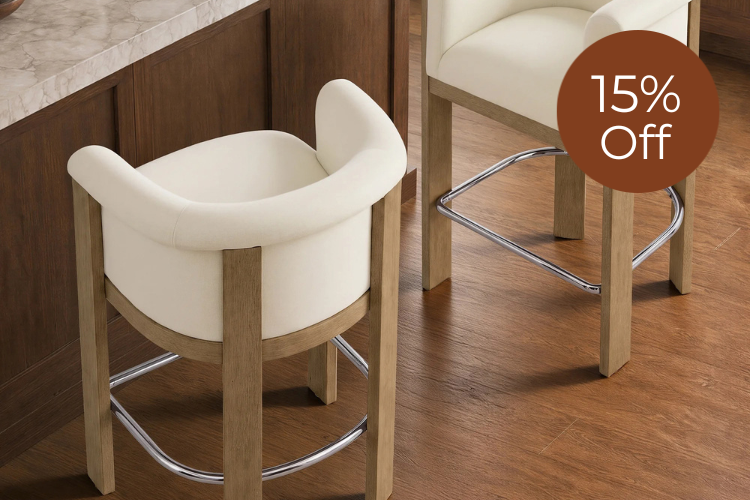











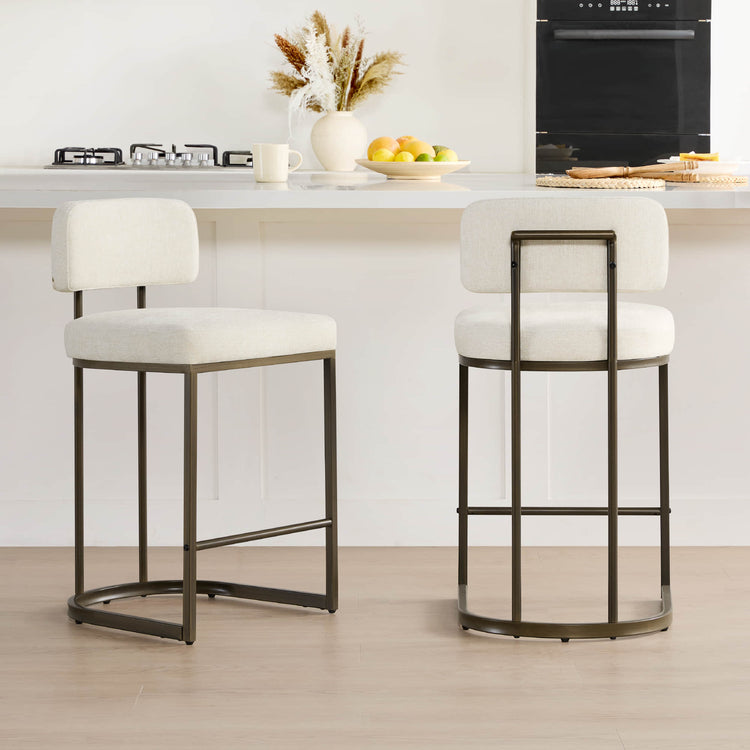













Choose swivel counter stools when turning, entering, and exiting the seat is the daily friction point at your island. Choose stationary counter stools when a fixed, predictable orientation and a tidy visual line matter more than rotating toward people or activity. Either choice depends on your island's actual measurements and the exact product's documented dimensions and instructions, not on the stool category alone.
That measurement step matters because a swivel base changes how much room a stool needs beyond its resting footprint, while a stationary base keeps the same footprint whether or not anyone is seated. Both can end up touching an island edge if the fit is wrong, so the category label by itself never settles the safety or damage question.
Which counter stool fits your island?
Swivel stools solve turning and entry friction; stationary stools solve consistent orientation. The table below breaks that trade-off into the five factors that actually change a buying decision.
| Decision driver | Swivel tendency | Stationary tendency |
|---|---|---|
| Entry and exit | Easier turning in place before sitting or standing | Requires stepping straight in and out |
| Island-edge interaction | Adds a moving contact path beyond the resting footprint | Contact risk limited to the fixed footprint and overhang |
| Visual alignment | Final resting angle can vary after use | Faces one direction consistently |
| Movement and spacing | May need extra room between neighboring seats | Simpler, more predictable spacing |
| Exact-product checks | Confirm swivel range, smoothness, and locking behavior | Confirm the base is genuinely fixed, not just unlabeled |
Wirecutter's testing team recommends leaving more room between swivel stools than stationary ones so knees don't knock during a spin, based on a tested swivel spacing observation from its reviewed models. Treat that as a reason to check spacing on your own island, not as a fixed number every swivel stool will need. Nothing here ranks one mechanism as safer; it only shows where each design tends to create friction.
When swivel seats improve entry and exit
A swivel seat helps most in a narrow or busy island run where people turn before standing, but the benefit only holds once you have checked the actual clearances around the seat. Confirm these in order before deciding a swivel solves your entry problem.

- Measure your island's finished counter height. Caesarstone notes that standard US counter height is typically 36 inches, though custom islands can run higher or lower, so measure yours directly.
- Measure underside clearance and knee room at that height with someone seated.
- Compare the stool's seat height and overall depth against that clearance and against how far the seat sits from the counter edge.
- Watch how a household member actually turns and exits the seat during a normal meal, especially if neighboring stools sit close together.
If the turning path clears the island and any neighboring seat, a swivel likely removes real friction. If space is tight, a stationary stool may avoid a new movement problem. Our guide on bar stool buying tips walks through the same height and depth checks in more detail if you are starting from scratch.
How to judge island-edge contact without overclaiming
Any stool can contact an island edge if its footprint or movement path does not match the available space; the mechanism only changes which path to check. Stationary stools risk contact through a fixed footprint and overhang, while swivel stools add a rotating sweep on top of that footprint.
Start by measuring the stool's assembled depth and how far it overhangs the counter edge when pushed in. Caesarstone advises that standard island depth guidance recommends at least 30 inches for seating knee room, which serves as a design starting point rather than a guarantee that any specific stool will clear your layout. Next, trace the swivel's rotation range if the stool has one, and check the gap to neighboring stools using the spacing habit Wirecutter's tested reviews support. If the measured resting or moving path reaches the island edge or another seat during normal use, change the layout or the product before assuming the stool is unsafe or that a stationary base is automatically safer. Neither claim is supported by these measurements alone.
When stationary stools keep a consistent visual line
Stationary stools are the better fit when you want every seat facing the same direction after use, which matters most in a design-forward kitchen where the seating line is part of the room's look. A fixed base holds that orientation regardless of how it was last used.
A swivel stool trades that consistency for flexibility. It lets someone turn toward conversation or activity around the island, but it can be left at a different angle each time, so a row of swivel stools rarely lines up as neatly as a row of fixed ones. Neither behavior says anything about comfort, durability, or stability; it is strictly a question of whether your household values a uniform look or easier turning more. Check the exact product's base design before assuming it behaves like every other stool in its category, since some bases described as fixed still allow slight rotation.
Run the exact-product check before adding stools to your cart
Before you check out, match the exact stool's documented dimensions and movement behavior to your island's real measurements, not to its category label. Work through this order for either swivel or stationary stools.
- Confirm your island's finished counter height and underside clearance again at the exact spot the stool will sit.
- Compare that clearance with the exact product's seat height. Our Aislinn Swivel Bar & Counter Stools, for example, list a 27.2-inch seat height and a 21.3-inch overall depth, which shows why the exact listing matters more than a general swivel-versus-stationary label.
- Check overall depth, width, and base footprint against your measured knee room and aisle space.
- Confirm whether the seat swivels, how far it rotates, and whether it locks in place; do not assume this from the product name alone. Two listings can share a nearly identical seat height while one adds a full swivel base and the other does not mention one.
- Read the manufacturer's assembly, use, and care instructions before purchase. The CPSC's Anchor It campaign advises following sturdy furniture guidelines and manufacturer instructions as a general furniture-safety baseline, not a comparison between stool categories.
If the exact product clears every measurement above, it passes. If any step fails, look at a different model in our Counter Stools collection rather than forcing an ill-fitting stool into the space.

FAQs
What does a 360-degree swivel tell me about a counter stool?
A listed 360-degree swivel confirms the seat can rotate fully, but it does not tell you the exact clearance it needs, how smoothly it moves, or how stable it feels under regular use. Check the product's own dimensions and instructions to judge fit for your island.
Does a 36-inch island automatically fit counter stools?
No. Thirty-six inches is a common US reference height, not a guarantee that any given stool will fit your island. Compare your island's actual finished height and underside clearance with the stool's specific seat-height listing before buying.
Can stationary counter stools still hit the island edge?
Yes. A stationary stool's fixed footprint and overhang can still reach the island edge if it is too deep or positioned too close. Measure the assembled depth and the resting distance from the edge rather than assuming a fixed base removes contact risk entirely.
Sources
- Caesarstone. Standard Counter Height Guide.
- Caesarstone. Standard Kitchen Counter Depth Guide.
- The New York Times Wirecutter. Favorite Barstools and Counter Stools.
- U.S. Consumer Product Safety Commission. AnchorIt.gov Safety Center.
Recommended Products

More to Read
 7 Sofa Trends That Actually Improve Comfort in 2026
Upgrade your living room with furniture that supports your body. Here are 7 modern sofa features designed to maximize your daily comfort...
7 Sofa Trends That Actually Improve Comfort in 2026
Upgrade your living room with furniture that supports your body. Here are 7 modern sofa features designed to maximize your daily comfort...
 Mother's Day Gift Guide: Cozy and Stylish Furniture Picks for Modern Moms
Make Mother's Day more meaningful with furniture gifts that bring comfort, smart features, storage, and quiet luxury into her everyday routine.
Mother's Day Gift Guide: Cozy and Stylish Furniture Picks for Modern Moms
Make Mother's Day more meaningful with furniture gifts that bring comfort, smart features, storage, and quiet luxury into her everyday routine.
 Performance Fabric Reality Check: Does It Really Repel Pet Hair and Stains?
Performance fabric is often marketed as a miracle solution for homes with pets and kids, but the reality is more nuanced. It...
Performance Fabric Reality Check: Does It Really Repel Pet Hair and Stains?
Performance fabric is often marketed as a miracle solution for homes with pets and kids, but the reality is more nuanced. It...