











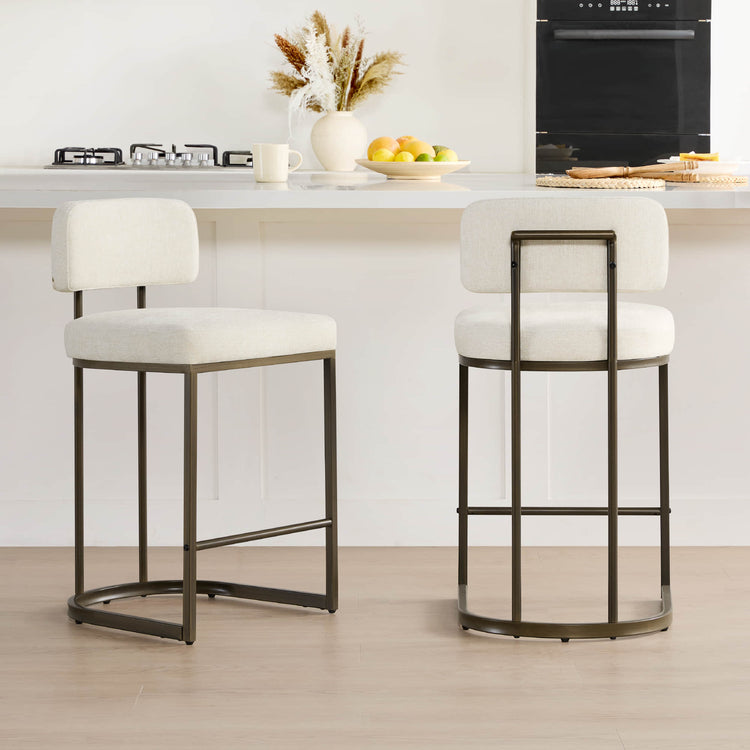















Bar stools for kitchen counters only work when the space under your overhang is deeper than the stool's usable seat depth. If your cabinet face sits closer than the stool's seat front, knees will hit the cabinet before anyone gets comfortable. The fix starts with two measurements: the clear knee depth under your counter, and the stool's actual seat depth and seating position, not its overall footprint.
Once those numbers line up, check the footrest. A stool's footrest should sit roughly 12 to 14 inches below the seat so your feet get real support instead of dangling or crowding underneath.
Measure and calculate knee clearance before shopping
Knee clearance depends on the smallest gap between your counter's overhang and the stool you're considering, not the overhang measurement by itself. Take these steps before you shop.
- Measure your finished counter height and the underside depth at the actual seating spot, from the floor to the countertop edge.
- Measure the minimum unobstructed depth from the cabinet face or apron to the counter's front edge. That number is your usable knee depth, not the total overhang.
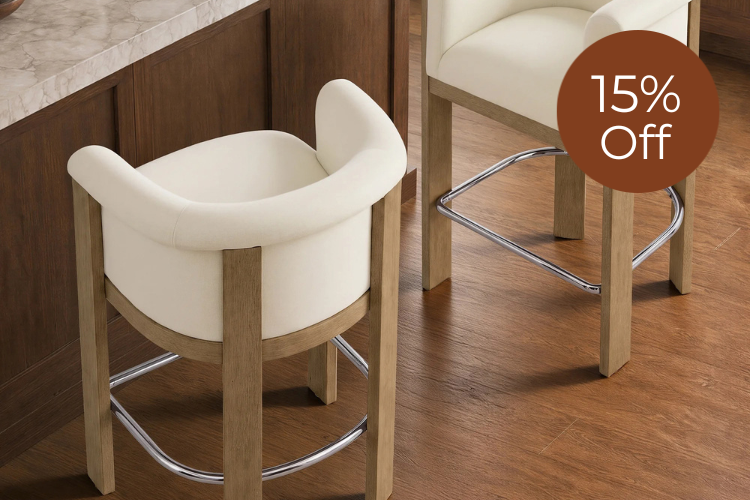
- Pull each stool's seat depth, seat height, and overall depth from its listing instead of assuming overall depth doubles as seat depth. Our Alina counter-height stool, for example, lists a 16.1-inch seat depth against a wider 22.5-inch overall depth, so the actual seat sits well forward of the stool's outer edge.
- Compare your usable knee depth with the stool's seat depth. When usable knee depth is smaller than the seat depth, the seat front will push toward the cabinet and knees will make contact. When it's equal or larger, move on to a physical test fit before you buy.
General seating guidance from OSHA notes that a properly sized seat allows adequate space behind the knees, which is the same principle that keeps knees off a cabinet face at a counter. Building codes set their own numbers for accessible fixtures; the U.S. Access Board's clear floor space guidance requires a fixed minimum knee depth for adaptive elements, but that figure covers accessibility compliance, not everyday kitchen-stool comfort, so use your own measurement instead of borrowing it.
Match counter height to the right stool seat height
Match your stool's seat height to your counter's finished height, measured from floor to countertop, not the height printed on the box. Most standard kitchen counters run about 34 to 36 inches, which is why counter stools in that category are built with seat heights between 24 and 27 inches.

| Measured counter height | Compatible stool seat height | Decision note |
|---|---|---|
| 34-36 in (standard kitchen counter) | 24-27 in (counter-height stool) | Confirm with a level test sit; fits most islands and peninsulas. |
| 35-37 in (Nova's listed range) | 27.1 in (Nova counter-height stool) | Manufacturer-specific pairing, not a universal rule. |
| Between bands or unlabeled | Use the nearest lower seat height | Test sit before buying; don't round up. |
If your counter falls between these bands, pick the nearest lower seat height and confirm it with a test sit rather than rounding up. A seat that's slightly low is easier to live with than one that crowds the underside of the counter.
Set the footrest 12–14 inches below the seat
When arranging bar stools for kitchen counters, the footrest should sit about 12 to 14 inches below the seat surface, measured straight down, so your feet land on real support instead of hanging or crowding underneath. Measure this drop from the top of the seat cushion to the top of the footrest, not to the floor.
Beyond the number, check that the support is stable and easy to reach without stretching or tucking your feet awkwardly. OSHA's seating guidance points out that feet resting on a stable footrest relieve pressure on the back of the leg, which is the same comfort goal at a kitchen counter. Fixed island footrests and stool-integrated footrests can sit at different heights, so measure each separately rather than assuming a rail automatically lands in the right spot. If a listing doesn't state the footrest height, treat that detail as unresolved until you confirm it in person or through customer support.
Prevent knee bumping with a full-size test fit
The only conclusive test is sitting in the actual stool at the actual counter, because no single overhang or seat-depth number applies to every kitchen. Run through this sequence before you finalize a purchase or installation.
- Bring the stool to the counter, or build a full-size mock-up if you're still remodeling.
- Sit at your normal posture and check whether your knees touch the cabinet face or apron.
- Check whether the seat front presses against the back of your knee.
- Rest your feet on the footrest and confirm it feels stable and reachable.
- If the stool swivels or has a tall back, rotate and lean back to check for new contact points.
- Decide: keep the setup only if every check passes. If knees still make contact or feet lack support, change the stool's depth or height, or adjust the layout before moving forward.
Choose for the shortest and tallest regular users
Keep one stool setup only if both your shortest and tallest regular users pass the knee-clearance and footrest checks; otherwise switch the model or height for at least one seat. A single fixed seat height and depth rarely suits every body in a household the same way, since taller users need more leg room while shorter users need their feet to actually reach the floor or footrest.
Research on seating fit notes that seating dimensions vary between users, a principle drawn from aged-care seating studies but relevant to any shared kitchen counter. If one person's knees clear the counter while another's don't, or if one person's feet reach the footrest while another's dangle, treat that as a failed fit for the household, not a minor inconvenience. The practical fix is usually a stool with adjustable height, a stable step or footrest addition, or a different seat depth for the seat that fails, rather than forcing everyone into one compromise size.
FAQs
Is a 12-inch overhang automatically enough for kitchen counter stools?
Not automatically. A 12-inch overhang can work or fail depending on the cabinet face position and the stool's usable seat depth. Measure your actual clear knee depth and compare it with the stool's listed seat depth, then confirm with a test sit before you buy.
What should I do if the stool is deeper than my available knee space?
Reject that stool or change the layout rather than forcing the fit. If the seat depth or rear position of the stool exceeds your measured clear zone, the knees will end up pressed against the cabinet no matter how the stool looks online. Choose a shallower seat depth or a stool positioned farther from the cabinet face instead.
What if my counter falls between standard stool-height ranges?
Use the nearest lower seat-height pairing and confirm it with a test sit for your regular users. Don't assume an in-between counter height creates its own matching stool range; if the nearest option still feels wrong after sitting in it, consider a layout adjustment instead of guessing at a custom height.
Can a stool footrest replace a built-in island footrest?
Yes, but only if it's stable, easy to reach, and lands close to the 12 to 14 inch drop below the seat without creating a new obstruction. Check the stool's actual footrest height in the listing or with customer support rather than assuming any footrest bar automatically provides adequate support.
Sources
- Occupational Safety and Health Administration. Workstation Computer Chairs.
- U.S. Access Board. Clear Floor and Ground Space.
- PMC. Aged Care Seating Fit Study.
Recommended Products


More to Read
 7 Sofa Trends That Actually Improve Comfort in 2026
Upgrade your living room with furniture that supports your body. Here are 7 modern sofa features designed to maximize your daily comfort...
7 Sofa Trends That Actually Improve Comfort in 2026
Upgrade your living room with furniture that supports your body. Here are 7 modern sofa features designed to maximize your daily comfort...
 Mother's Day Gift Guide: Cozy and Stylish Furniture Picks for Modern Moms
Make Mother's Day more meaningful with furniture gifts that bring comfort, smart features, storage, and quiet luxury into her everyday routine.
Mother's Day Gift Guide: Cozy and Stylish Furniture Picks for Modern Moms
Make Mother's Day more meaningful with furniture gifts that bring comfort, smart features, storage, and quiet luxury into her everyday routine.
 Performance Fabric Reality Check: Does It Really Repel Pet Hair and Stains?
Performance fabric is often marketed as a miracle solution for homes with pets and kids, but the reality is more nuanced. It...
Performance Fabric Reality Check: Does It Really Repel Pet Hair and Stains?
Performance fabric is often marketed as a miracle solution for homes with pets and kids, but the reality is more nuanced. It...