















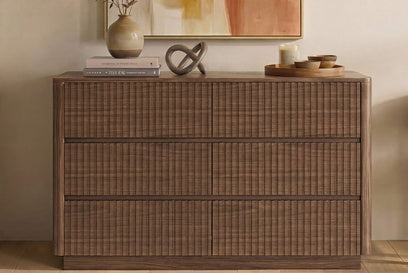
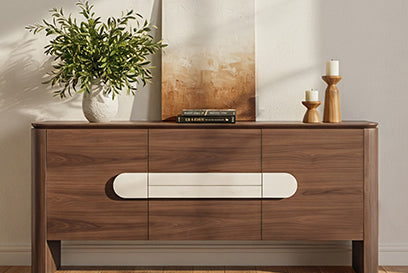







Coffee tables and end tables don't need to match exactly. They need to coordinate: a similar height range, a related scale, and at least one shared visual cue such as undertone, shape, or a repeated detail. From there the decision splits two ways: a matching set for deliberate symmetry and low-guesswork coordination, or a curated mix of complementary materials when your room already has texture or you're swapping in just one new piece.
Either path only works once you've checked height, scale, and reach against your actual seating, which is the step most rooms skip.
Do Coffee Tables and End Tables Need to Match Exactly?
No. The tables need a visible relationship, not identical finishes or silhouettes. That relationship can come from a shared color or wood tone, a repeated curve or leg shape, a matching era or design language, or one structural detail that shows up on every piece.
A matching set gives you that relationship automatically, which is why it's the lower-guesswork route when symmetry is the goal. A mixed grouping can look just as intentional, but only if you deliberately repeat one or two cues instead of contrasting every finish at once. Design guidance on coordinating occasional tables backs this up directly: keeping a deliberate visual relationship between pieces matters more than making them identical, and shapes should stay different enough that the grouping doesn't read as one oversized set. Height and scale still have to work for either choice, which the later sections cover.
Choose a Matching Set When Symmetry and Simplicity Matter
A matching set is the easier choice when your room's layout depends on balanced sightlines, such as a sofa flanked by two identical seating areas, or when you want a streamlined look without hunting for finish combinations. It also helps on a first furnishing project, since one purchase decision replaces several.

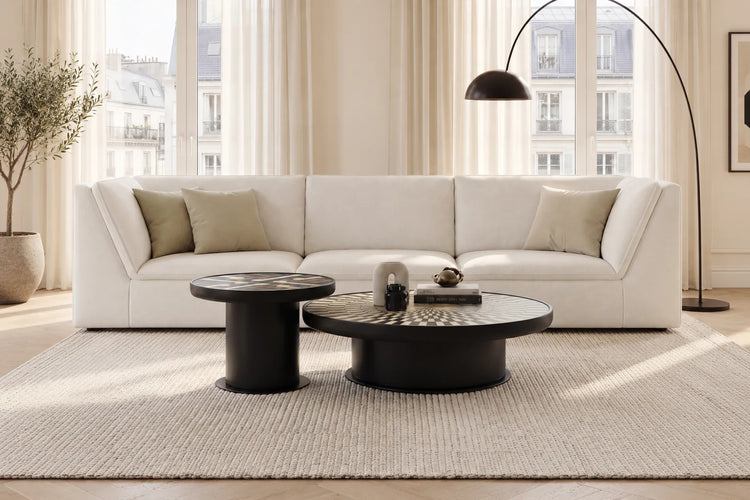
Matching design language doesn't always mean matching functional dimensions. For example, our Chess nesting set pairs a 35.4" W x 35.4" D x 12.2" H coffee table with a 23.6" W x 23.6" D x 16.9" H side table, both sharing the same chessboard-inspired veneer pattern and rounded, family-friendly edges. This configuration shows how a set can look cohesive while the two pieces still serve different seat heights. Before buying any matching set, confirm its footprint and height suit your actual sofa and chairs; shared styling doesn't fix a table that's too tall for your seat or too deep for your walkway.
Choose Curated Mixed Materials When You Want Layered Texture
Curated mixing works best when your room already contains related materials, or when you're replacing a single table and need it to join an existing grouping rather than duplicate it exactly. It also suits anyone who wants texture instead of a uniform, catalog-matched look.
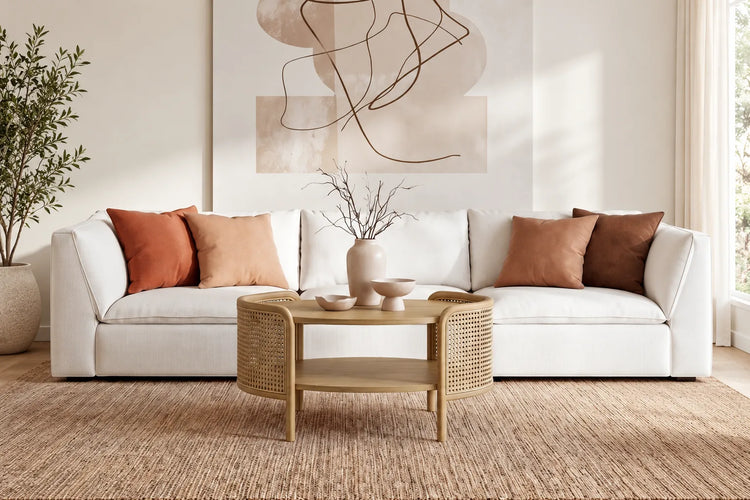
The trick is restraint. Contrast one or two attributes, such as swapping a solid wood coffee table for a woven cane one, then repeat one or two cues elsewhere, like a shared warm undertone, a rounded silhouette, or matching metal hardware. Skip more than two contrasting materials in one grouping, since that's usually where a room starts to feel disconnected rather than layered. These pairing ideas describe appearance only; they aren't claims about durability, cleanability, or how a material will perform over time.
Select Complementary Material Pairings Without Losing Cohesion
Each pairing below names the materials, the cue that ties them together, and stays limited to how the grouping looks rather than how it performs.
- Cane with fluted wood: repeat a warm wood undertone or a vertical ribbed rhythm so the two textures read as related, not competing.
- Cane with a stone accent: carry the stone's undertone into a nearby lamp base, tray, or hardware finish to link the pieces.
- Wood with metal: repeat the same metal finish in table legs, a lighting fixture, or small accessories so the contrast feels planned.
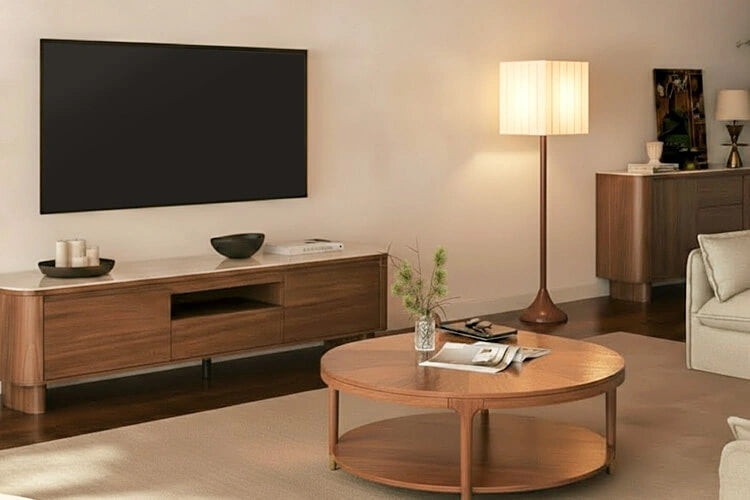
- Wood with woven texture: connect the pieces through a shared natural tone or a rounded silhouette rather than matching wood species.
Our cane living room pieces offer a clear example of this approach: both the coffee table and side table use oak veneer tops, solid ash legs, and woven cane panels, but the coffee table stands 15.75" H while the side table stands 21.65" H. Pairing the Renee coffee table with the Renee side table keeps the cane-and-ash cue consistent even though the two pieces sit at different heights for different seats.
Use the Room Scenario to Break the Tie
Your room layout, not a general rule, usually decides between matching and mixing. Match the scenario below to your space, then confirm it still fits once you measure.
Symmetrical seating, such as a sofa balanced by two identical chairs, favors a matching route because balanced sightlines are the whole point of the layout. A compact room should prioritize footprint, walkway width, and table depth over exact matching, since a tight room fails on circulation long before it fails on finish coordination. A layered-texture room, where cane, wood, metal, or stone already show up elsewhere, favors a controlled mix as long as one undertone or structural detail already repeats. If you're replacing a single table, repeat one existing cue and recheck that piece against the seat next to it, rather than assuming you need an exact duplicate that may not even be available anymore.
Coordinate Height, Scale, and Reach Before You Buy
Check height and proportion against your actual furniture, not a standard size chart, before you finalize any grouping. This four-step method applies whether you're matching or mixing.
- Measure your seating first. Note the height of your sofa cushion and any chair arms next to where the tables will sit.
- Compare the coffee table to the sofa. A 16 to 18 inch coffee table height is a common starting point, but you may want to adjust it up or down depending on your sofa's actual height so it stays a comfortable footrest and arm-reach distance. Buying guidance also recommends keeping the coffee table no longer than about two-thirds your sofa's length and leaving roughly a foot of walking room around it, a useful way to match coffee-table height to your sofa rather than guessing.
- Compare each end table to its seat. The tabletop should sit close to the height of the adjacent armrest, and the table shouldn't be deeper than the chair or sofa arm it sits beside.
- Tape-test the footprint. Mark the outlines on your floor, or set boxes in place, and walk the room to check reach and circulation before you order anything.
The grouping is ready to buy only when every table comfortably serves the seat next to it, the room stays easy to walk through, and the pieces share at least one deliberate cue. If any of those three fail, adjust the size or swap the piece before moving forward.

FAQs
Can the end tables be different heights?
Yes, as long as each one relates well to the seat beside it. A table that's noticeably too tall or short for its adjacent armrest will feel off no matter how well the finishes match. Equal heights remain the simpler choice when you specifically want a symmetrical look, but varied heights can stay coordinated if the grouping still shares one visual cue and each table works from the seat it serves.
Should end tables be taller than the coffee table?
Usually yes. Coffee tables typically sit around sofa cushion height, often between 16 and 18 inches, while end tables need to align with sofa or chair armrests, which are often taller. What matters most is that each surface is easy to reach from its adjacent seat.
What is the simplest way to tie mismatched tables together?
Repeat one specific design element across the room. A shared wood undertone, matching metal accents on table feet or lamps, or similar curved profiles will make mixed tables look intentional rather than mismatched.
Recommended Products

More to Read
 7 Sofa Trends That Actually Improve Comfort in 2026
Upgrade your living room with furniture that supports your body. Here are 7 modern sofa features designed to maximize your daily comfort...
7 Sofa Trends That Actually Improve Comfort in 2026
Upgrade your living room with furniture that supports your body. Here are 7 modern sofa features designed to maximize your daily comfort...
 Mother's Day Gift Guide: Cozy and Stylish Furniture Picks for Modern Moms
Make Mother's Day more meaningful with furniture gifts that bring comfort, smart features, storage, and quiet luxury into her everyday routine.
Mother's Day Gift Guide: Cozy and Stylish Furniture Picks for Modern Moms
Make Mother's Day more meaningful with furniture gifts that bring comfort, smart features, storage, and quiet luxury into her everyday routine.
 Performance Fabric Reality Check: Does It Really Repel Pet Hair and Stains?
Performance fabric is often marketed as a miracle solution for homes with pets and kids, but the reality is more nuanced. It...
Performance Fabric Reality Check: Does It Really Repel Pet Hair and Stains?
Performance fabric is often marketed as a miracle solution for homes with pets and kids, but the reality is more nuanced. It...