
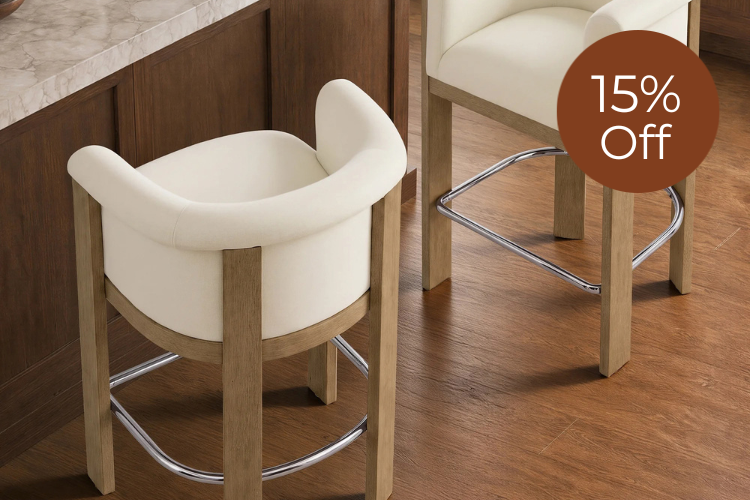











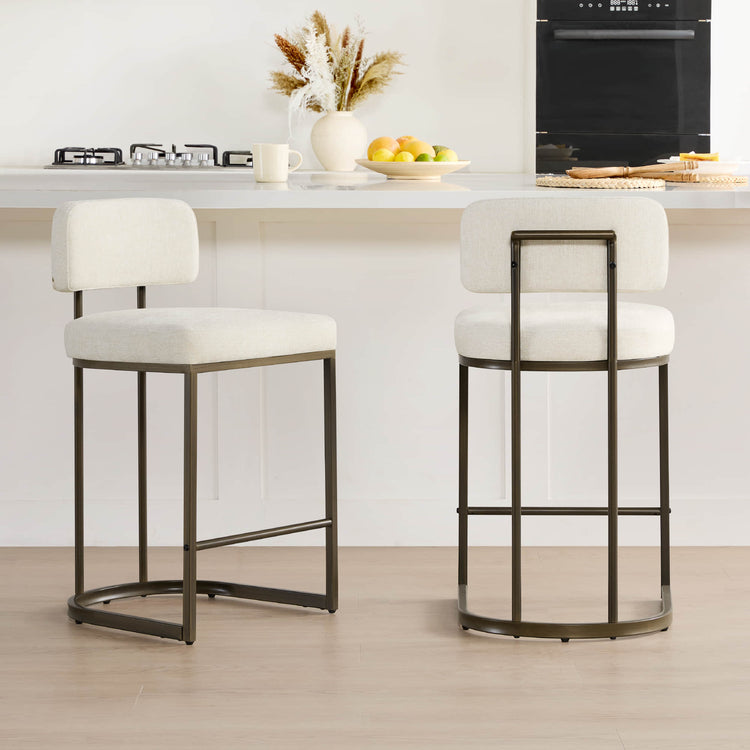











Choose bar stools with backs when island seating lasts through meals, homework, or long conversations and back support matters most. Choose backless stools when you want the island to stay visually open and need stools that can disappear fully underneath it. Real comfort and true clearance depend on the exact product and your island's own measurements, not on the style label alone.
The short answer: choose backs for longer seating, backless stools for openness and tuck-in potential
Use this table to see which trade-off each style favors first, then check the matching section for the specific verification each row depends on. No option wins every category outright; the right pick depends on your routine and your island's real dimensions.
| Factor | Favors | What still needs verification |
|---|---|---|
| Comfort/support | Backed stools, for longer sitting | Seat depth, padding, and footrest fit |
| Visual sightlines | Backless or low-back stools | Back height and island placement |
| Under-counter tucking | Backless stools, as a starting point | Overall depth, legs, and island apron/lip |
| Space efficiency | Backless stools | Actual clearance once tucked |
| Cleaning/daily use | Backless stools, fewer surfaces | Upholstery and frame material on either style |
A back adds a support surface and visual height. A backless design trims both, but only a measured fit confirms whether it actually slides out of the way.
How backs change comfort and postural support
Choosing stools with backs can give you something to lean on during longer sitting, but a backrest does not by itself guarantee comfort or good posture. Authoritative guidance on backrests and footrests comes mostly from office-chair ergonomics, so treat it as supportive context for a kitchen stool rather than a stool-specific standard.
Screen for longer use. If the island hosts breakfast, homework, or work calls for 20 minutes or more, start with a backed option and check seat depth, seat width, padding, and whether your feet rest flat or on a footrail.
Screen for brief use. If the stool is mainly for quick coffee or a fast lunch, a backless seat can work fine as long as the seat pan itself feels stable and comfortable, since you will not be leaning back anyway.

Either way, the back is only one part of the comfort equation. A padded, well-sized seat on a backless stool can outperform a poorly fitted backed one.
How backs change kitchen-island sightlines
Adding bar stools with backs introduces a vertical element above the counter that a backless seat does not have, so the sightline choice comes down to how much of that added presence your room can absorb. Back height, where the island sits in the room, and whether it is visible from an adjoining living or dining space all affect how noticeable that presence feels.
- Backless stools keep the profile at counter height or just above it, which reads as the most open option in a room where the island is a focal sightline.
- Low- or mid-back stools add some vertical mass but can work as a compromise, provided the actual back height and depth still meet your support needs.
- Taller-backed stools add the most visual weight and suit kitchens where the island is not a primary sightline from other rooms.
Stand in the adjoining room and look at the island straight on before deciding. What reads as open on a showroom floor can look different against your own cabinetry and lighting.
When does a stool truly tuck under the island?
A stool only truly tucks under an island when every part that enters the opening, not just the seat, clears the counter's underside, apron, lip, and support legs. A backless label or a low profile in a photo does not prove that on its own.
- Measure the island's usable opening: width, depth, and height from the floor to the underside of the overhang.
- Identify obstructions inside that opening, including the apron, any lip, support legs, and outlets.
- Compare those numbers with the stool's overall width, depth, height, and back depth (if any).
- Classify the result as full tuck-in, partial clearance, or no practical tuck-in based on whether the stool's widest and deepest points clear the opening.
A backless saddle-style stool tested for this kind of fit slid neatly under a narrow island lip, but some testers found its narrow, unpadded edge uncomfortable after a short sit. That is the trade-off in one example: good tuck-in and lighter comfort can arrive in the same stool, so check both independently instead of assuming one predicts the other.
Choose by routine, room, and circulation
Match the stool direction to how you actually use the island, then let the room and the tuck-in test override that starting point when they conflict.
- Daily meals, homework, or work sessions: start with backed bar stools if seated support is the leading concern.
- Coffee, quick meals, or occasional perching: start with backless candidates when a minimal profile benefits the room.
- Open-plan kitchens: compare the stool's silhouette from the adjoining room, not just at the island itself.
- Tight underside clearance: let the measured full-tuck result decide, since a backless label does not guarantee it fits your specific apron or lip.
If two scenarios overlap, for example daily use in an open-plan kitchen, a low- or mid-back stool is often the practical middle ground once you confirm it still clears the counter.
Measure the island before you shop
Buy only after the stool's seat height and full or partial tuck-in result both work for your island, not because a product is labeled "counter" or "bar" height. Those words describe a general category, not your specific counter.
- Measure from the floor to the finished countertop to confirm whether your island is counter-height or bar-height.
- Measure the usable space under the counter after accounting for the apron, lip, legs, and any other obstruction.
- Compare that space with the stool's seat height, overall width, overall depth, overall height, and back height or depth.
- Proceed only if the seat height suits your counter and the stool clears the opening to the degree you need; otherwise keep looking.
Seat heights for counter-style stools commonly run in the mid-20-inch range, while bar-height seats run several inches taller, though there is no single fixed industry rule, according to a buying guide from a major review outlet. That same guide notes shoppers often leave roughly 10 to 12 inches between the seat and the counter's underside for comfortable knee room, which is a useful starting check rather than a guarantee for your exact island. If you are still unsure which height category your island calls for, our bar vs. counter stools comparison walks through that distinction in more detail.
FAQs
Can a bar stool with a low back still tuck fully under a kitchen island?
A lower back reduces visual height, but it does not guarantee full tuck-in on its own. Compare the stool's total depth, height, and back angle against your island's usable opening, apron, and overhang support to verify clearance before buying.
Which stool style is easier to maintain in a busy kitchen?
Backless stools generally have fewer crevices and less surface area to wipe down after daily meals. However, overall maintenance also depends on the upholstery; smooth faux leather or performance fabrics on backed stools can clean up just as quickly as bare wood or molded seats.
Can foot support make a backless stool more comfortable?
Proper foot support on a built-in footrail helps distribute seated weight and stabilize posture. While a footrest will not replace a backrest for leaning back during long sessions, it makes brief sitting at the counter significantly more stable and comfortable.
Recommended Products

More to Read
 7 Sofa Trends That Actually Improve Comfort in 2026
Upgrade your living room with furniture that supports your body. Here are 7 modern sofa features designed to maximize your daily comfort...
7 Sofa Trends That Actually Improve Comfort in 2026
Upgrade your living room with furniture that supports your body. Here are 7 modern sofa features designed to maximize your daily comfort...
 Mother's Day Gift Guide: Cozy and Stylish Furniture Picks for Modern Moms
Make Mother's Day more meaningful with furniture gifts that bring comfort, smart features, storage, and quiet luxury into her everyday routine.
Mother's Day Gift Guide: Cozy and Stylish Furniture Picks for Modern Moms
Make Mother's Day more meaningful with furniture gifts that bring comfort, smart features, storage, and quiet luxury into her everyday routine.
 Performance Fabric Reality Check: Does It Really Repel Pet Hair and Stains?
Performance fabric is often marketed as a miracle solution for homes with pets and kids, but the reality is more nuanced. It...
Performance Fabric Reality Check: Does It Really Repel Pet Hair and Stains?
Performance fabric is often marketed as a miracle solution for homes with pets and kids, but the reality is more nuanced. It...