
























Pedestal vs. Four-Leg Dining Tables: Check the Space Underneath

The space under a dining table affects where you can put your feet, how far a chair slides in, and whether an extra seat fits comfortably. Compare pedestal and four-leg tables by those measurements as well as the tabletop shape. A central base and four slim legs can occupy very different parts of the same floor area.
Look at where the supports meet the floor
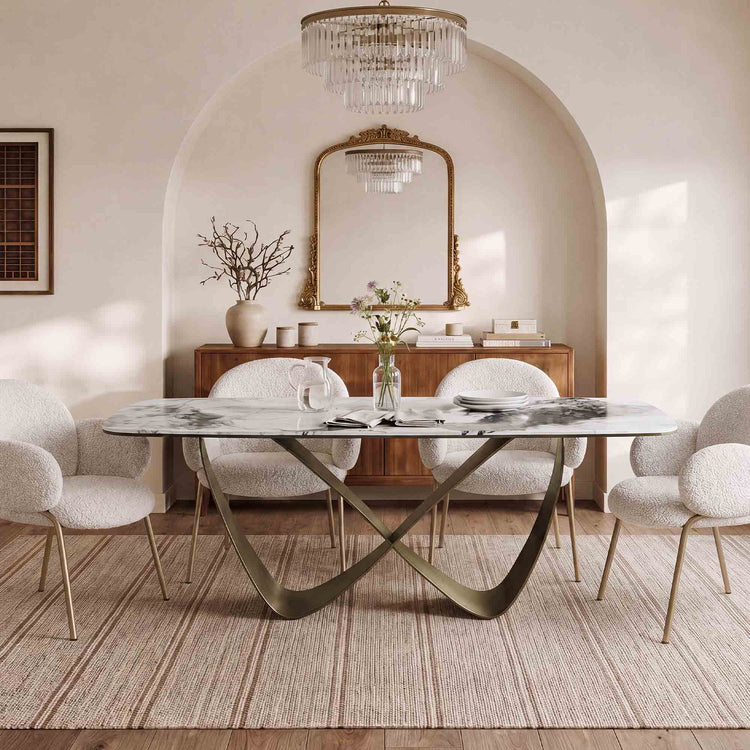
A pedestal table uses a central support or a central base assembly. Some larger tables use two supports, a broad plinth, or sculptural panels. A four-leg table places legs nearer the corners or perimeter. The visible category name is a starting point for inspecting the actual support layout.
| Space to inspect | Pedestal or central base | Four-leg base |
|---|---|---|
| Near the table edge | Often clear of corner legs. | Leg positions determine where chairs can sit. |
| Under the middle | A wide base can occupy foot space. | The middle may be open, depending on stretchers or other supports. |
| At the ends | Check the base projection toward end seats. | Check the gap between legs and any apron. |
| On the floor | Check the full base footprint. | Check each leg and any connecting rails. |
Our dining tables include different support shapes. Compare the underside and base views alongside the top view, then picture your own chairs in the gaps.
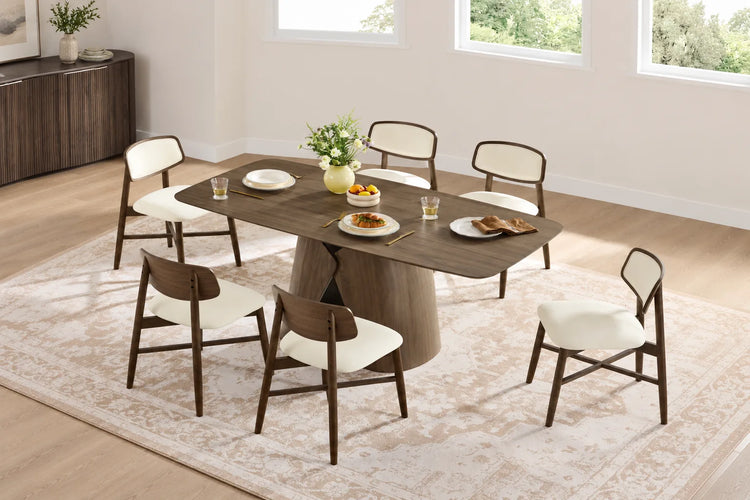
Our Elowen Sculptural Wood Base Dining Table shows how a sculptural central base occupies its own footprint beneath the top. Check the space beside the panels at each intended seat.

Test the space for knees, feet, and chair arms
Measure the height from the floor to the lowest part of the table underside in front of the seat. An apron can hang below the tabletop. Compare that opening with the chair seat and the space your thighs need while seated. Our dining table height and legroom guide separates tabletop height from the usable space beneath the apron.
For an armchair, measure the arm height and check how far the chair can tuck in before the arms meet the table. For a pedestal, look at where your feet would land against the base. For a four-leg table, compare chair width with the gap between neighboring legs. For chairs with arms, our chair arm and table-apron clearance guide checks the lowest obstruction and the chair’s full push-in profile.
Try the end seats as carefully as the side seats. A rectangular table may have enough tabletop length for another place setting while a leg, stretcher, or pedestal leaves little room below it. Our six-chair table-length guide accounts for seat width, end positions, and supports beneath the top. If a diner uses a wheelchair, check the approach and clear space for knees and toes beneath the chosen seat position. The U.S. Access Board illustrates these separate spaces in its knee and toe clearance standards for accessible facilities; fit the home arrangement to the person and chair using it.
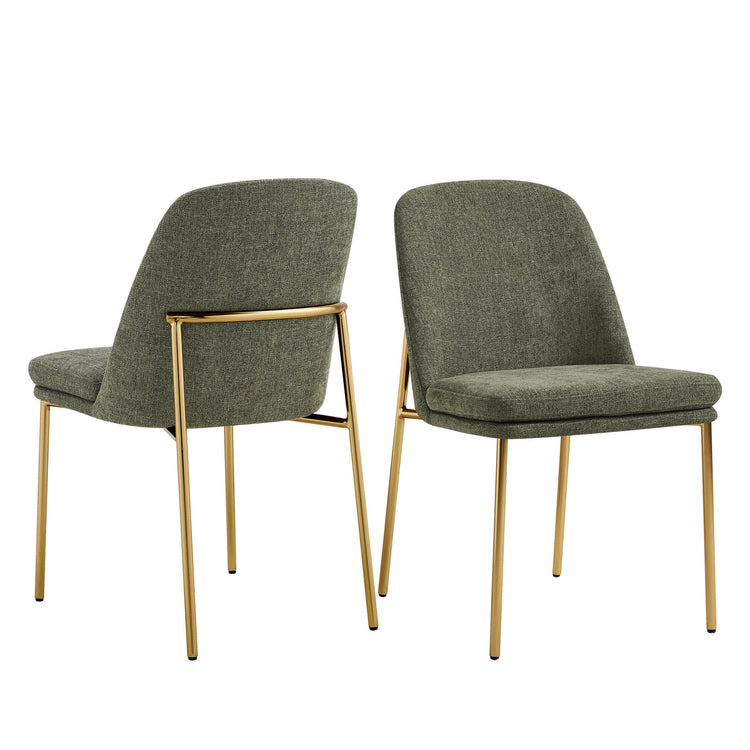
If you are buying the table and chairs together, compare the dimensions of both. Our dining chairs offer different widths, backs, and arm styles, so choose the combination that fits beneath the table you select.
Measure the room with chairs pulled out
- Mark the tabletop outline on the floor at its normal size. If it extends, mark the extended size too.
- Mark the base footprint inside the outline. Include feet, panels, and any wide plinth.
- Place or mark the chairs in their sitting positions, then pull one back as you would to stand.
- Walk behind that chair along the route to the kitchen or door.
- Open nearby cabinets and check the route when every everyday seat is occupied.
A small room benefits from a table-and-chair combination that keeps its main route usable. A central base can free the corners, while slim perimeter legs can leave the middle open. Compare those clear areas with the place your feet and chair legs actually need to go.
For a bench, check its width and height against the table’s supports. A long bench may fit below the top yet stop short against an inset pedestal.
Match the base to the tabletop and seating plan
A round table lets you vary seat positions around the edge, and a central base can leave those positions free of corner legs. Its base diameter still matters for feet and chair legs. The number of comfortable seats depends on the tabletop size and the chairs you use.
A rectangular table can align with a long room or sit near a wall between meals. Check the legs or base at the intended end seats. An oval top softens the corners while still needing the same underside checks.
An extension changes the working footprint. Compare the table’s open dimensions with the room and find out how the supports relate to the extended top. Plan a place to store a removable leaf when the design uses one.
Choose the daily layout first, then check the occasional extra seating. Moving a table for a gathering is easier to plan when you know the routes it will affect.

Check stability and everyday cleaning
Assess stability on the assembled table and the floor where it will stand. Follow the assembly instructions for fasteners and leveling features. If a new table rocks, check floor contact and assembly before using it for a meal, then contact us if the issue remains.
Base style alone leaves out the weight distribution, joints, materials, and floor conditions that affect a particular table. Use the table for its intended loads and keep sitting or climbing off the tabletop.
For cleaning, picture the route of a vacuum or mop around the supports. A pedestal can have fewer separate floor contacts and a broad surface that needs dusting. Four legs create more contact points, with floor access depending on the connecting rails and chair placement. For a wood tabletop, keep coasters at hand to protect against beverage rings, a step included in the American Cleaning Institute’s furniture care checklist. Follow the table finish’s own cleaning instructions. At the floor, check protectors beneath the table and chair feet. The National Wood Flooring Association recommends furniture-leg pads in its wood-floor scratch-prevention guidance.
Finish by checking the table and chair measurements together. The base that suits your room is the one that leaves the space you use every day: at your knees, around your feet, and behind your chair.

Dining table base questions
Is a pedestal dining table better for a small room?
It can be, when the central base leaves the chair positions and walking route clear. Check the base footprint and foot space. A compact four-leg design can also fit well when its legs align with your seating arrangement.
Do pedestal tables give more legroom?
They often remove corner-leg interference, while the central base can occupy foot space. Compare the base width, the distance from the edge, and your actual chair position to judge the available room.
Can a four-leg table seat someone at the end?
Yes, when the gap between the legs, the apron height, and any stretcher leave enough room for that person and chair. Measure the end position instead of judging it from tabletop length alone.
Are pedestal tables less stable than four-leg tables?
Stability depends on the specific table’s construction, assembly, load distribution, and floor contact. Check the assembled table, follow its instructions, and address any rocking before regular use.
What should I measure before buying dining chairs?
Measure the opening below the table, the gaps between supports, and the room around the table. Compare those figures with chair width, seat height, arm height, and the space needed to pull the chair out.
Recommended Products

More to Read
 7 Sofa Trends That Actually Improve Comfort in 2026
Upgrade your living room with furniture that supports your body. Here are 7 modern sofa features designed to maximize your daily comfort...
7 Sofa Trends That Actually Improve Comfort in 2026
Upgrade your living room with furniture that supports your body. Here are 7 modern sofa features designed to maximize your daily comfort...
 Mother's Day Gift Guide: Cozy and Stylish Furniture Picks for Modern Moms
Make Mother's Day more meaningful with furniture gifts that bring comfort, smart features, storage, and quiet luxury into her everyday routine.
Mother's Day Gift Guide: Cozy and Stylish Furniture Picks for Modern Moms
Make Mother's Day more meaningful with furniture gifts that bring comfort, smart features, storage, and quiet luxury into her everyday routine.
 Performance Fabric Reality Check: Does It Really Repel Pet Hair and Stains?
Performance fabric is often marketed as a miracle solution for homes with pets and kids, but the reality is more nuanced. It...
Performance Fabric Reality Check: Does It Really Repel Pet Hair and Stains?
Performance fabric is often marketed as a miracle solution for homes with pets and kids, but the reality is more nuanced. It...