


























The Ultimate 2026 Buyer's Guide to Modern Power Recliners

A modern power recliner earns a spot in your living room only when it clears four checks: it fits through your delivery route and has enough measured room for its upright and fully reclined positions, it matches the way you actually sit and the support or motion you need, its upholstery comes with real care documentation, and its motorized parts meet your household's safe-use requirements. A chair loaded with hidden speakers or a 165-degree recline will still disappoint if it fails any of those.

For a 2026 purchase, treat Engineered Comfort as a way to evaluate the whole chair rather than a feature count: the frame provides the base, the mechanism controls movement, and support zones determine where the chair meets your body. Controls, upholstery, and placement then affect how the chair fits your routine. This guide shows you how to test each part before you buy, from the shortlist rule and feature-to-use breakdown to zero-gravity language, fabric evidence, room measurements, layout, and scenario-based paths to two CHITA models.
Start With the Fit-and-Use Shortlist
The fastest way to choose a power recliner is to eliminate anything that fails your room and delivery constraints first, then compare only the chairs that already qualify. Feature preferences like built-in audio or swivel motion only matter once a chair passes that opening test.

Write Down the Non-Negotiables
Before you open a single product page, write down the numbers that decide fit:
- Room width, the wall the chair will sit against, and the walkway around it.
- The narrowest doorway or hallway on the delivery route.
- The outlet location and how far the cord needs to reach.
- The chair's main job: reading, watching TV, resting, or a nursery routine.
Then separate that list from softer preferences, such as built-in charging, Bluetooth audio, or a specific recline angle. Preferences can break a tie between two chairs that already fit; they should never override a hard room constraint.
Use the Shortlist Stop Rule
Apply the non-negotiables in order. First, confirm the chair passes your measured room and delivery path; a chair that cannot get through the door or fit its operating space is not a candidate no matter how many features it has. Second, match its support and motion to your primary activity, whether that is upright reading, TV-watching recline, or nursery rocking. Third, confirm the upholstery has a documented care code and that any pet- or mess-related claim is backed by real instructions rather than a marketing adjective. Fourth, check the motorized mechanisms, moving footrest, and safe-use instructions before you treat the chair as ready for purchase. A chair that clears all four steps is a legitimate shortlist candidate.
Match Power Features to the Way You Sit
Power-recliner features fall into two groups: ones that change your support and posture, and ones that add convenience. Knowing which group a feature belongs to keeps you from paying for the wrong thing.
Separate Posture Features From Convenience Features
Power lumbar support and adjustable headrests change where the chair pushes against your back and neck, so they need to be tested against your own body, not assumed to fit everyone. Built-in USB and Type-C charging, speakers, side storage, and hidden controls solve access and entertainment problems, such as reaching a phone charger or a remote, and they do not change how well the chair supports your spine. If your main complaint with your current seating is back or neck discomfort, prioritize the posture features and test them in person or against a detailed return policy. If your complaint is clutter or lost remotes, convenience features solve that directly.
Match Motion to the Room
Swivel and glide functions can improve orientation for conversation, feeding, or reaching a side table, but they need a larger moving footprint than a stationary chair of the same upright size. A wall-hugger recliner is built to prioritize rear clearance in tight spaces, and you should not assume it also swivels or glides unless the product listing says so. In a shared room or a compact nursery, decide whether you need that extra motion before you shop by motion type; a swivel glider in a dedicated lounge corner works differently than the same chair squeezed against a shared wall.
Test Comfort Without Treating Zero Gravity as a Medical Claim
Judge a zero-gravity or reclined-position feature by how it supports your own body during your intended activity, not by the label on the listing. Support-zone fit matters more than the term used to describe the position.
Run the Comfort Test
Before buying based on a zero-gravity or wellness claim, run this test in the showroom or during your return window:
- Sit upright first and check whether the chair supports your normal reading or TV-watching posture without the motor engaged.
- Recline slowly and check lumbar contact at the point where your lower back meets the chair.
- Check head and neck position against the headrest at your preferred recline angle.
- Check whether your heels and calves are supported by the footrest without your knees locking or straining.
- Return to upright and note whether the motion is smooth or whether you have to push or brace yourself.
Keep the Health Boundary Clear
A small peer-reviewed study of five healthy subjects examined spinal posture during upright and reclined sitting in an office chair and found posture changes with substantial variation between individuals. The finding describes posture changes between those office-chair positions; it does not establish that any residential recliner treats pain, improves circulation, or prevents an injury. If you are shopping for pain, circulation, or a pressure-related condition rather than everyday comfort, treat this as a comfort purchase and talk to a qualified clinician about your actual condition before relying on a retail positioning claim.
Compare Upholstery by Care Evidence, Not by the Word Performance
Start with the household problem, then verify the documentation. A performance or pet-focused label identifies a marketed use, while standard upholstery still needs its own care code and material instructions.
Use the Label as a Starting Point, Not a Guarantee
| Upholstery description | What the label may establish | What it does not establish | Next check |
|---|---|---|---|
| Performance or pet-focused fabric | A marketed use target, such as households with pets or kids | Pet-proof construction, guaranteed stain resistance, or chemical-treatment status | Ask for the exact cleaning code and any material or treatment disclosure |
| Standard upholstery without a performance label | A general-use fabric with its own construction and finish | Automatic unsuitability for pets or frequent spills | Confirm the current care code before assuming it will not hold up |
Choose a performance or pet-focused fabric for a pet-heavy or spill-prone household only when its exact care code and approved cleaning method fit your routine; the label alone does not provide that choice. Choose standard upholstery when its care code and instructions match your needs. If either type lacks current care evidence, keep comparing instead of treating the label as proof, because the cleaning method and suitability remain unverified.
Ask for the Care Evidence
Before buying for a pet-heavy or spill-prone household, get the current cleaning code, the approved cleaning method, and any explicit statement about chemical treatments in writing from the product page or customer support. Do not infer pet suitability from the word polyester, a marketing adjective, or an unrelated emissions certification alone; none of those confirm how the fabric holds up against claws, fur, or repeated wet cleaning. Our fabric durability guide explains how to read durability and cleaning-code terminology so you can compare listings on real evidence instead of adjectives.
Measure the Chair, the Reclined Footprint, and the Delivery Path
Start your measurements at the narrowest point of your delivery route, not at the wall where the chair will sit. A chair that fits your room can still get stuck in a hallway or stairwell on the way there.
Take the First Measurement at the Doorway
- Measure the narrowest doorway, hallway turn, staircase, or elevator on the path from the street to the room.
- Compare that number against the chair's packaged box dimensions and its assembled width, since some models ship in one box while others require in-room assembly.
Map the Operating Footprint
Once the delivery path clears, map the chair's full operating space:
- Upright depth and width against the wall you plan to use.
- Documented wall clearance for wall-hugger designs, confirmed on the exact product page rather than assumed from a general range.
- Fully reclined front extension and, for swivel or glide models, the radius the chair needs to move.
- Walkway space and outlet location so the cord and footrest never block traffic.
- The exact model's specifications, checked again right before ordering, since generic wall-hugger ranges can vary by model.
As part of a broader safety inspection, older CPSC guidance describes five inches or less as 1988 voluntary industry sizing for the seat-to-footrest opening, not a universal standard that every current recliner must meet. Use it as a prompt to check the exact model's documentation rather than a guarantee that any specific chair passes. Our wall-hugger clearance guide walks through model-specific clearance ranges in more detail if you are working with a tight wall.
Build the Living-Room Layout Around Movement
A power recliner's footprint changes the moment it moves, even if its upright dimensions already fit your wall. Plan the layout around the motion type you chose, not just the box dimensions.
Choose the Movement Pattern First
Pick your placement strategy before you fall in love with a specific chair:
- Choose a stationary wall-hugger when predictable rear clearance and a fixed spot against the wall matter most.
- Choose a swivel recliner when you need to turn toward a TV, a doorway, or a conversation area without relocating the chair.
- Choose a glider only when the room can absorb its front-to-back motion, such as a nursery corner or a dedicated lounge nook.
Protect Circulation and Power Access
Whichever motion type you choose, keep the walkway, the outlet, and the cord route clear in every position the chair will actually reach, not just its resting spot. In a nursery or another sleep-sensitive room, verify the mechanism's real-world sound behavior with the retailer or in person rather than assuming a marketing phrase like "whisper-quiet" guarantees silent operation during a late-night recline.
Choose the CHITA Path That Matches Your Scenario
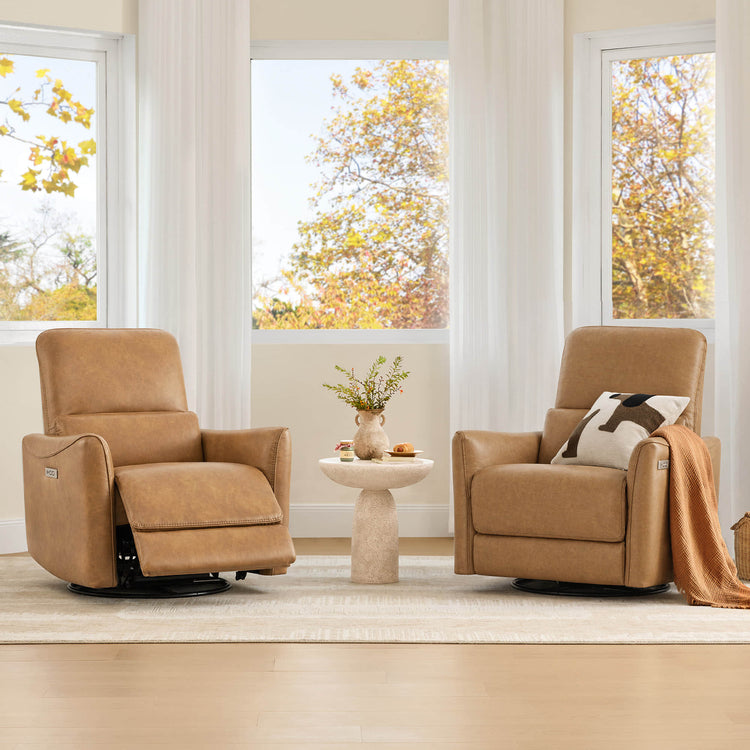
Two scenarios have documented CHITA product fits: a compact room that benefits from hidden tech, and a nursery or multi-use room that benefits from swivel and glide. A third scenario, pet-focused households, stays a verify-first path until upholstery evidence is confirmed for the specific model you want.
Use the Supported Scenario Paths
| Reader scenario | Supported candidate | Key fit facts | Not-fit boundary |
|---|---|---|---|
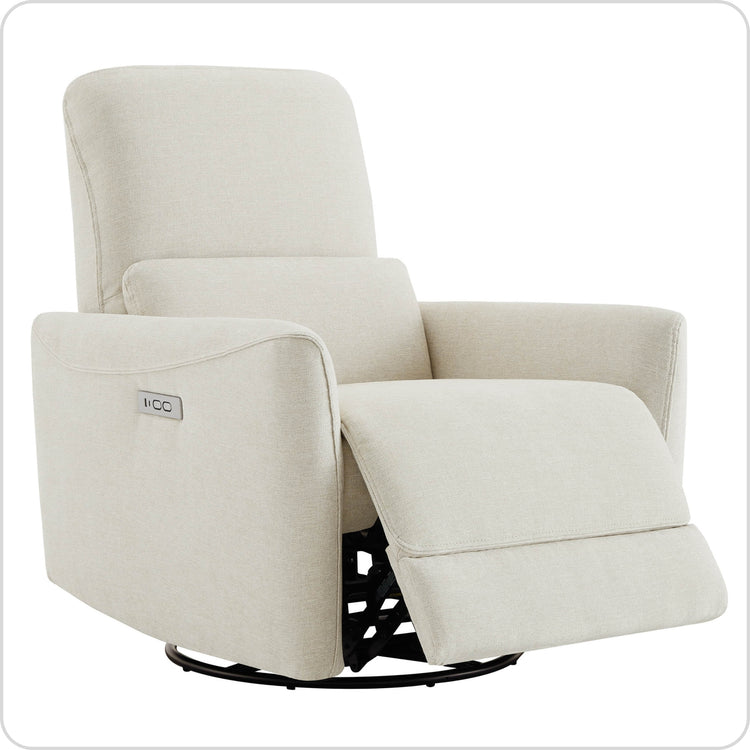
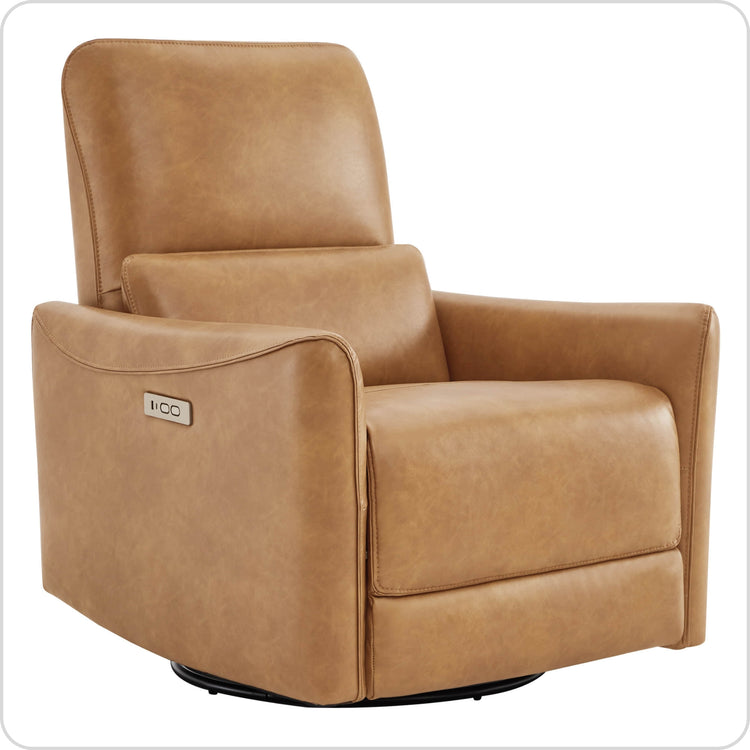
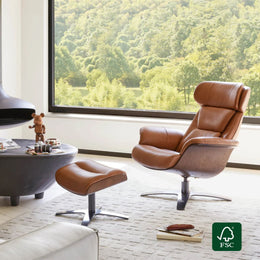
| Compact room, hidden-tech interest | Sonia feature recliner | 40.4"W x 38"D x 40.7"H, 5.9" wall clearance, fits through 27" doorways, 165° max recline, power lumbar, Bluetooth speakers, USB/Type-C charging, 350 lb capacity | Full-recline depth is not supplied here; check your own doorway, wall, and operating-space measurements before ordering |
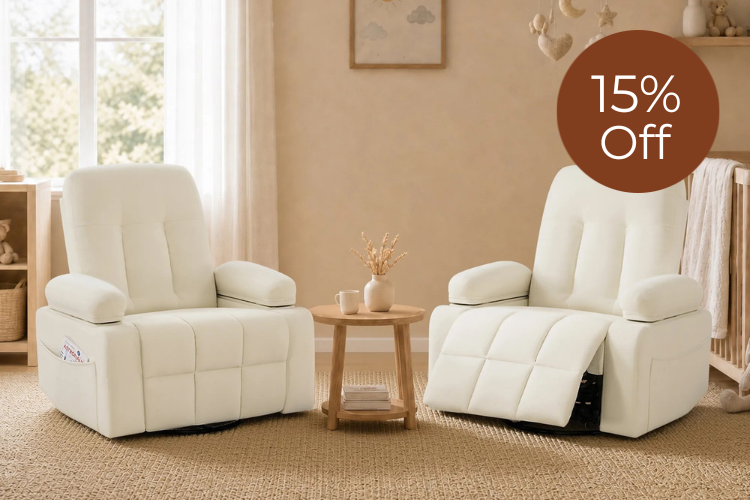
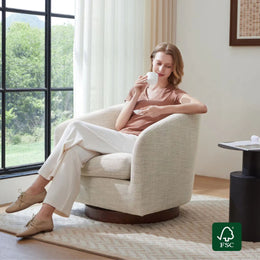
| Nursery, feeding, or multi-use room | Theo swivel glider | 33.3"W x 39"D x 39.6"H, 270° swivel, smooth glide, power recline, USB/Type-C charging, 350 lb capacity, best fit for users 5'1"-5'10" | No documented wall-clearance figure or doorway measurement; confirm access and room space separately |
| Pet-heavy or frequent-mess household | Verify-first, no named recommendation | Upholstery care code and cleaning method must be confirmed per model | Do not treat either model above as pet-proof without checking current documentation |
Keep Configuration and Collection Claims Honest
Some Theo features, such as a power headrest or an FSC-certified frame, apply only to certain configurations, so confirm the exact version before you order if either matters to you. When you are ready to compare more options side by side, our power recliner collection is a useful starting point for browsing current models, though the collection page itself is not a substitute for checking the specific product's measurements and care documentation.
Set Maintenance and Safe-Use Expectations Before Delivery
Treat the pre-delivery window as your last chance to confirm care, power placement, and safety details before the chair is in your home. For the named products, the supplied one-year warranties are coverage periods, not lifespan promises.
Complete the Pre-Delivery Check
- Save the current product page, listed care code, and warranty terms so you have a record if anything differs on arrival.
- Confirm your outlet location and cord route match the chair's final position.
- Confirm the delivery path and final room placement one more time against your earlier measurements.
- Test the recline and any swivel or glide motion once during setup, before regular daily use begins.
Use the Safety Stop
Test movement slowly the first time and keep the mechanism and footrest area clear of toys, cords, and pets while you do. CPSC staff have reported child-entrapment incidents involving motorized recliners and moving foot supports, including cases involving young children. Keep children away from the underside of the chair and any moving footrest, and supervise them any time the recliner is in use, regardless of how the specific model is marketed.
FAQs
How Do You Maintain a Power Recliner?
Follow the exact care code and current cleaning instructions listed on your specific model's product page rather than a general performance-fabric rule. When a listing shows conflicting cleaning-code information, contact the retailer to confirm the correct method before you clean the fabric.
How Much Space Does a Power Recliner Need?
Measure the chair's upright footprint and its fully reclined, swiveled, or glided footprint, plus wall clearance, walkway space, outlet location, and the delivery path. Example only: using the supplied Sonia figures, 38 inches of upright depth + 5.9 inches of documented wall clearance = a 43.9-inch upright wall-to-front baseline. That result excludes the full-recline extension, any swivel or glide radius, walkway, and delivery path, so it is not a total room-space requirement. Check every result against the exact product page or manual; upright dimensions alone are not enough to confirm fit in a small room.
Does a Zero-Gravity Recliner Provide Health Benefits?
Zero gravity describes a reclined body position, not a diagnosis, treatment, or guaranteed source of pain relief. Test the position for your own comfort and support, and talk to a healthcare provider if you are shopping to address a specific medical condition.
Are Power Recliners Safe Around Children?
Powered footrests and other moving mechanisms need supervision around young children, and the exact model's instructions should guide how it is operated. Keep children away from the underside and moving parts of the chair whenever it is in use.
Sources and Further Reading
- U.S. Consumer Product Safety Commission (2015). CPSC Staff Letter to ASTM on Recliner Entrapment.
- U.S. Consumer Product Safety Commission (1996). Golden Chair and Allen Manufacturing Announce Recliner Chair Recall.
- PubMed (2013). In vivo spinal posture during upright and reclined sitting in an office chair.
Recommended Products


More to Read
 7 Sofa Trends That Actually Improve Comfort in 2026
Upgrade your living room with furniture that supports your body. Here are 7 modern sofa features designed to maximize your daily comfort...
7 Sofa Trends That Actually Improve Comfort in 2026
Upgrade your living room with furniture that supports your body. Here are 7 modern sofa features designed to maximize your daily comfort...
 Mother's Day Gift Guide: Cozy and Stylish Furniture Picks for Modern Moms
Make Mother's Day more meaningful with furniture gifts that bring comfort, smart features, storage, and quiet luxury into her everyday routine.
Mother's Day Gift Guide: Cozy and Stylish Furniture Picks for Modern Moms
Make Mother's Day more meaningful with furniture gifts that bring comfort, smart features, storage, and quiet luxury into her everyday routine.
 Performance Fabric Reality Check: Does It Really Repel Pet Hair and Stains?
Performance fabric is often marketed as a miracle solution for homes with pets and kids, but the reality is more nuanced. It...
Performance Fabric Reality Check: Does It Really Repel Pet Hair and Stains?
Performance fabric is often marketed as a miracle solution for homes with pets and kids, but the reality is more nuanced. It...