













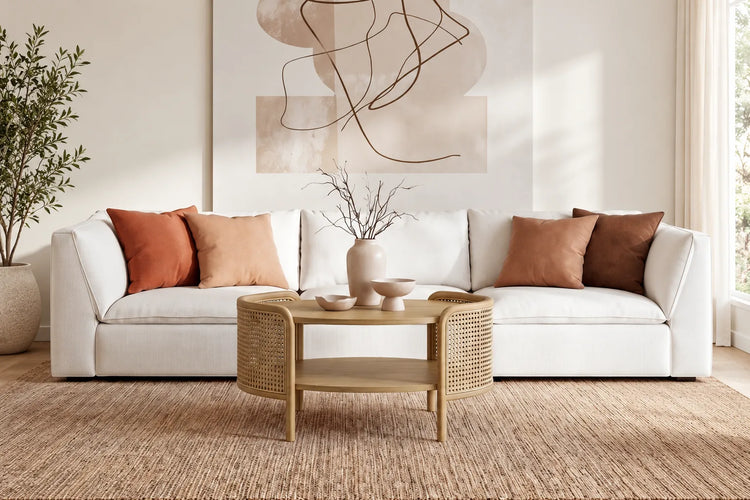
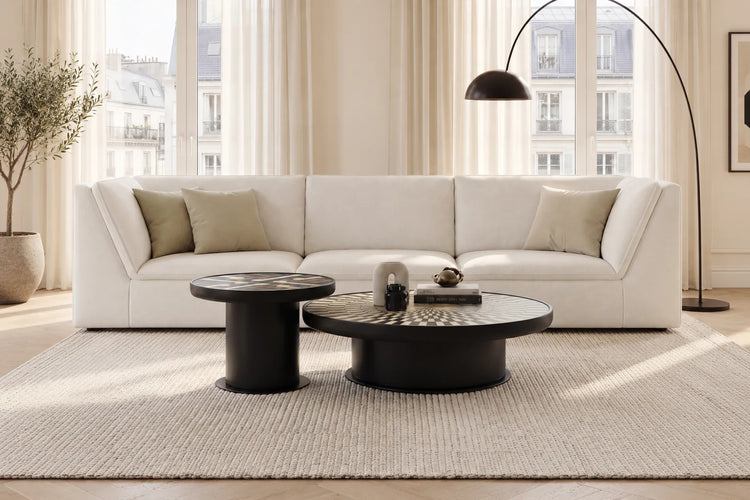
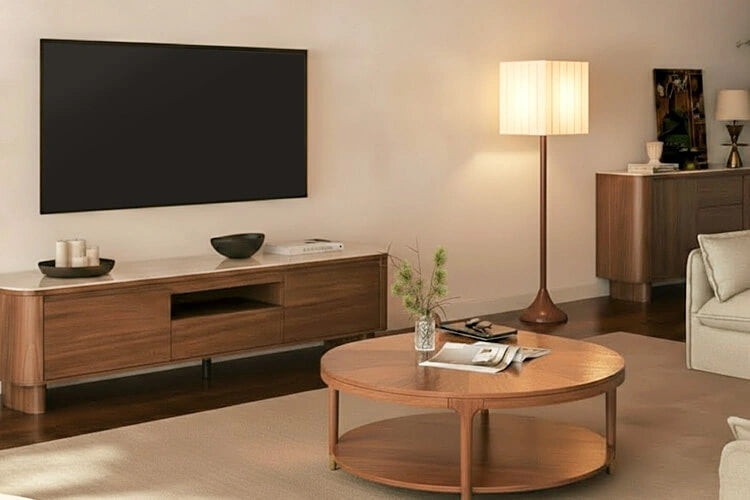









A round drum side table can soften a boxy living room and ease foot traffic around a tight seating area, but only if it clears the same safety and storage checks any table needs near children. A well-chosen mid century modern side table removes a hard corner without narrowing the path people walk, and its stability and storage details still have to hold up before it earns a spot in a child-accessible corner.
Check the taped footprint first, then work through stability, storage, and clearance before you buy or place one.
When a Round Drum Side Table Helps in a Small Living Room
A round drum table earns its place when it removes a corner conflict without shrinking the room's main walking path. Judge it by the taped footprint and the traffic pattern together, not by the silhouette alone.
Choose the Round Profile When the Route Stays Clear
- Use a round drum table when a hard corner is the main friction point with a knee, doorway, or a path someone walks daily.
- Tape the table's actual width and depth on the floor before buying. If the route around the seating stays open, the round profile is doing its job.
- Treat the shape as one input among several, not a stand-alone reason to buy.
Know When a Different Table Is the Better Fit
- Pick a smaller table, a different shape, or no side table at all when the circular footprint still crowds the seating or blocks the route.
- Do not let a softer-looking outline override a missing stability check or an unclear storage plan; style should not outrank those two questions.
How to Evaluate Stability Before a Child Can Reach the Table
Rounded edges solve one problem: sharp-corner contact. Whether the table can tip over depends on the whole setup, so check loading, floor conditions, and anchoring documentation before it goes anywhere within a child's reach.
Check the Complete Setup, Not Only the Silhouette
- Look at what sits on top and inside the table. A heavy top, a heavy lamp, or a stack of books raises the center of mass and changes how easily the table tips.
- Keep heavier stored items on the lowest shelf and avoid placing remotes, toys, or anything tempting on top, since that can turn the table into a climbing prompt.
- Note the floor surface. Furniture instability can increase on carpet or an uneven surface, even when nothing about the table itself has changed.
- If nearby furniture invites climbing toward the table, treat that as a setup problem to fix, not a table-shape problem.
Verify Anchoring Compatibility Before Placement
- Read the specific table's instructions and identify whether the manufacturer names approved furniture and wall attachment points. CPSC's anchoring guidance recommends securing furniture to the wall and keeping tempting items out of reach as part of a complete setup.
- Confirm the anchoring kit's weight rating covers the piece and match the hardware to a wall stud or verified solid backing. Do not attach a strap to thin drywall or an unverified surface, since that defeats the purpose of anchoring.
Neither the Irais nor the Renee side table ships with published tip-over certification or a model-specific anchoring kit, so treat this step as something to confirm directly from the product page or by contacting support before placing either table where a child can reach it.

How Much Interior Storage Is Actually Usable?
Storage only helps if you can actually reach what you put inside it. Compare the opening size, shelf height, and door swing against the items you plan to store before assuming a table will hold them.
Nominal Storage Versus Usable Storage
A listed storage feature describes the configuration, not the usable volume. Measure the item you want to store, then check it against the actual opening height, interior depth, and whether a door or shelf edge blocks part of that space. Daily reach matters more than the largest theoretical volume a compartment could hold, especially for items you grab every day like remotes, chargers, or coasters.
Choose Enclosed or Open Storage by Household Need
Enclosed storage hides clutter behind a door but can limit access if the opening or shelf height doesn't match your items. Open shelving gives faster visibility and reach, at the cost of leaving contents exposed to a child's reach.
| Table | Documented storage | Best fit and limit |
|---|---|---|
| Irais round storage table | Concealed shelving behind a fluted door; 20.39" W × 20.39" D × 22.05" H; 55 lb net weight | Good for hiding small items out of sight; check the door swing and shelf height against your items first |
| Renee round cane table | Two open tiers; 22.83" W × 21.26" D × 21.65" H; 20 lb net weight; 7.68" clearance underneath | Good for quick visibility and reach; contents stay exposed, so plan for what a child can pull |
Neither configuration proves tip-over safety on its own. Storage choice is a clutter-and-access decision; stability is a separate check covered above.
How Rounded Geometry Changes Flow in Tight Seating Areas
A round profile softens visual lines only when its actual footprint preserves the room's movement. Compare the physical space it takes up, not just how it looks in a photo.
Compare the Footprint, Not Just the Outline
- Tape the candidate table's width and depth on the floor at the exact spot you plan to use.
- Compare that taped circle with your current angular table in the same location. A round shape can still take up more floor area than a low rectangular table it's replacing.
Protect the Route Around the Seating
- Walk the path from the seat to the doorway with the taped footprint in place. Check that you can still sit down, stand up, and reach the table without brushing past it.
- Reject the placement if it creates a new collision point, even though the edges are rounded. Softer corners reduce the impact of a bump; they don't remove the bump itself.
A Room-Specific Fit and Documentation Test
Run this short sequence before you commit to a specific table, and stop at whichever step fails.
- Tape the table's footprint on the floor in its intended spot.
- Walk the everyday route around the seating area with the tape in place, checking for any new pinch point.
- Test storage access by holding the items you plan to store against the documented opening, shelf height, and clearance.
- Pull up the model's setup and anchoring instructions and confirm the anchor kit's weight rating covers the piece; check the anchor kit rating against the furniture's actual weight rather than estimating.
- Place the table only if it passes the footprint, route, and storage checks and the anchoring documentation resolves cleanly. If any step fails, resize, reposition, or hold off until the open question is answered.
For a broader layout view before you finalize a spot, our family room layout ideas walk through common seating arrangements around sofas and kids' spaces.
FAQs
Do rounded edges make a drum side table child-safe?
No. Rounded edges only reduce the impact of a sharp-corner bump; they don't address tip-over risk. Known instability factors include heavy loading, a heavy top, and an unstable floor surface, all of which apply regardless of the table's shape. Run the full stability check above before treating any table as child-ready.
Can I anchor a round side table to the wall?
Only when the specific table, the wall structure, and the anchoring hardware all support it. Check the model's instructions for approved attachment points and confirm the kit's weight rating covers the table before installing anything. Don't improvise a strap connection to drywall or an unverified surface; that setup won't hold the way a stud-anchored connection does.
Is open or enclosed storage better for a child-accessible sitting area?
It depends on what you're storing and how often you need it. Open shelves are faster to see and reach but leave contents exposed to a child. Enclosed storage keeps items out of sight but only helps if the opening and shelf height actually fit what you're storing. Neither configuration on its own makes the table more stable.
Sources
- U.S. Consumer Product Safety Commission. Anchor It! Campaign Marks 10 Years.
- Anchor It!. What You'll Need.
- American Academy of Pediatrics. Preventing Furniture and TV Tip-Overs.
Recommended Products

More to Read
 7 Sofa Trends That Actually Improve Comfort in 2026
Upgrade your living room with furniture that supports your body. Here are 7 modern sofa features designed to maximize your daily comfort...
7 Sofa Trends That Actually Improve Comfort in 2026
Upgrade your living room with furniture that supports your body. Here are 7 modern sofa features designed to maximize your daily comfort...
 Mother's Day Gift Guide: Cozy and Stylish Furniture Picks for Modern Moms
Make Mother's Day more meaningful with furniture gifts that bring comfort, smart features, storage, and quiet luxury into her everyday routine.
Mother's Day Gift Guide: Cozy and Stylish Furniture Picks for Modern Moms
Make Mother's Day more meaningful with furniture gifts that bring comfort, smart features, storage, and quiet luxury into her everyday routine.
 Performance Fabric Reality Check: Does It Really Repel Pet Hair and Stains?
Performance fabric is often marketed as a miracle solution for homes with pets and kids, but the reality is more nuanced. It...
Performance Fabric Reality Check: Does It Really Repel Pet Hair and Stains?
Performance fabric is often marketed as a miracle solution for homes with pets and kids, but the reality is more nuanced. It...