






















Deciding between a bench ottoman and two small cube ottomans comes down to whether you need a fixed anchor or modular flexibility. A bench ottoman provides one continuous seat in a stable footprint, while two small cube ottomans split apart to serve as separate seats or footrests in different spots.
The right choice depends on your entryway traffic path, living room seating habits, and storage clearance rather than shape alone.
Bench Ottoman vs. Two Small Cube Ottomans: The Choice Split
When comparing a bench ottoman or two small cube ottomans, a bench wins whenever continuous shared seating and one unified footprint matter most. Two cubes win whenever separability, repositioning, or two different jobs matter more than a single anchored piece.
| Decision question | Bench ottoman | Pair of small cube ottomans |
|---|---|---|
| Footprint | One continuous footprint | Two smaller footprints, together or apart |
| Seating continuity | One shared seat for two or more people | Two separate seats, can sit unevenly |
| Moving effort | One larger piece to carry | Two lighter pieces, more trips |
| Weight considerations | Model-specific net weight and capacity apply to one unit | Model-specific net weight and capacity apply per unit |
| Storage access | One storage opening to plan around | Two independent openings, more placement options |
| Best-fit use | Stable shared seating in one fixed spot | Rooms needing separate roles or frequent rearranging |
Neither configuration is automatically the easier one to move or the one with better storage access. That answer depends on the room's actual clearance and the model's real specifications, which the next two sections walk through.
In a Tight Entryway, Choose for Clearance and Access
A tight entryway rewards whichever configuration leaves the door swing and walking path clear. Test both the bench and the pair against your actual traffic route before you commit to either one.

Map the Active Path Before the Footprint
Treat your entryway as a circulation and receiving zone first, and a seating spot second. Walk the path from your front door to the rest of the home and mark exactly where the door swings open. A widely used furniture-planning guide recommends you map traffic routes and door swings and leave 36 inches clear in front of a door as a practical planning check, not a legal minimum. Older US extension research treats the entryway as a circulation zone that also needs room for one person to stand and reach nearby storage.
Choose the Setup That Keeps Storage Reachable
- A bench can work if it sits outside that walking path and its storage lid still lifts fully open in place.
- Two cubes can work if one unit slides aside, or if placing them apart clears the door swing entirely.
- Reject either option if reaching what is stored inside means moving furniture through the active entry path first.
If anyone in the household uses a wheelchair or walker, check the door maneuvering clearance standards instead of relying on either ottoman's advertised footprint. Our guide to small-space furniture arrangements has more layout ideas for foyers this tight.
In a Living Room, Choose for Repositioning and Shared Use
Deciding on a bench ottoman versus two cube ottomans for a living room depends on how frequently your seating arrangement changes. Match the choice to how everyone actually uses the room.
When a Bench Is the Better Living-Room Anchor
A bench works best when two or three people need one shared surface for movie nights or extra seating around a coffee table. A single footprint stays useful when you want the arrangement to stay put between guests, cleaning days, and everyday use. Before you buy, confirm the bench's actual dimensions and storage-lid clearance fit alongside your sofa, chairs, and walking route.
When Two Cubes Earn Their Floor Space
Two cubes earn their space when each one takes on a separate role, such as a footrest in one corner and an extra seat for guests in another. Split them when the layout changes often, since one unit can move without disturbing the other during cleaning or hosting. Modular does not automatically mean lighter or easier to carry: compare the actual per-unit weight, doorway width, and carrying route before assuming two smaller pieces beat one bench for moving effort. Our modular storage guide covers similar tradeoffs for pet- and kid-friendly rooms.
Verify Footprint, Weight, and Storage Before You Buy
Before buying either configuration, measure your room and check the model's real numbers instead of guessing from a product photo. Skipping these checks is how shoppers end up with furniture they cannot move through a doorway or open once it is in place.
Measure the Room and Route
- Tape off the ottoman's full exterior footprint in the exact spot you plan to use it.
- Measure the doorway width, any turns, and the full carrying route, not just the final resting spot.
- Mark the door swing and the space you need to stand, walk by, and reach nearby storage.
Verify Weight, Capacity, and Construction
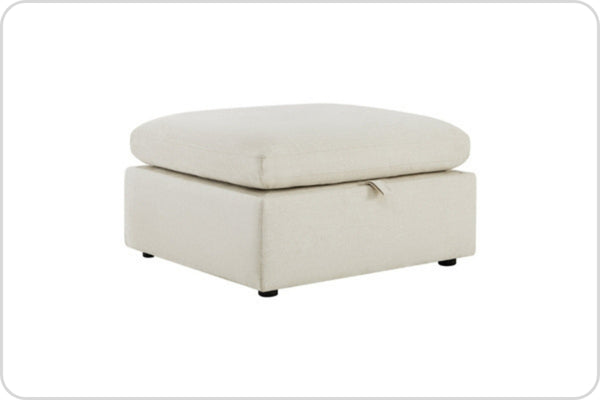
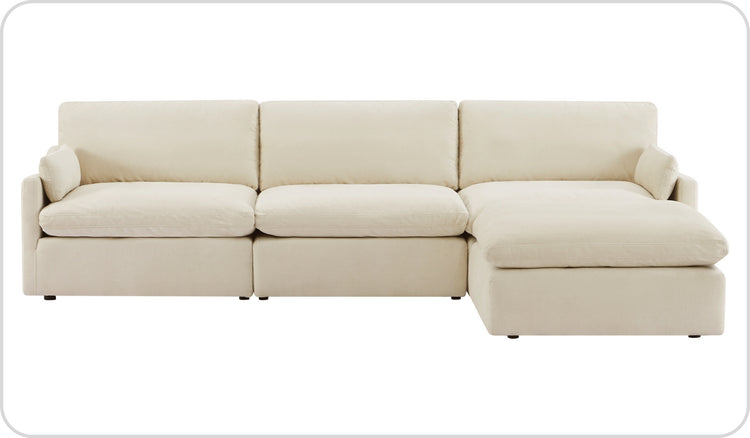
- Record the model's net weight and stated load rating instead of assuming a category-wide limit. Our Maisie Modular Ottoman lists a net weight around 59.4 lbs with a 350-lb capacity per seat and a doorway requirement of 20 inches or wider, while our Cube Storage Ottoman lists about 18 lbs net weight with a 350-lb capacity and an 18 by 18 by 17-inch footprint.
- Check the frame or suspension details the maker actually supplies rather than guessing from appearance. Maisie uses a kiln-dried wood frame with sinuous springs and high-resilient foam, and the Cube uses a sinuous-spring seat with plush fiber and CertiPUR-US certified foam.
- Treat a pair as two separate units for handling: two Cube ottomans total roughly 36 lbs in net weight before packaging, but that number alone does not confirm both storage lids will actually open once positioned. Our ottoman sizing guide walks through matching footprint to your room.
Test Storage Access in the Actual Layout
Check whether the top lifts straight up, flips over, or slides before you buy, since each motion needs different clearance behind or beside the ottoman. Compare interior storage dimensions only after confirming that opening path is actually usable in your room, not just on paper. Then choose whichever configuration keeps stored items reachable without moving other furniture first.
FAQs
Do I need to measure the door swing as well as the ottoman footprint?
Yes. Measure the door opening, the arc it swings through, and the clear route to the ottoman's intended spot. The 36-inch clearance figure used in furniture-planning guides is a practical check, not a building code, but it is still a useful minimum to test against. Reject any configuration, bench or pair, that blocks that route once it is in place.
How should I compare weight when there's no universal ottoman weight limit?
Compare each model's actual net weight, its stated per-seat or per-unit capacity, how many pieces you are handling, and the doorway and route you will carry it through. No single furniture-wide weight threshold applies to every bench or cube ottoman. Choose the option your specific route and helpers can actually handle, based on the model's own listed figures.
How can I tell whether an ottoman's storage will stay accessible after I place it?
Storage usability depends on how the lid or top opens, how much clearance that motion needs, and whether a wall or nearby furniture blocks it. Comparing interior compartment dimensions alone will not tell you this. Test the opening path in your actual room layout before you decide the storage is genuinely usable where you want to put it.
Sources
- Access Board. Chapter 4: Entrances, Doors, and Gates.
- NYIAD. Planning a Furniture Layout.
- University of Nebraska-Lincoln Extension. Inviting Entryways.
Recommended Products

More to Read
 7 Sofa Trends That Actually Improve Comfort in 2026
Upgrade your living room with furniture that supports your body. Here are 7 modern sofa features designed to maximize your daily comfort...
7 Sofa Trends That Actually Improve Comfort in 2026
Upgrade your living room with furniture that supports your body. Here are 7 modern sofa features designed to maximize your daily comfort...
 Mother's Day Gift Guide: Cozy and Stylish Furniture Picks for Modern Moms
Make Mother's Day more meaningful with furniture gifts that bring comfort, smart features, storage, and quiet luxury into her everyday routine.
Mother's Day Gift Guide: Cozy and Stylish Furniture Picks for Modern Moms
Make Mother's Day more meaningful with furniture gifts that bring comfort, smart features, storage, and quiet luxury into her everyday routine.
 Performance Fabric Reality Check: Does It Really Repel Pet Hair and Stains?
Performance fabric is often marketed as a miracle solution for homes with pets and kids, but the reality is more nuanced. It...
Performance Fabric Reality Check: Does It Really Repel Pet Hair and Stains?
Performance fabric is often marketed as a miracle solution for homes with pets and kids, but the reality is more nuanced. It...