






















How Far Should a Coffee Table Be From the Couch?

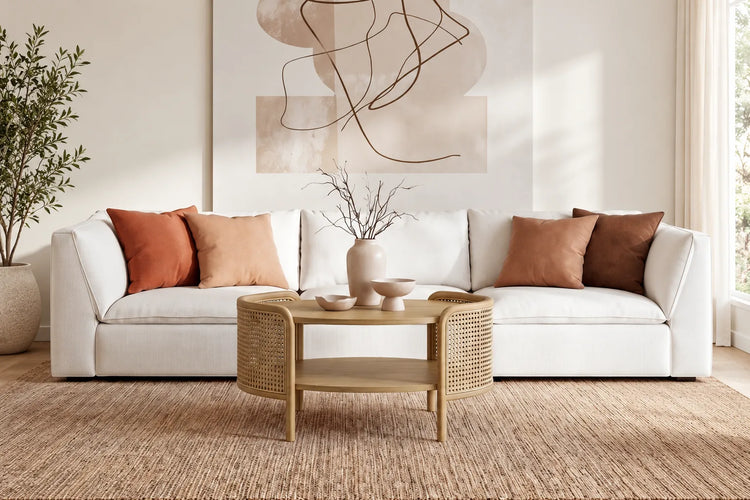
A good coffee table distance from couch setups is usually 16 to 18 inches, which gives you enough room to reach drinks and books without crowding your legs. Treat that as a starting point, not a universal rule. If your sofa is extra deep, your table is oversized, or people need to pass through the area often, the best gap can change.

Start With the Simple Spacing Rule
If you only want the quick answer to how far should coffee table be from couch, start at 16 to 18 inches between the sofa edge and the table. That range is close enough for easy reach, but usually wide enough to avoid the cramped feeling that comes from pushing the table too close. Emily Henderson's living-room spacing rule uses that same starting point for sofa-to-table placement.
Think of this as a comfort test, not a code. If you sit down and can naturally place a mug, remote, or book on the table without leaning forward too much, the gap is probably in the right zone. If your knees brush the table or you have to twist awkwardly to set things down, the table is too close. If you keep missing the table with your hand, it is probably too far away.
The main thing to avoid is blending this gap with walkway clearance. The couch-to-table distance is about reach and legroom. The aisle around the seating area is about traffic flow, which may need more space.
What Affects the Best Coffee Table Distance
The best coffee table spacing changes because the furniture around it changes. A deeper sofa leaves less visual and physical breathing room in front, while a slimmer seat can handle a slightly tighter placement. Table shape matters too, because a long rectangular table feels different from a round one even when the tape-measure number is similar.
Emily Henderson also recommends a coffee table that is roughly two-thirds the length of the sofa. That rule is about scale, not clearance. A table can be the right distance from the couch but still feel wrong if it is too small for the seating group or too large for the room.

Sofa Depth and Seat Clearance
A deep sofa often needs a little more judgment than a shallow one. The front edge of the seat can already feel visually close to the table before the tape measure says it is. For most rooms, the right move is to sit on the sofa and check whether your knees, shins, and feet have a comfortable landing zone.
Seat height matters too. A low, loungey sofa can make a table feel closer than it measures, while a taller seat can make the same gap feel more open. If the table feels like part of the couch instead of a separate surface, move it out a bit.
Coffee Table Size and Shape
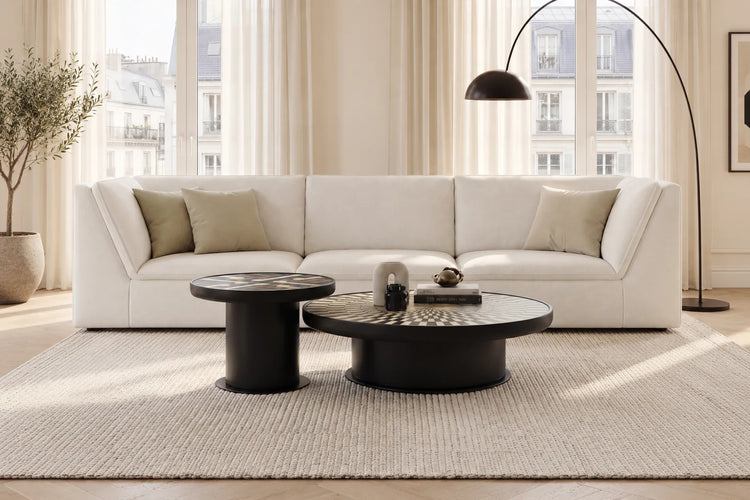
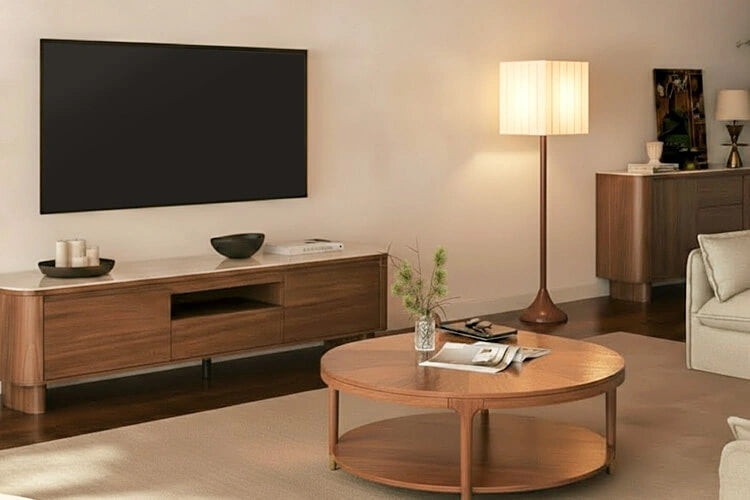
Coffee table size changes the way spacing reads in the room. A long rectangle can dominate the front of a sofa faster than a round or oval table because it creates a broader visual block. A round table can feel softer in a small room, especially when you want to keep edges from crowding the seating area.
As a planning rule, bigger table footprints usually need more breathing room. Even if the gap stays at 16 to 18 inches, a bulky table can still feel tight. That is why the distance from the couch and the table footprint should be judged together, not separately.
Traffic Flow Around the Seating Area
This is where many rooms break down. A layout can feel fine when you are sitting still, but annoying when someone walks behind the table, cuts across the room, or heads toward a doorway. The coffee table spacing that works for reach can still be too tight for circulation if the room doubles as a main passage.
For a shared living room, protect the path first, then place the table as close as the path allows. In a dedicated conversation area, you can usually prioritize the seating relationship more heavily. That is why the ideal gap flips more often in small apartments and open layouts than in enclosed family rooms.
Table Height and Everyday Reach
Height does not replace distance, but it changes how the setup feels. A table that sits too high can feel awkward to use from a relaxed sofa, while a table that sits too low can make drinks harder to grab. If you are constantly reaching up or down instead of forward, the layout is fighting the way you actually sit.
What matters most is everyday use. If the table is where your hand naturally lands and the top is easy to use without hunching, the room is probably working. If not, the problem may be height, not just spacing.
How to Adjust for Small Rooms and Sectionals
Small rooms are where a rigid rule causes the most trouble. In a compact apartment, the right answer is often to preserve the walkway first and then bring the coffee table in as far as the room comfortably allows. That may mean staying near the lower end of the usual gap, especially if the seating area is also a main traffic lane.
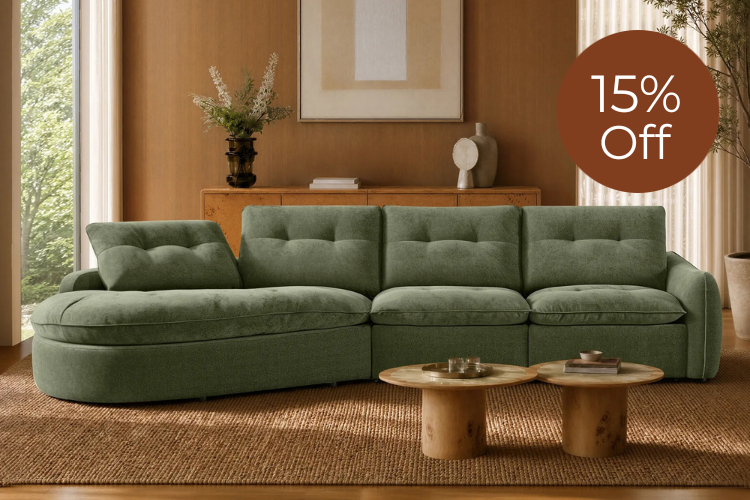
For sectionals and chaise layouts, the front edge is rarely a simple straight line. One side may feel tighter than the other, so the table has to work with the longest, most used seating edge instead of pretending every seat has the same reach. In that kind of setup, a slightly adjusted gap is often more practical than forcing one measurement across the whole room.
Here is the simplest way to decide:
- Move the table closer if the room feels too spread out, the table is hard to reach, or the sofa-to-table relationship looks disconnected.
- Move the table farther if your knees hit the table, you feel boxed in, or sitting down and standing up takes extra effort.
- Choose a different shape if the table footprint overwhelms the room, especially in a narrow layout or around a sectional corner.
- Prioritize circulation first in a shared space, because a room that looks ideal on paper can still feel awkward if people keep sidestepping the table.
If your room is especially tight, a better answer may be a smaller footprint rather than a perfect measurement. That is where a round table, nesting table, or a browseable category like side tables can be more useful than forcing one large coffee table into a narrow path.
Common Coffee Table Spacing Mistakes
-
Placing the table too close. This is the fastest way to make a room feel cramped. You lose legroom, the front of the sofa feels boxed in, and everyday movement becomes annoying. The fix is simple: pull the table forward until sitting down and standing up feel natural again.
-
Pushing the table too far away. A table that sits well beyond arm's reach breaks the connection between the couch and the surface. Drinks, remotes, and books become inconvenient, and the seating zone can feel unfinished. Move it closer until it serves the sofa instead of floating in front of it.
-
Ignoring the table footprint. A table can have the right gap and still feel wrong if it is oversized for the seating group. The fix is to check both the open space and the actual size of the table top so the room does not feel crowded.
-
Blocking the main walkway. If people have to squeeze around the table to enter or cross the room, the layout needs more circulation space. This matters most in open-plan homes and narrow family rooms, where the path through the room is used every day.
-
Choosing shape without checking use. A round table can soften a tight room, but a rectangular one may suit a longer sofa better. Shape is not just style; it changes how far your hand travels and how much visual room the table takes up.
For more layout context, a small-space furniture arrangement guide can help if your living room has more than one path or more than one function.
Quick Placement Checklist Before You Buy
Before you choose a table, measure the real walking path, not just the open spot in the middle of the room. Doors, corners, and built-ins can change how usable the space feels.
Then sit on the couch and test reach from your usual seat. Drinks, remotes, and books should feel easy to place down without leaning hard forward.
Finally, compare the table footprint to the full seating zone. The best coffee table distance from couch setups usually work because the table matches the scale of the sofa, not because it happens to fit the empty floor space.
Recommended Products

More to Read
 7 Sofa Trends That Actually Improve Comfort in 2026
Upgrade your living room with furniture that supports your body. Here are 7 modern sofa features designed to maximize your daily comfort...
7 Sofa Trends That Actually Improve Comfort in 2026
Upgrade your living room with furniture that supports your body. Here are 7 modern sofa features designed to maximize your daily comfort...
 Mother's Day Gift Guide: Cozy and Stylish Furniture Picks for Modern Moms
Make Mother's Day more meaningful with furniture gifts that bring comfort, smart features, storage, and quiet luxury into her everyday routine.
Mother's Day Gift Guide: Cozy and Stylish Furniture Picks for Modern Moms
Make Mother's Day more meaningful with furniture gifts that bring comfort, smart features, storage, and quiet luxury into her everyday routine.
 Performance Fabric Reality Check: Does It Really Repel Pet Hair and Stains?
Performance fabric is often marketed as a miracle solution for homes with pets and kids, but the reality is more nuanced. It...
Performance Fabric Reality Check: Does It Really Repel Pet Hair and Stains?
Performance fabric is often marketed as a miracle solution for homes with pets and kids, but the reality is more nuanced. It...