






















How to Choose coffee tables for hosting snacks

Start with the table’s job, not its finish: a hosting-ready coffee table should give the seats you plan to use reachable places for snacks and drinks, preserve walking routes, stay stable during ordinary use, and come with care instructions your household can follow. Measure the seating area first, then compare usable tabletop space, height, shape, construction details, and delivery dimensions. Styling comes after those checks.

Measure your seating area before choosing a coffee table size, shape, and height
The right footprint is the largest one that serves your planned seats without narrowing routes or forcing guests to reach across the serving area. Build a room-specific fit brief before comparing finishes or storage features.
Begin by mapping the sofa, chairs, most-used seats, walking routes, door swings, and any path guests use to reach the kitchen or entry. Mark the seats that need direct access to snacks and drinks. Then use painter’s tape or newspaper to outline a possible table on the floor. Record the largest practical length and width that preserve the routes and keep the most-used seats accessible. This is your working table size, not a universal category standard.

No single clearance or height rule works for every room. Treat any design reference you find as a starting point, and give priority to the taped footprint, circulation, seat access, and posture. Write down the listed table height and compare it with the sofa and chair seat heights. Test whether people can set down and pick up a drink comfortably from the posture they will actually use.
Choose the shape based on movement and serving. Rounded or oval tops may suit a room with frequent turns. Whatever the shape, mark where shared bowls and trays would sit, then check whether guests can reach those areas without crossing a protected route or leaning over another person. Reject any option whose measured footprint blocks movement or leaves key seats difficult to reach.
Finally, compare the full listed dimensions—and any available packaged dimensions—with doorways, stairs, elevators, tight turns, and the route into the living room. A table that fits the floor plan can still fail before it reaches the room. Your fit brief should state the largest practical footprint, seats served, routes protected, table-to-seat height relationship, preferred shape conditions, and delivery-access limits.
Plan a snack-friendly tabletop for the way you host
A snack-friendly tabletop earns its space through reachable placement, not just a large outside measurement. Plan where food, drinks, serving pieces, remotes, and cleanup items will go before deciding that a top is spacious enough.
Start with the sofa corners, chairs, and any seats guests regularly use during movie nights or game days. If only the center seats can reach the surface, the arrangement may not serve the room as intended. Reserve practical landing zones for cups, small plates, and remotes, keeping them reachable without making guests lean across bowls, shared platters, or another person.
Next, assign a shared serving zone for a snack bowl, tray, pizza box, or game-day dish. Leave open surface around it for personal items, and test the actual items you serve instead of turning an assumed guest count into a size formula. Keep a separate area for used plates, napkins, or a small cleanup tray so one round of serving does not displace every drink. Some supplies may work better in storage than on the tabletop.
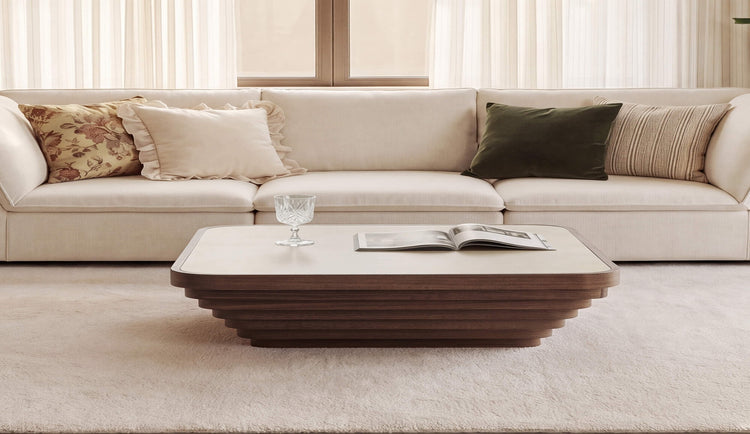
Drawers and shelves can support hosting by holding remotes, coasters, napkins, or items used between serving moments, but they are not automatically extra serving surface. For example, the Blake table storage details list a 51.18-by-29.53-inch footprint, a 14.96-inch height, two hidden drawers, and rounded edges. Compare those listed features with your fit brief instead of treating them as proof of capacity or stability.
Run a reach test from each intended seat. Point to the landing zone you would use and note whether guests must cross the central serving area, reach over other items, or move through a protected route. If they do, reject the layout even if the top looks generous. Judge a table for entertaining by the zones guests can actually reach; outside dimensions and storage features do not establish usable serving capacity.
Verify surface care and construction details before you buy
A material name is a starting point, not proof that a surface is spill-proof, stain-proof, heat-proof, waterproof, scratch-proof, or maintenance-free. Read the product-specific care and specification information before deciding that a tabletop suits recurring snacks and drinks.
For a stone or stone-look surface, look for approved cleaners, spill and stain guidance, wipe-up timing, heat limitations, restricted substances, and finish-specific instructions. The Natural Stone Institute’s cleaning guidance provides general context on cleaning products, stain prevention, and preserving natural stone, but it does not establish the care requirements of every ceramic, sintered-stone, coated, or stone-look tabletop. As a manufacturer-specific example, Wolf’s natural-stone care guidance describes prompt cleanup with a soft cloth and mild soap and water and warns against acidic or abrasive cleaners. Treat that as an example of the detail to look for, not a universal rule, and follow the table’s own instructions first.
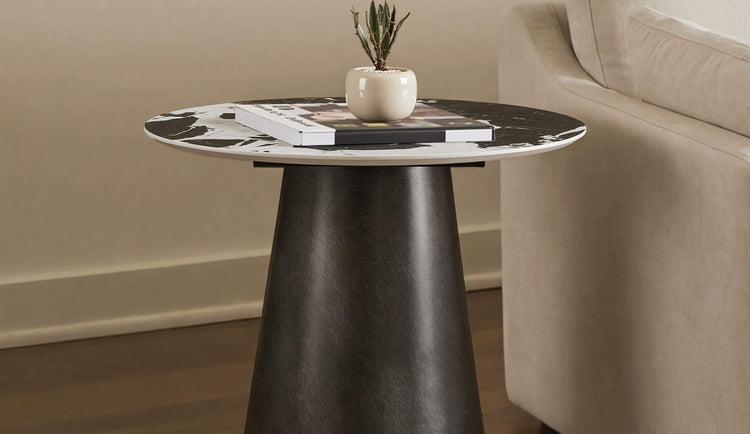
Separate the tabletop from its finish, backing, and base. A product page may list a ceramic-plus-MDF tabletop, metal support, veneer, or another construction detail, but that description alone does not prove load capacity, stability, heat tolerance, or resistance to spills and scratches. The Natalie table surface details list a 51.2-by-27.56-by-15.75-inch table with a Napoleon ceramic-plus-MDF tabletop and metal base. Its product information also states claims about resistance to stains, acids, heat, and scratches. Keep those claims attributed to that product information; do not generalize them to ceramic or MDF as categories.
Read the care page for the approved cleaner and everyday wipe-down method. Then look for instructions covering spills, stains, heat, acidic or abrasive substances, finish limitations, and any timing requirements after a spill. Read the stated construction and stability details, if provided, in light of how you plan to use the table. The deciding question is whether the documented routine fits your household’s actual behavior. If it requires steps you will not follow after game day, choose a different documented care profile. If the documentation does not address the care boundary that matters to you, narrow the purchase instead of filling the gap with an assumption.
Make the final choice for your room and hosting pattern
Let the household’s dominant constraint decide between otherwise suitable tables. Apply this matrix only after the fit, reach, care, and construction checks pass.
| Hosting situation | Dominant priority | Reject condition |
|---|---|---|
| Compact room | Protect measured routes and access to the most-used seats | The footprint crowds a turn, blocks a route, or leaves side seats difficult to reach |
| Frequent hosting | Preserve usable shared placement for multiple snacks and drinks | Guests must reach across the serving zone, or the usable top becomes crowded in your real setup |
| Easy-clean priority | Choose documented care guidance that matches your cleanup routine | The cleaner, spill-timing, heat, or finish restrictions do not fit how your household hosts |
| Children or pets | Consider edge profile, placement, route width, and stated construction | The layout creates an avoidable circulation problem, or a key construction detail is not documented for the intended use |
Rounded edges can be a conditional layout choice in a high-traffic room, but they do not establish child safety or pet safety. A heavy-looking base does not prove stability, and storage does not prove suitability for climbing, loading, or any use beyond the product’s stated information. Keep the table only if it passes the measurable room and access checks and its documented care routine is realistic for your home.
Before adding it to your cart, compare any full delivered or packaged dimensions with the entry route and make sure the documentation covers the use that decided your choice.
Frequently asked questions
These questions cover purchase conditions that can change the choice after room planning and care review.
Do drawers make a coffee table better for hosting?
They can support hosting by moving remotes, coasters, or napkins off the open surface, but they do not add serving space. Test the bowls, cups, plates, and cleanup items you actually use, then decide whether the remaining reachable tabletop is sufficient.
What should you do when a coffee table’s care instructions omit heat or spill limits?
Do not fill the gap with a material name or appearance-based assumption. Narrow the purchase to an option with documented guidance that fits your routine, or obtain product-specific information before ordering.
Does a rounded edge make a table safe around children or pets?
No universal safety conclusion follows from a rounded edge. Assess the edge profile together with placement, route width, and stated construction. If a detail that matters to the intended use is missing, do not treat the option as cleared; narrow the purchase or seek product-specific information.
Recommended Products


More to Read
 7 Sofa Trends That Actually Improve Comfort in 2026
Upgrade your living room with furniture that supports your body. Here are 7 modern sofa features designed to maximize your daily comfort...
7 Sofa Trends That Actually Improve Comfort in 2026
Upgrade your living room with furniture that supports your body. Here are 7 modern sofa features designed to maximize your daily comfort...
 Mother's Day Gift Guide: Cozy and Stylish Furniture Picks for Modern Moms
Make Mother's Day more meaningful with furniture gifts that bring comfort, smart features, storage, and quiet luxury into her everyday routine.
Mother's Day Gift Guide: Cozy and Stylish Furniture Picks for Modern Moms
Make Mother's Day more meaningful with furniture gifts that bring comfort, smart features, storage, and quiet luxury into her everyday routine.
 Performance Fabric Reality Check: Does It Really Repel Pet Hair and Stains?
Performance fabric is often marketed as a miracle solution for homes with pets and kids, but the reality is more nuanced. It...
Performance Fabric Reality Check: Does It Really Repel Pet Hair and Stains?
Performance fabric is often marketed as a miracle solution for homes with pets and kids, but the reality is more nuanced. It...