





















Best coffee tables for small living rooms

Choose the coffee table format that solves your room’s biggest constraint, then set its maximum footprint with a full-size floor template. Nesting tables suit changing surface needs, round or oval tables can help when corners interrupt movement, open-frame designs reduce visual heaviness, and multifunctional tables may be worthwhile when they replace a storage or work surface you use regularly. None is universally best: the right piece must preserve your walking route in both its everyday and active configurations.

Choose a Coffee Table Format by Your Room’s Main Constraint
Choose the format that addresses your room’s biggest limitation without creating a new footprint problem. Compare the widest points, base, sightlines, and active configuration before ordering; a format-selection guide can provide layout context, but it does not offer a universal ranking.
| Format | Choose it when | Tradeoff to verify |
|---|---|---|
| Nesting tables | You need a smaller everyday surface but want extra surface area for guests or occasional use. | Tape both the nested and separated layouts. The pieces may spread farther than the largest tabletop suggests. |
| Round or oval | Table corners interrupt a route between the sofa, entry, media unit, or another seat. | Measure the widest points and the full footprint. A curved top does not automatically take less floor space. |
| Open-frame | The room feels visually crowded and sightlines matter more than adding enclosed storage. | Check the base dimensions and stated stability information. Visual openness may reduce perceived heaviness without reducing the physical footprint. |
| Multifunctional | Storage, work, casual dining, or another use occurs often enough to replace a separate surface. | Measure the closed and active positions, including drawer, lift, reach, knee, or opening clearance. |
Whichever format you consider, compare nested and separated layouts, widest points, base dimensions, sightlines, and any active mechanism. Visual-weight guidance can inform the open-frame comparison, but visual lightness does not show that a piece takes up less measured floor space.
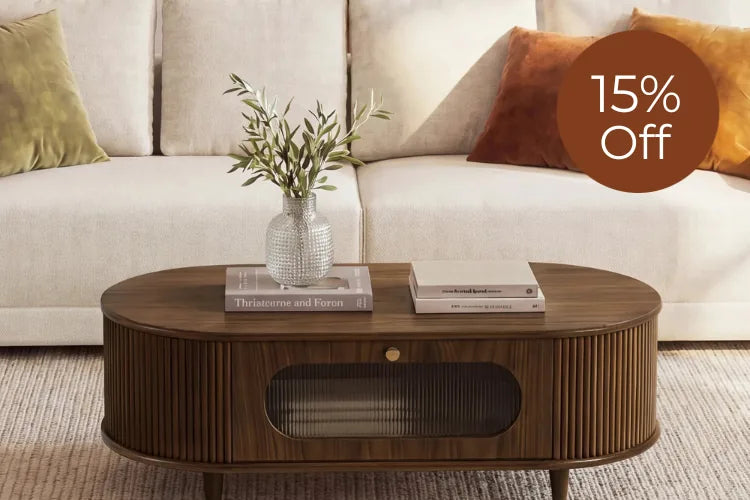
For an oval example, the oval table example lists a 51.2-inch width, 27.56-inch depth, and 15.75-inch height, with a Napoleon Ceramic and MDF tabletop and a metal base. Those are product facts, not proof of fit. Compare the full dimensions with your taped zone, sofa, and walking path before treating the Natalie as a match.
Measure the Usable Zone Before You Shop for a Coffee Table
The usable zone—not the room’s total square footage—sets the maximum footprint for a small living room table. Establish that boundary on the floor, compare the listed height with your sofa seat, and include delivery access before choosing a finish or feature.
- Map the open zone. Mark the area between the sofa, chairs, media furniture, entry points, and regular passageways, including routes used to sit down, reach the media unit, open a nearby door, or move between rooms.
- Record the sofa-seat height. Measure from the floor to the top of the cushion and compare it with the listed table height as a comfort and proportion check for how you sit and reach—not as a universal rule. For additional context after taking your own measurement, check the height guide.
- Create a full-size template. Mark the listed length and width with painter’s tape, cardboard, or paper, then extend it to the widest points of the legs, rounded ends, drawer pulls, lift mechanisms, or nesting pieces.
- Test every use position. Sit on each seat, walk the regular route, reach for the surface, and simulate the intended activity. If drawers open, a top lifts, or pieces separate, mark those positions and test them too.
- Measure the delivery path. Check the building entrance, apartment or condo door, elevator, stairwell, hallway turns, and the room’s final doorway. Compare them with package dimensions when supplied, not just with the assembled top, and record assembly requirements and delivery method before checkout.

If the template blocks a regular route or the table works only when a feature remains closed, reduce the footprint or return to a different format. That measured boundary is more useful than applying a fixed small-room size to every layout.
Decide Whether Storage or Multiple Functions Earn the Footprint
Storage or multifunctionality earns its space only when it replaces a repeated need and both the closed and active configurations fit within the tested living-room zone. A feature is not automatically space-saving simply because it adds drawers, a lift mechanism, or a second arrangement.
Use Concealed Storage for Everyday Clutter
Choose concealed storage when remotes, books, chargers, or other daily items need a dedicated home and the piece can replace another storage surface. Compare the closed footprint with drawer-opening space, reach, visual weight, and the circulation path. Background storage buying guidance can help frame this tradeoff, but it does not establish fit for a specific product.
The Glenn has two drawers and listed dimensions of 31.50 inches wide by 31.50 inches deep by 13.00 inches high. It arrives fully assembled. You can inspect this dual-drawer storage table, then compare those dimensions and the drawer access with your template.
The Vanessa is another option with two concealed drawers, rounded edges, and listed dimensions of 35.43 inches wide by 35.43 inches deep by 12.99 inches high. It also arrives fully assembled. Inspect this round storage table only after measuring its widest points. Its product name and shape do not establish compatibility with your room.
Choose Multifunctional Features for a Repeated Activity
Consider a lift-top or comparable feature when the room regularly supports laptop work, casual dining, or another activity that would otherwise require a separate surface. Test the opened position with the sofa occupied, including reach, knee room, and the route around the piece. If the activity is occasional and the active footprint creates a pinch point, a simpler table may serve the room better.
For ideas rather than product proof, you can compare smart storage ideas or explore lift-top use cases. These links do not establish that a particular current CHITA product has a lift-top mechanism.
Verify the Coffee Table Before You Add It to Your Cart
Before ordering a table for a compact living room, verify the physical fit, active use, current product documentation, delivery access, and post-purchase terms—in that order. Buy only when every applicable check passes; if one essential check fails, reconsider the format or size.
- Physical fit: Confirm the listed length, width, and height against the floor template. Check the widest points, base dimensions, storage dimensions, and the space occupied by nesting pieces or other projecting parts.
- Active-use fit: Mark drawer openings, lift positions, separated nesting layouts, reach zones, and knee room. Walk the regular route while each feature is open or fully arranged.
- Product facts: Confirm the tabletop material, finish, construction, care instructions, assembly requirements, stated weight capacity, and any product-specific stability or safety information on the current product page. Do not infer construction or performance from a photograph.
- Access and delivery: Check package count and dimensions, delivery method, building entry, doors, elevators, stairs, and turns. Delivery terms can differ by item and destination.
- Returns and warranty: Read the current return window, cancellation timing, damage-reporting or restocking rules, and warranty terms before checkout. Do not assume that one table’s policy applies to another.
Package and assembly details vary by table: Natalie is listed as a two-package item, while Glenn and Vanessa are fully assembled and listed as one-package items. Review the exact product page for the selected table’s current specifications and terms. A published product roundup may help you form questions, but it is not product-page evidence for a specific table’s dimensions or policies.
Use the measured format and footprint to browse current table options. The collection is only a starting point. Open the exact product page, verify its dimensions, active-use clearance, access, delivery, return, and warranty terms, and add it to your cart only when those checks pass.
Frequently Asked Questions
These answers address common fit and use questions that can affect the final layout choice.
How Much Room Should Be Between a Table and the Sofa?
There is no single gap that fits every room. Sofa depth, table footprint, seating arrangement, and the walking route all affect the usable spacing. Tape the proposed piece and test sitting, reaching, and walking before ordering; keep the placement only when the regular route remains comfortable.
What Size Works Best in a Small Living Room?
The best size is the largest measured footprint that works with the sofa, other seating, widest points, active features, and circulation path. Room shape and furniture placement matter more than a fixed small-room size. Mark the candidate dimensions on the floor and reduce them if the template interrupts a regular route.
Is a Round or Oval Table Better for a Tight Living Room?
Round or oval may be a better choice when corners interrupt movement around the seating area. Measure the widest points and full footprint first, because a curved top does not guarantee a smaller piece. Choose the shape that preserves your actual route after the template test.
Are Nesting or Multifunctional Tables Worth It in a Small Living Room?
Nesting tables suit changing surface needs, while storage or lift-top features suit repeated utility. Either is worth considering only when the separated or active configuration fits and the feature replaces a need you regularly have. Test every configuration before buying.
Recommended Products

More to Read
 7 Sofa Trends That Actually Improve Comfort in 2026
Upgrade your living room with furniture that supports your body. Here are 7 modern sofa features designed to maximize your daily comfort...
7 Sofa Trends That Actually Improve Comfort in 2026
Upgrade your living room with furniture that supports your body. Here are 7 modern sofa features designed to maximize your daily comfort...
 Mother's Day Gift Guide: Cozy and Stylish Furniture Picks for Modern Moms
Make Mother's Day more meaningful with furniture gifts that bring comfort, smart features, storage, and quiet luxury into her everyday routine.
Mother's Day Gift Guide: Cozy and Stylish Furniture Picks for Modern Moms
Make Mother's Day more meaningful with furniture gifts that bring comfort, smart features, storage, and quiet luxury into her everyday routine.
 Performance Fabric Reality Check: Does It Really Repel Pet Hair and Stains?
Performance fabric is often marketed as a miracle solution for homes with pets and kids, but the reality is more nuanced. It...
Performance Fabric Reality Check: Does It Really Repel Pet Hair and Stains?
Performance fabric is often marketed as a miracle solution for homes with pets and kids, but the reality is more nuanced. It...