




















Family Board Games Layout Ideas with coffee tables

Start by centering the coffee table within the main seating group, with its usable play surface facing the largest span of seats. Then test the arrangement from every planned player position, keeping the route to the room’s main entry, adjoining space, and frequently used furniture clear. This default works only when players can reach the board, cards, and pieces without leaning across one another or blocking normal movement.

For a practical family board-game room layout, judge the usable tabletop separately from the table’s outer footprint. A complete setup may include a board, player areas, cards, pieces, snacks, and drinks, while the room still needs workable clearance around the furniture. Painter’s tape, the furnished room, and your largest expected game provide a better starting test than a universal table size or clearance number.
Start With a Reachable Coffee Table Layout
A central table creates a shared play surface when the seating faces it, but the room’s traffic pattern is the deciding factor. Center the table within the main seating group, orient the play area toward the largest seating span, and sit in every planned position before committing to the arrangement. General living-room arrangement guidance supports starting with the seating group, but it does not establish a universal clearance rule.
Check sightlines and reach from the sofa, chairs, or floor-level seats your family will actually use. If one player must lean across another person, reach around a corner, or cross the game zone to enter the room, change the table position or seating orientation. Keep components away from passing feet, and avoid placing them where a drawer or other moving feature would need to operate through the play area.

Treat the table’s listed outside dimensions as the footprint it occupies, not as proof of the usable game surface. Edges, curved contours, drawer fronts, and other construction details can affect where a board or player area can sit. Use the actual tabletop and the largest complete setup as the inputs for the play zone.
Choose a Board-Game Layout for Your Room and Group
Choose the arrangement based on traffic and player access, not the room label alone. The three options below are room-dependent fits rather than a ranking; each gives up some convenience to protect another part of the living space.
| Room condition | Best-fit arrangement | Main tradeoff |
|---|---|---|
| Small living room | One protected route with a compact, reachable play surface | Less space for snacks, player dashboards, or multiple games |
| Open-plan family room | Defined social anchor | Supplies must stay contained within the living zone |
| Larger group | Access from multiple sides of the table | A broader footprint can make the far edge harder to reach |
For Small Living Rooms: Keep One Protected Route Open
Use the smallest tested table that accommodates the largest expected game setup while arranging the seating around one direct route. Keep the play surface close enough for the main seats, but do not let chairs, table corners, or game boxes turn the route into a bottleneck.
The tradeoff is accessory space. Snacks, extra cards, and player dashboards may not fit comfortably on the table, so place only what the game needs in the play zone. Keep extras on a nearby surface that does not extend into the route.
For Open-Plan Rooms: Make the Surface the Social Anchor
Arrange the seating around the table so the game defines the living zone without placing the play area in a through-route between the living, kitchen, and dining areas. This creates a clear living room game-night setup while preserving the room’s multiple traffic directions.
The tradeoff is visible clutter. Keep the game box, snacks, drinks, and extra chairs within the social zone instead of allowing them to spread into adjoining areas. If the setup regularly expands beyond the table, the layout needs more containment or a different surface arrangement.
For Larger Groups: Give Players Access From Multiple Sides
Use a broad, tested surface that players can view and reach from more than one side without trapping seats. This can support a larger game footprint, but the far edge still needs a real reach test from every planned seat.
The tradeoff is that a larger central footprint may reduce movement or make the middle of the board harder to reach. Do not infer player capacity from the table’s shape or advertised dimensions. Place the complete game on the proposed surface and test the far edge before buying.
Match Coffee Table Shape and Features to the Game
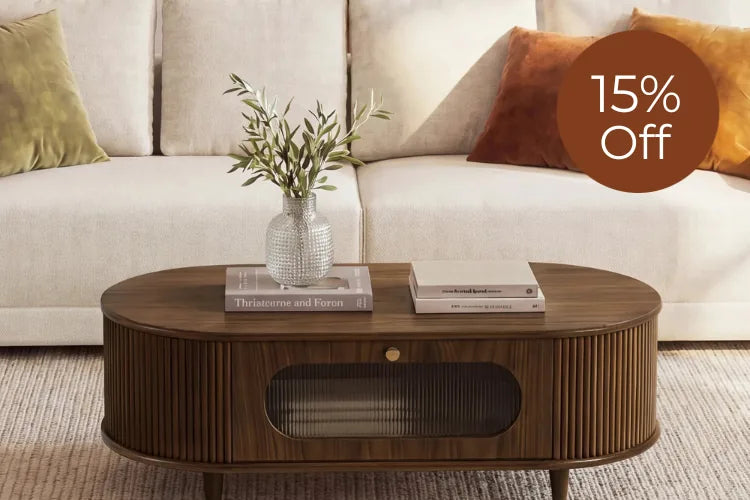
Choose the shape based on seating direction, player access, game geometry, and how people enter and leave the room. Then compare the largest complete setup with the usable tabletop area, not just the advertised outer dimensions. For a longer session, also verify height, reach, edge profile, stability information, cleanability or care instructions, and storage access on the current product page. Shape-selection guidance from Emily Henderson offers useful comparison vocabulary, but it remains a bounded heuristic rather than a fit guarantee.
- Choose rectangular for sofa-facing play or longer boards. Its directional surface can align with a sofa and give a long game setup a clear orientation. Check whether the corners narrow the passage or interfere with entry and exit.
- Choose round for multidirectional gathering. A round top can suit players approaching from several sides and avoids projecting corners into the route. Check the curved usable area and each player’s space rather than assuming the full diameter is available for play.
- Choose square when four-side access fits the room. A square footprint can give each side a clear orientation for a central game. Test the corners against walking routes and confirm that the table does not crowd the seating.
- Separate usable surface from outer footprint. Measure the largest board-game setup, including cards, pieces, player areas, snacks, and drinks. A table can fit the room while still leaving too little practical play area.
- Treat storage as a conditional convenience. For lift-top organization, verify that the specific product actually has a lift-top, then check the mechanism, raised height, operating clearance, compartment size, and access with players seated. A drawer can help contain supplies, but its access may conflict with chairs or game pieces.
- Check long-session details without guessing from appearance. Materials, rounded edges, storage, or a product name do not by themselves prove game-use durability, stability, cleanability, or safety outcomes. Use only the construction, care, edge, and stability information explicitly listed for the table you are considering.
Shortlist CHITA Coffee Tables After Choosing the Layout
Start with the measured room, seating arrangement, and largest game footprint, then use the product pages as shopping paths. The listed outer dimensions and features below support a shape or organization preference, but they do not establish usable game area, player capacity, lift-top operation, or game-specific performance.
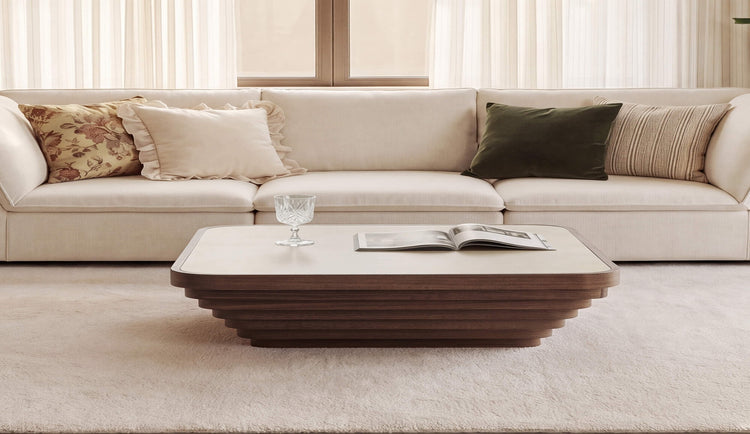
For a rectangular layout, inspect the Taylor ash storage table. Its product facts list a 47.24-inch W × 23.62-inch D × 16.93-inch H overall footprint, a concealed soft-close drawer, rounded corners, and solid ash wood legs. These details make it a rectangular option to compare with the measured layout, not a standalone fit decision.
For a square or organic-footprint preference, inspect the Lamont flower-shaped table. The product facts list a 39.4-inch W × 39.4-inch D × 12.6-inch H overall dimension, concealed drawer storage, and curved edges. These listed features describe the product option, while the room test determines whether its footprint and usable surface work for the planned setup.
For a round layout, inspect the Vanessa round table. Its product facts list a 35.43-inch round footprint, dual concealed drawers, rounded edges, and a listed 220-pound weight capacity. That capacity is a product-listed specification, not a board-game or player-capacity claim.
Measure, Test, and Choose the Coffee Table
Use one furnished-room test before adding a table to your cart. Sofa length and room circulation can serve as starting inputs, but they are not a universal ratio or standard for board-game layouts. The actual taped footprint and complete game setup determine whether the arrangement works. A coffee table size guide may offer a starting heuristic, but the room test remains decisive.
- Tape the proposed outer footprint. Mark the table’s listed width, depth, or round diameter on the floor with painter’s tape while furniture, doors, and commonly used routes remain in their normal positions.
- Lay out the largest complete game setup. Include the board, cards, pieces, player areas, snacks, and drinks your family expects to use. Record the tabletop area the setup actually needs rather than treating the outside footprint as usable play space.
- Test every planned seat. Sit where each player will sit and check reach, sightlines, knee and footroom, entry, exit, and whether anyone must cross the play zone. Test the far edge for a larger-group arrangement.
- Compare the test with current product facts. Match the taped footprint and setup against the listed outer dimensions, tabletop dimensions when supplied, height, drawer or lift-top clearances, edge details, stability information, and care instructions. Verify any lift-top feature on the specific product page instead of assuming storage means lift-top operation.
- Make the cart decision. Add the table to the cart only when the taped layout and verified product facts pass together. If either test fails, change the position, seating, shape, or size and repeat the test before buying.
Frequently Asked Questions
These quick answers address shape, sizing, room movement, and storage after you have a game setup in mind.
Is a round or rectangular table better for family board games?
Neither shape is universally better. Choose rectangular when the sofa and game face one direction; choose round when players gather from multiple sides. The best choice is the one that preserves access for the seats you will use.
How do I choose a table size for board games?
Measure the largest complete setup and compare it with the usable tabletop area. Then tape the proposed outer footprint in the furnished room. This gives you a room-specific answer without relying on a universal dimension.
How much room does a table need for board games?
There is no single clearance number that fits every furnished room. Protect the main walking route, seating access, knee and footroom, and the movement of any drawer or lift-top feature while the room is arranged for play.
Are storage or lift-top tables useful for family board games?
Storage can help contain pieces and accessories when the compartment is large enough and remains accessible. A lift-top matters only when the specific product page confirms the mechanism, usable surface, operating clearance, and raised height. A drawer alone does not imply lift-top functionality.
Recommended Products

More to Read
 7 Sofa Trends That Actually Improve Comfort in 2026
Upgrade your living room with furniture that supports your body. Here are 7 modern sofa features designed to maximize your daily comfort...
7 Sofa Trends That Actually Improve Comfort in 2026
Upgrade your living room with furniture that supports your body. Here are 7 modern sofa features designed to maximize your daily comfort...
 Mother's Day Gift Guide: Cozy and Stylish Furniture Picks for Modern Moms
Make Mother's Day more meaningful with furniture gifts that bring comfort, smart features, storage, and quiet luxury into her everyday routine.
Mother's Day Gift Guide: Cozy and Stylish Furniture Picks for Modern Moms
Make Mother's Day more meaningful with furniture gifts that bring comfort, smart features, storage, and quiet luxury into her everyday routine.
 Performance Fabric Reality Check: Does It Really Repel Pet Hair and Stains?
Performance fabric is often marketed as a miracle solution for homes with pets and kids, but the reality is more nuanced. It...
Performance Fabric Reality Check: Does It Really Repel Pet Hair and Stains?
Performance fabric is often marketed as a miracle solution for homes with pets and kids, but the reality is more nuanced. It...