























Learning how to choose an entryway console table comes down to three checks: how much depth your walking route can spare, how much storage you actually need, and whether the table's open drawers or doors still clear that space once it's installed. Start by measuring the route and any door swing, not just the wall length.
Then match the depth to your storage needs, adjust for behind-sofa placement if that applies, and confirm the exact listed dimensions before you order.
Choose the Table by the Tightest Constraint
The tightest measurement in the room, not the table's style or category, should decide whether you buy a narrow console or a deeper storage piece. If a door swing, baseboard, outlet, or nearby furniture already limits how much front-to-back space you have, that measurement controls the decision no matter how appealing a deeper piece looks in photos.
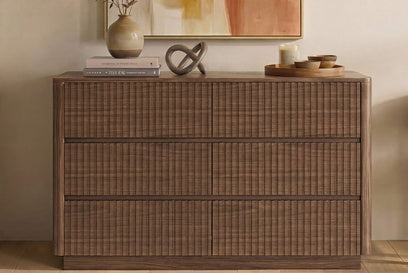
A narrow console preserves more of a constrained route, but it usually holds less enclosed storage. A deeper format, similar in spirit to a deeper storage sideboard, is worth considering only when the space in front of it still leaves the route clear after its doors or drawers are open. Both the closed footprint and the open footprint belong in this decision. A piece that slides into place when closed can still block a doorway or narrow a hallway the moment a drawer comes out, so treat that opened state as part of the real footprint rather than an afterthought you'll deal with later.
Measure the Entryway Before You Shop
Measure the actual usable span next to the wall or sofa, then map everything nearby that could eat into it: door swings, baseboards, outlets, vents, and the edges of other furniture. The U.S. Access Board's clear floor space and door-swing guidance explains that a door can swing into open floor space, and that locating the swing outside a required clearance is generally advisable. That guidance is written for accessible design, not residential furniture, but the underlying logic still applies here: a door's swing arc is part of the space a console has to share, not a separate problem.
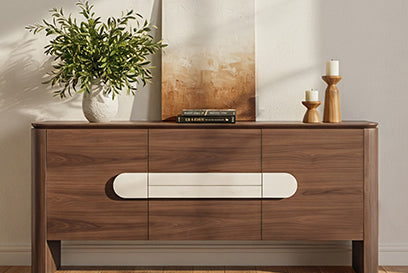
Walk the route yourself and note the single narrowest point, since that pinch point controls fit even if the rest of the hallway is wider. If you're comparing a slim console against something larger, like a multi-section curved sideboard, tape out its full footprint on the floor rather than relying on the listed width and depth alone. Painter's tape or a cut piece of cardboard lets you walk past the taped outline and see whether bags, strollers, or a second person can still get through.

Set Depth From the Storage Job
Storage needs, not habit, should set your maximum depth. A slim surface suits light daily use, drawers add quick-access containment, open shelves trade concealment for easy reach, and cabinets or mixed storage hold the most but need the most operating space in front of them.
| Storage format | Best fit for daily items | Space and access consequence |
|---|---|---|
| Slim surface | Keys, mail, small trays | Minimal footprint; little concealed storage |
| Drawers | Chargers, gloves, small clutter | Needs drawer-pull clearance in front |
| Open shelves | Baskets, shoes, bags | Easy access; items stay visible |
| Cabinets or mixed storage | Bulkier or larger items | Needs door-swing space; more enclosed volume |
Separate the tabletop's drop-zone capacity from a cabinet's enclosed capacity, since they solve different problems. A console with more advertised drawers isn't automatically more useful if the interior dimensions are shallow, so check the actual usable interior space rather than the drawer count alone. A larger cabinet-style piece, in the range of a large-capacity console, only makes sense in an entryway when the measured footprint already accounts for its door or drawer travel. Choose the format that solves your actual item problem instead of defaulting to extra depth because it looks more substantial.
Adjust the Choice for Behind-Sofa Placement
Behind a sofa, measure the sofa and the console together, not the table alone. The combined projection into the room, plus the route on the room side of the sofa, is what actually controls whether the space still works.
Favor the shallower table when the room-side passage is already tight, since a deeper piece adds a second obstruction behind furniture that's already taking up floor space. A deeper format only makes sense when the room-side route stays open and the drawers or doors can be reached without dragging the sofa forward. Check that the console lines up with the sofa's length as well, so it doesn't create an extra corner someone can catch a hip or a bag on while walking past.
Verify the Listing's Closed and Open Dimensions
Before you add a console to your cart, confirm these details against the current product listing or manual rather than a photo or category label:
- Overall width, depth, and height match your measured fit envelope.
- Operating dimensions cover how far a drawer pulls out or a door swings open.
- Component dimensions, such as shelf or drawer interior size, match what you plan to store.
- Baseboard clearance confirms the piece will sit flush against your specific wall trim.
- Any wall-fixing instructions are compatible with your wall type and installation plans.
- Delivery-route dimensions confirm the boxed or assembled piece can reach the entryway.
- All of the above line up with the taped-out fit envelope from your own measurements.
Exact width, depth, height, opening travel, baseboard accommodation, and fixing details vary by product, so treat any specification you haven't confirmed on the actual listing as unresolved rather than assumed.
Build a Drop Zone That Keeps the Route Clear
Reserve the most reachable part of the tabletop for the two or three items you use every day, like keys, mail, or a phone tray, and route everything else into the drawers, shelves, or cabinets you chose for that purpose. Contained storage handles overflow better than a wider tabletop does, since a crowded surface pushes bags and shoes toward the floor and into the walking path.
Keep loose shoes, bags, and cords in one defined spot that doesn't creep into the route, and recheck that arrangement once you've actually opened a drawer or cabinet door with items already in front of it. A drop zone that works on day one can still fail once the console fills up, so it's worth a quick walk-through after the first week of real use. Before adding a table to your cart, compare its confirmed closed and open dimensions one more time against the fit envelope you measured, and only order once both pass.

FAQs
Does a console table's listed depth include its open drawers or doors?
No. Listed overall dimensions describe the closed footprint only. Add the drawer pull-out distance or door swing to that number to see the full operating footprint you need to keep clear.
What if I can't confirm baseboard clearance before ordering?
If the listing doesn't specify baseboard accommodation, measure your baseboard's height and projection and compare it to the table's back-leg or base design, or contact the seller directly rather than guessing. Ordering without that confirmation risks a gap at the wall or a piece that won't sit flush.
How do I know if I need drawers instead of open shelves?
Choose drawers when you want small items contained and out of sight, and open shelves when quick, visible access matters more than tidiness. Either way, confirm the interior dimensions fit what you actually plan to store before committing to depth.
Is a deeper console table always better for storage?
No. A deeper table only helps if the extra footprint, plus its door or drawer travel, still leaves your measured route clear. In a tight hallway, a shallower table with well-organized drawers often serves daily use better than a deeper piece that crowds the path.
Recommended Products

More to Read
 7 Sofa Trends That Actually Improve Comfort in 2026
Upgrade your living room with furniture that supports your body. Here are 7 modern sofa features designed to maximize your daily comfort...
7 Sofa Trends That Actually Improve Comfort in 2026
Upgrade your living room with furniture that supports your body. Here are 7 modern sofa features designed to maximize your daily comfort...
 Mother's Day Gift Guide: Cozy and Stylish Furniture Picks for Modern Moms
Make Mother's Day more meaningful with furniture gifts that bring comfort, smart features, storage, and quiet luxury into her everyday routine.
Mother's Day Gift Guide: Cozy and Stylish Furniture Picks for Modern Moms
Make Mother's Day more meaningful with furniture gifts that bring comfort, smart features, storage, and quiet luxury into her everyday routine.
 Performance Fabric Reality Check: Does It Really Repel Pet Hair and Stains?
Performance fabric is often marketed as a miracle solution for homes with pets and kids, but the reality is more nuanced. It...
Performance Fabric Reality Check: Does It Really Repel Pet Hair and Stains?
Performance fabric is often marketed as a miracle solution for homes with pets and kids, but the reality is more nuanced. It...