
















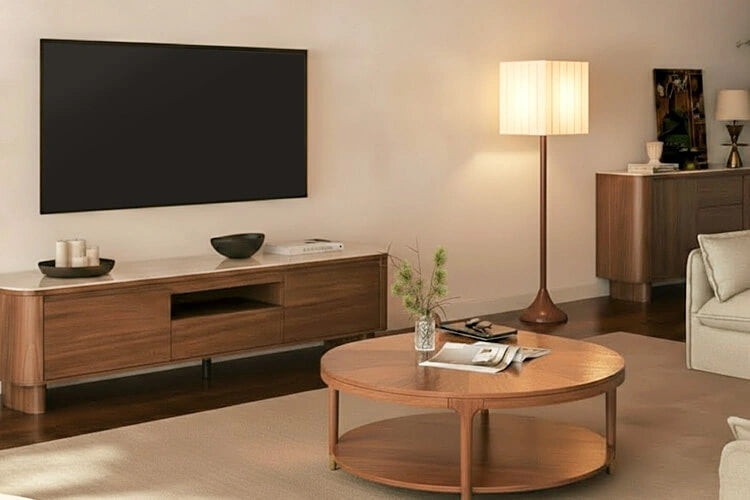


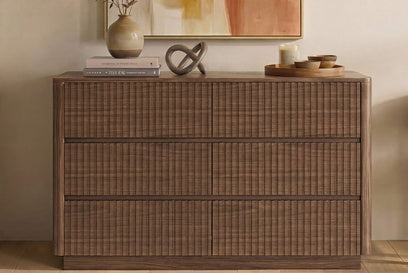
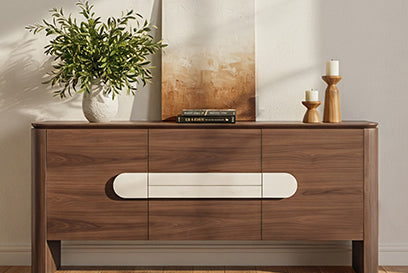








Choosing a sideboard buffet comes down to three checks: does it fit the measured wall and traffic path, does its interior match what you actually store, and does its height and finish read right against your dining room. Start with the tape measure, not the catalog. Once the footprint and storage layout are settled, styling the top and wall is the easy part.
Key Takeaways
- Measure the wall, depth, height, and circulation path before comparing any listing's overall dimensions.
- Match closed doors, drawers, shelves, or glass-front sections to the items you actually store, not to the cabinet's label.
- Treat material names and marketing adjectives as descriptions, not proof of durability or craftsmanship.
- Style the top with a working landing zone and let the wall echo the cabinet's height and finish rather than a fixed ratio.
- Hold an order if any single decision-changing detail, such as usable interior space or delivery access, is missing.
Set the Maximum Footprint and Visual Scale
Before you compare a single sideboard dimension chart, record what your dining room can actually take: a maximum width, depth, and height at the exact spot the cabinet will sit. That number, not a generic size guide, is your first pass or fail filter.
Record the Wall and Circulation Limits
- Measure the wall's width, the depth available before the nearest walking path, and the ceiling or artwork clearance above.
- Mark outlets, baseboards, windows, doors, and any dining chairs or tables that need to stay usable when the cabinet's doors or drawers are open.
- Write down the result as your maximum footprint, and use it to screen every sideboard buffet listing before you look at style.
Judge Visual Scale from More Than Width
Width alone will not tell you how a piece feels in the room. A tall, dark-framed cabinet with solid doors can visually dominate a wall even at a narrower width than a lower piece with open shelving or glass fronts. Before ordering, tape off the footprint on the floor, or mark its height on the wall, so you can see how the actual proportions sit next to your table and windows. This quick check catches a mismatch that a spec sheet alone will not show.
Match the Storage Layout to What You Keep
The right storage layout depends on what you are hiding, what you want visible, and how tall your tallest serving pieces are, not on whether a listing is labeled a sideboard, buffet, or credenza. Start by sorting your dining items into what should stay out of sight and what earns display space.
Closed Doors and Drawers for Concealed Organization
Solid doors work well for tablecloths, extra flatware, and serving pieces you do not want on display. Drawers, when a cabinet includes them, are the better fit for linens, utensils, and smaller accessories that get lost behind a deep door. Before assuming a cabinet holds everything you own, check its actual opening size and interior dimensions; a wide sideboard or credenza can still have a shallower usable interior than its outside footprint suggests.

Shelves for Dinnerware and Serving Pieces
Adjustable shelving lets you rearrange the interior as your dinnerware collection changes, which matters if plate stacks, platters, or glassware vary in height. Removable shelves matter even more when one tall serving piece, like a punch bowl or vase, needs a clear compartment. Choose this layout based on the items you are actually storing rather than the name printed on the listing.
Glass-Front or Open Display Storage
Open or glass-front sections make sense when your dinnerware or serving pieces are attractive enough to leave visible, and when you are willing to keep that interior edited rather than cluttered. A glass-front display cabinet can carry more visual weight than a closed piece of the same size, especially with a dark frame, so weigh the finish along with the storage format. For a broad glass-front example, our Ethan display sideboard measures 70.87 inches wide by 17.72 inches deep by 33.46 inches high, with four tempered-glass doors, magnetic closures, and two rear cord cutouts for media or lighting wires. If you want a lower, fully closed profile instead, our Moore rounded sideboard measures 70.67 by 17.52 by 31.3 inches and uses a three-door layout with three-level adjustable, removable shelving and anti-tip hardware. Neither is a universal winner; each fits a different storage routine.
Use Finish and Construction Details as Buying Evidence
Material names and marketing language describe a product; they do not prove it will hold up over years of use. Verify the exact details on the listing instead of assuming a finish or certification guarantees performance.
- Separate the material list from a performance claim. Terms like solid wood, MDF, veneer, FSC-certified, or powder-coated metal describe construction, not a durability score, unless the listing defines that further.
- Match care instructions to the stated finish and material; do not invent a cleaning method because a cabinet is described as wood or metal.
- Check hardware type, assembly status, warranty length, delivery service level, and the return window, since these affect whether the piece is a good purchase even after it fits your wall.
- If a listing uses words like durable, eco-friendly, or crafted without describing the actual construction, treat that as an open question and ask for the missing detail, or compare a listing that documents it.
Style the Sideboard Without Overloading the Wall
Once the cabinet fits your wall and holds what you need, styling comes down to keeping the top functional and letting the wall echo the piece instead of competing with it.
Keep the Top Useful
Reserve part of the surface as a working landing zone for serving dishes, mail, or keys, rather than covering the entire top with decor. Group a small number of objects by height and material instead of scattering many small pieces across the surface. If the cabinet has glass or open shelving, keep the visible interior just as edited as the top.
Balance the Wall and Cabinet Together
Look at the cabinet's height and density before deciding what goes above it. One primary focal piece, like a mirror or a single large frame, paired with a small supporting group usually reads better than several competing pieces, though there is no fixed size ratio that works in every room. Repeating one finish or color from elsewhere in the dining room helps tie the cabinet into the space. A tall, dark, or heavily closed cabinet generally benefits from a lighter, simpler wall treatment, while an open or light-finished piece can carry a bit more visual activity above it without feeling crowded.
Make the Shortlist Pass a Final Purchase Check
Run every shortlisted cabinet through a four-part verification before placing your order. Clear every check on dimensions, internal organization, verified materials, and delivery conditions before you buy, and pause if any key detail is missing.
- Confirm the footprint pass: the overall listed width, depth, and height fit your measured wall, and the doors or drawers open fully in that spot.
- Confirm the storage pass: the interior layout, whether closed, shelved, or display-front, matches the dining items you actually plan to store.
- Confirm the visual and evidence pass: the height, frame, and finish suit the wall, and the listing's material, care, and construction details are documented rather than vague.
- Confirm the logistics pass: delivery access, assembly status, warranty length, and the return window work for your home before you place the order.
Order when all four checks pass. Hold the order if one decision-changing detail, such as usable interior space, care instructions, or delivery access, is missing or contradictory, and go back to the listing or ask before buying. Replace the candidate entirely if the storage format forces a routine you do not want or the visual weight overwhelms the wall once tested. Readers who want more options at this stage can compare additional layouts in our sideboard storage collection before finalizing a shortlist. For a closer look at how sideboard, buffet, and credenza labels differ before you shop, see our sideboard vs. buffet guide.

FAQs
Are a sideboard and a buffet cabinet the same thing?
Furniture listings often use sideboard, buffet, server, credenza, and cabinet somewhat interchangeably, and buffet-style pieces are commonly used for serving in a dining room. Rather than relying on the name, compare the listed dimensions and internal layout directly, since two pieces with different labels can share nearly identical storage.
What should I compare when two sideboards have similar outside dimensions?
Look past the outer footprint to the usable interior dimensions when they are listed, shelf adjustability or removability, how doors and drawers open, and how visible the contents will be. A cabinet that matches your wall but not your tallest platter or linen stack is still the wrong choice.
What should I verify before trusting a sideboard's material or durability claims?
Check for exact details on the body material, veneer, glass, base, hardware, finish, and care instructions, along with warranty, delivery, and return terms. Treat words like durable, eco-friendly, or crafted as unverified until the listing or an authoritative source defines what they actually mean for that piece.
Recommended Products


More to Read
 7 Sofa Trends That Actually Improve Comfort in 2026
Upgrade your living room with furniture that supports your body. Here are 7 modern sofa features designed to maximize your daily comfort...
7 Sofa Trends That Actually Improve Comfort in 2026
Upgrade your living room with furniture that supports your body. Here are 7 modern sofa features designed to maximize your daily comfort...
 Mother's Day Gift Guide: Cozy and Stylish Furniture Picks for Modern Moms
Make Mother's Day more meaningful with furniture gifts that bring comfort, smart features, storage, and quiet luxury into her everyday routine.
Mother's Day Gift Guide: Cozy and Stylish Furniture Picks for Modern Moms
Make Mother's Day more meaningful with furniture gifts that bring comfort, smart features, storage, and quiet luxury into her everyday routine.
 Performance Fabric Reality Check: Does It Really Repel Pet Hair and Stains?
Performance fabric is often marketed as a miracle solution for homes with pets and kids, but the reality is more nuanced. It...
Performance Fabric Reality Check: Does It Really Repel Pet Hair and Stains?
Performance fabric is often marketed as a miracle solution for homes with pets and kids, but the reality is more nuanced. It...