






















Start by naming the one job your ottoman must do: hide clutter, hold a drink tray, seat an extra guest, or prop up tired feet. That primary job points you toward a storage, cocktail, bench, or footrest ottoman. This ottoman buying guide treats each category as a starting point, not a guarantee, because whether a piece can also seat you comfortably or survive a coffee spill depends on the exact listing, not the category name.
If you need one ottoman to do two jobs, such as serving as both a footrest and extra seating, plan to confirm height, firmness, and stated capacity on the product page before you buy. The sections below walk through each type, the room-fit math, and the exact facts worth checking first.
Start with the job your ottoman must do
Match the category to your top priority, then treat any second job as something the specific listing has to prove. The table below shows the tradeoff and the one fact worth checking for each type.
| Primary job | Likely living-room role | Hybrid-use tradeoff | Fact to verify |
|---|---|---|---|
| Storage | Concealed spot for blankets, toys, or media clutter | Interior space is usually smaller than the exterior suggests | Interior storage dimensions and access method |
| Cocktail (tabletop) | Surface for drinks, trays, or shared snacks | A comfortable footrest surface may not double as a stable table | Top material, height, and any stated tabletop use |
| Bench | Extra seating along a sofa or in a wider seating area | Longer forms need more floor length and can block walking paths | Length, depth, and stated seating capacity |
| Footrest | Compact leg support paired with an existing chair or sofa | Smallest footprint usually means no storage or table function | Height relative to your seat and confirmed secondary use |
Pick the row that matches your main complaint about the current setup. If it is clutter, start with storage. If people keep balancing plates on their knees, start with a cocktail style. If guests run out of seats, look at a bench. If your feet are the only thing missing support, a footrest is the leaner choice. Whichever row you pick, the listing's exact numbers decide whether it can also handle a second job.
Storage ottoman: choose it when concealed organization is essential
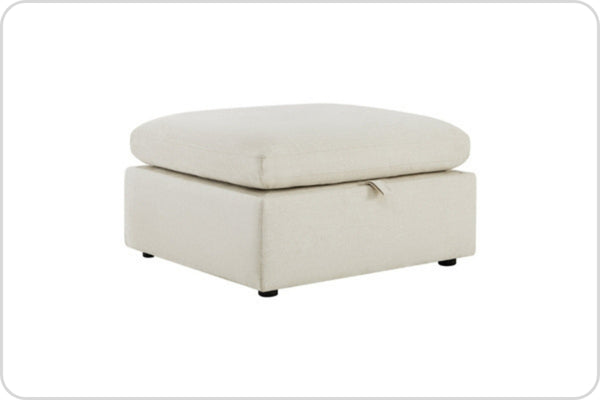
Choose a storage ottoman when hiding clutter is the main reason you are shopping, not a bonus feature. Before you commit, check how the top opens, whether that motion needs clearance where you plan to place it, and how the interior dimensions compare with what you actually want to store, since a lid's footprint is often larger than its usable interior.
Our Twin Stone-shaped Storage Modern Ottoman is a useful example of what a fully documented listing looks like. Its removable top reveals a storage compartment, and the same top flips to work as a coffee table, while a smaller companion ottoman nests inside the larger piece. The listing states a 350-pound weight capacity and a 16.1-inch height, which is the kind of detail you want confirmed before assuming any storage ottoman can also serve as a footrest or side table.
Cocktail ottoman: choose it when tabletop use leads
Choose a cocktail ottoman when a stable surface for drinks, trays, or shared snacks matters more than deep seating comfort. Look for listing language that actually describes tabletop or serving use rather than assuming it from the name, since not every cushioned top is built to hold a tray steadily.

Compare the stated height with your sofa's seat height and think about how far each seat is from the ottoman, because a piece placed too low or too far away undercuts the reason you chose it. Also check whether the top is removable, firm, or protected in some way, and treat foot comfort and table stability as two separate questions: a soft top that feels great under tired feet is not automatically a dependable serving surface.
Bench ottoman: choose it when extra seating leads
Choose a bench ottoman when you regularly run short on seats and need a longer piece that can host more than one person at a time. Start with who will actually sit there and how often, then measure the length and depth against your sofa and the walkway space around it, since a long bench changes room circulation more than a compact one does.
Look for a stated seating capacity or explicit seating use in the listing before treating the piece as a everyday seat rather than an occasional perch. A bench that looks proportional in a showroom photo can still crowd a smaller room once it sits at the foot of your actual sofa.
Footrest ottoman: choose it when leg support leads
Choose a footrest ottoman when compact leg support is the only job you need solved and you are not counting on it for storage or serving. Prioritize its relationship to the chair or sofa you already own: the height should let your legs rest without strain from that specific seat, not from a generic ideal.
Pick the smallest footprint that still does the job comfortably, since a footrest's main appeal is that it stays out of the way. If the listing does not document a secondary storage, seating, or table function, assume it does not have one rather than testing that assumption after delivery.
Check height, firmness, and sofa relationship
Height and firmness priorities change with the job. For foot support, compare the ottoman's height with your existing seat, while seating demands a construction explicitly rated for sitting. If you plan to use it as a tabletop, ensure the surface and firmness are specifically documented for serving.
Use the exact fill and height listed for the piece you are considering instead of guessing from a general description. If you are still working out how your sofa's seat height should relate to a nearby ottoman or coffee table, our guide to sofa seat height and depth walks through that measurement relationship in more detail.
Match size, shape, and clearance to the room
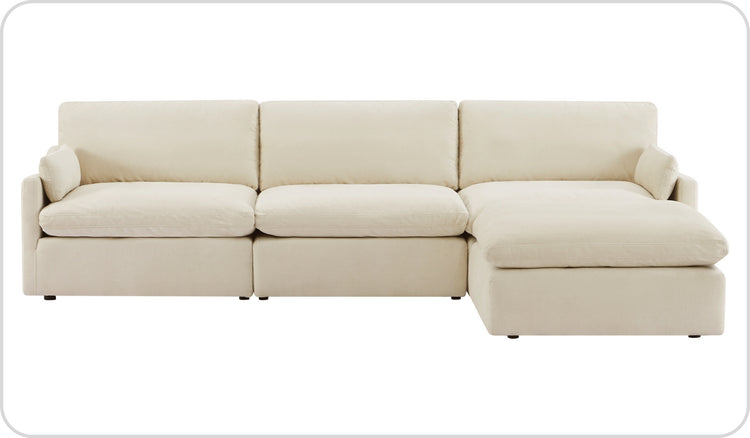
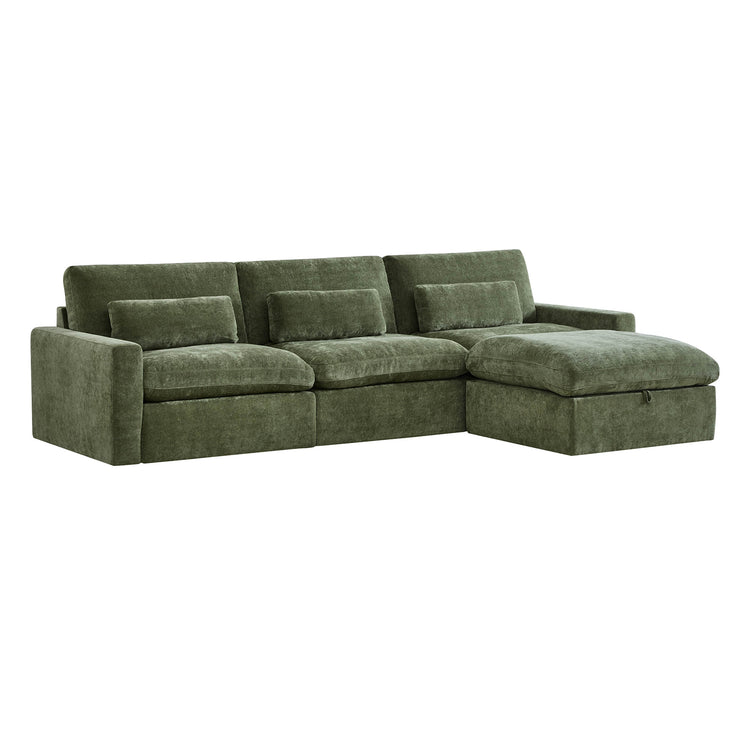
Before you shop, mark the ottoman's footprint on your actual floor with tape or boxes, then check whether people can still move through the space comfortably. Compare the ottoman's shape and position against your sofa or sectional, since a round piece and a rectangular one interact differently with an L-shaped seating layout.
If you are considering a storage or flip-top design, include the full opening path in your measurement, not just the closed footprint. Finally, compare both the assembled dimensions and the packaged shipping dimensions against your narrowest doorway or hallway turn, since a piece that fits the room can still get stuck getting into it.
Choose upholstery for the way the room is used
Match upholstery to your actual traffic pattern, not to a marketing adjective. Start with the cleaning code and material-specific care instructions on the listing, since these tell you what to do when a spill happens, and check separately whether any cover is removable and whether the listing actually calls it washable, because those are two different claims.
For a family room or a home with pets, look for care language that matches the mess you expect rather than substituting a stain-resistant claim for real mechanical wear resistance. If a listing references performance fabric more broadly, our comparison of performance fabric sofa care breaks down what that label does and does not promise for upkeep. Testing references also vary by product category, covering fabric, filling, seating frames, tables, or storage units separately, so a mention of testing is worth reading closely rather than treating as a blanket durability guarantee.
Verify the product listing before you buy
Run one verification pass before adding an ottoman to your cart, in this order:

- Dimensions and package path. Confirm assembled width, depth, and height, then check the packaged shipping dimensions against your doorway or hallway route.
- Construction and fill. Look for the frame material and cushion fill, since these affect both comfort and expected lifespan.
- Access mechanism. If storage is involved, confirm how the top opens and whether that motion needs extra clearance.
- Stated capacity or use limits. Treat a stated weight capacity or seating use as the deciding fact, not an assumption based on size.
- Upholstery care and cover details. Match the cleaning code and cover information to your actual maintenance routine.
- Testing scope, delivery, and returns. If a performance or furniture testing claim appears, note which product category and component it covers before relying on it, and confirm delivery and return terms.
Our twin stone-shaped model shows what a complete listing looks like in practice: a 31.9-inch by 31.9-inch by 16.1-inch overall size, a 350-pound weight capacity, a solid and engineered wood frame, high-resilient polyfoam with polyester fiber fill, a removable top for storage access, and separate care instructions for its polyester and faux leather options. Treat this as one documented example rather than a standard every storage ottoman meets. You can browse our ottoman collection to compare listings side by side once you know which job and dimensions you need.
Finish by holding your measured footprint and primary job next to the verified facts. If both line up, you are ready to order.
FAQs
Should I measure the space with a storage ottoman's lid open?
Yes. Mark the full swing or lift path of the lid, drawer, or flip-top on the floor, not just the closed footprint, since the operating motion often needs more clearance than the ottoman's resting size suggests.
What should I do if an ottoman listing gives a cleaning code but no washability claim?
Treat the cleaning code as care instructions only, not a washability or durability promise. Look for explicit language about removable or machine-washable covers, and check the exact test scope if performance testing is mentioned, or contact support before assuming more than the listing states.
How do I check whether an ottoman will fit through my doorway?
Compare the largest packaged shipping dimension, not just the assembled ottoman size, against your narrowest doorway or hallway turn. If the listing does not include packaged dimensions, confirm them through product support before ordering.
Recommended Products


More to Read
 7 Sofa Trends That Actually Improve Comfort in 2026
Upgrade your living room with furniture that supports your body. Here are 7 modern sofa features designed to maximize your daily comfort...
7 Sofa Trends That Actually Improve Comfort in 2026
Upgrade your living room with furniture that supports your body. Here are 7 modern sofa features designed to maximize your daily comfort...
 Mother's Day Gift Guide: Cozy and Stylish Furniture Picks for Modern Moms
Make Mother's Day more meaningful with furniture gifts that bring comfort, smart features, storage, and quiet luxury into her everyday routine.
Mother's Day Gift Guide: Cozy and Stylish Furniture Picks for Modern Moms
Make Mother's Day more meaningful with furniture gifts that bring comfort, smart features, storage, and quiet luxury into her everyday routine.
 Performance Fabric Reality Check: Does It Really Repel Pet Hair and Stains?
Performance fabric is often marketed as a miracle solution for homes with pets and kids, but the reality is more nuanced. It...
Performance Fabric Reality Check: Does It Really Repel Pet Hair and Stains?
Performance fabric is often marketed as a miracle solution for homes with pets and kids, but the reality is more nuanced. It...