
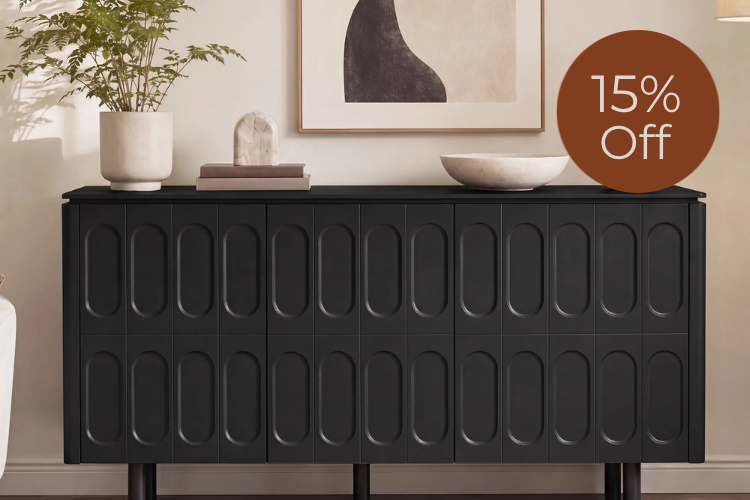













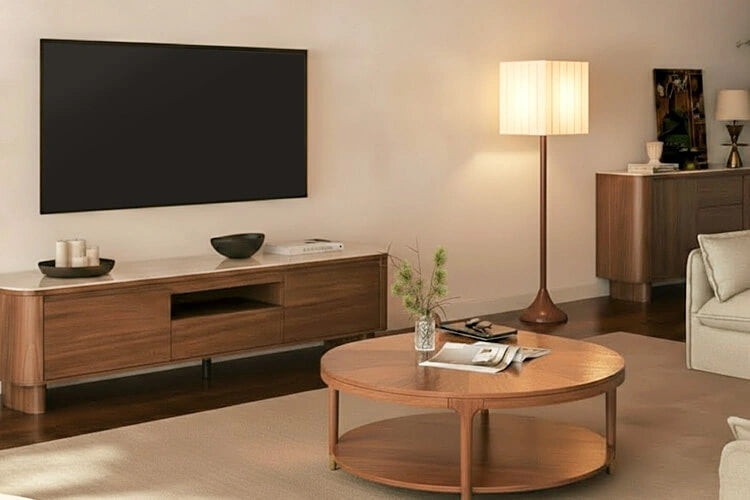


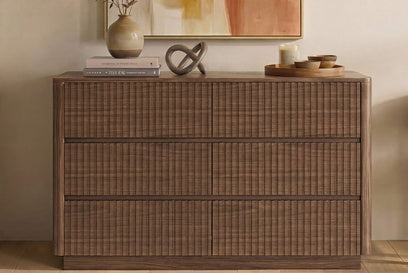
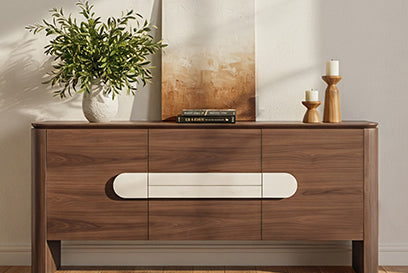







Style a sideboard top by clearing it completely, choosing one anchor with a dominant height, and layering in one or two supporting groupings that leave visible open space. This three-step formula works for a living room console, a dining buffet, or a narrow entry piece, and it scales up or down depending on the actual width and depth of your furniture. From there, rule-of-thirds spacing and a few lamp-to-anchor visual checks keep the arrangement balanced without turning it into a design project.
How to Start Styling a Sideboard Top
Every sideboard styling project starts the same way, no matter the room or the piece.
- Clear the entire surface. Existing clutter will otherwise dictate the layout instead of the furniture's actual proportions.
- Choose one anchor and give it a dominant height. A mirror, a piece of art, a tall lamp, or a large vase can all work, as long as one item clearly reads as the tallest or largest element.
- Add one or two supporting groupings with different heights than the anchor, then step back and check that open surface is still visible.
If you're starting on a wide farmhouse-style piece like our Ethan farmhouse display sideboard, a travertine-topped design such as our Blake travertine top sideboard, or a rounded buffet like our Moore rounded corner sideboard, the same three steps apply before you adjust for that surface's specific width and depth.
The Rule-of-Thirds Formula for Sideboard Decor
Use the width of your sideboard as a loose grid instead of measuring to the inch. Picture the surface split into three roughly equal sections, then place your anchor in the center third or shifted toward one outer third, and let a supporting grouping occupy the opposite section.
The remaining third should stay mostly open. This isn't a fixed rule, but leaving close to a third of the surface bare is a practical buffet styling principle that keeps a composition from feeling crowded. If your sideboard is unusually deep or shallow, adjust the proportions of each third rather than forcing an even split, since depth changes how much visual weight each section can hold.
Choose a Symmetrical or Asymmetrical Arrangement
Pick symmetry when you want centered, formal calm, and asymmetry when you want a more relaxed look or you're working with a narrower surface.

- Symmetrical pairs: Center a mirror or artwork, then flank it with two matching or visually similar lamps. This works best on a broad surface where the anchor is already centered on the wall or the furniture itself.
- Asymmetrical vignettes: Use one lamp on one side, then balance it with a grouped vignette of two or three smaller objects at varying heights on the other. This suits a narrower sideboard, an off-center anchor, or a look that feels less matched.
Both approaches still need one dominant anchor and enough negative space; symmetry just repeats the supporting elements while asymmetry varies them.
Scale Lamps With a Mirror or Artwork
Judge lamp scale by how it looks next to the anchor, not by a fixed measurement. A lamp is sized correctly when the mirror or artwork behind it is still clearly visible and reads as the dominant shape.
If the lamp's shade covers a large portion of the art or mirror, or if the lamp becomes the only thing your eye lands on, it's too large for that spot. As a flexible starting point, many balanced pairings have the lamp's total height, base to shade top, land somewhere between a third and half of the anchor's height, with a few inches of breathing room on each side so the two objects don't visually touch. Confirm the fit with a step-back test: stand at a normal viewing distance, or take a photo, and check whether the anchor and lamp both stay legible as separate shapes. If one disappears behind the other, shift the lamp, swap it for a shorter version, or move it slightly off-center from the anchor's edge.
Adapt the Formula for Narrow Sideboards and Dining Rooms
A shallow or narrow sideboard needs a more contained version of the same formula, while a dining buffet needs one that stays functional day to day.
On a shallow surface, favor a horizontal anchor over a tall one, since a tight depth makes height feel unstable rather than dramatic. Keep lamp bases and any art supports within the available depth so nothing overhangs the front edge, and choose low, compact supporting pieces instead of deep bowls or wide vases. In a dining room, protect a clear working zone near the center or one end of the buffet so plates and serving pieces have somewhere to land. Group your decor toward one side instead of spreading it across the full width, and choose pieces that are easy to shift or remove temporarily during meals or entertaining. For everyday organization behind the styled surface, it also helps to use smart sideboard storage strategies for platters, linens, and stemware inside the cabinet so the decor on top doesn't have to compete with items pulled out for serving.
Make the Vignette Feel Finished, Not Cluttered
A vignette feels finished when you can name each item's job: anchor, height contrast, and negative space. If it feels off, one specific adjustment usually fixes it.
If the surface looks busy, remove the smallest or least distinct object first rather than rearranging everything. If it looks undersized or disconnected from the furniture, group two or three small pieces together into one denser cluster instead of scattering them, which reads as a single stronger shape. If the top feels heavy on one side, lower the tallest item slightly, swap in something shorter, or add a low, wider piece on the opposite side to anchor the composition. Recheck the open third of the surface after each change. If it has disappeared, you've likely added rather than edited.
Common Sideboard Styling Mistakes and the Fix for Each
Most sideboard styling problems trace back to one of three patterns, each with a specific fix rather than a full restart.
| Mistake | Fix |
|---|---|
| Arrangement looks too small | Increase the anchor's scale or group smaller pieces into one denser cluster |
| Arrangement looks too busy | Remove the least distinct item and consolidate remaining pieces into fewer groupings |
| Arrangement looks top-heavy | Lower or shorten the tallest piece, or add a low, wide counterweight opposite it |
Working through this table after your first pass usually resolves the issue without requiring you to clear the surface and start over.
FAQs
Can I style a sideboard without a mirror or artwork above it?
Yes. Use one tall object, such as a floor-height lamp, a tall vase, or a stack of decorative books topped with an object, as your vertical anchor instead of wall art. Balance it with a lower, wider grouping on the opposite side so the composition still reads as a visual pair rather than one tall item floating alone. Keep the same open-space check: if the surface-only arrangement leaves no visible bare space, remove or consolidate a piece until it does.
How high should artwork or a mirror hang above a sideboard?
Hang wall art or a mirror so the bottom edge sits roughly 4 to 8 inches above the top of the sideboard. This keeps the anchor visually connected to the furniture without crowding tabletop lamps or taller decorative accents placed directly beneath it.
Should I use one lamp or a pair of lamps on a sideboard?
Choose a matching pair if you prefer a formal, symmetrical look on a wider sideboard where the center anchor is fixed. Use a single lamp when you want a relaxed asymmetrical vignette, have an off-center wall anchor, or need to preserve open surface space on a narrower piece.
Recommended Products

More to Read
 7 Sofa Trends That Actually Improve Comfort in 2026
Upgrade your living room with furniture that supports your body. Here are 7 modern sofa features designed to maximize your daily comfort...
7 Sofa Trends That Actually Improve Comfort in 2026
Upgrade your living room with furniture that supports your body. Here are 7 modern sofa features designed to maximize your daily comfort...
 Mother's Day Gift Guide: Cozy and Stylish Furniture Picks for Modern Moms
Make Mother's Day more meaningful with furniture gifts that bring comfort, smart features, storage, and quiet luxury into her everyday routine.
Mother's Day Gift Guide: Cozy and Stylish Furniture Picks for Modern Moms
Make Mother's Day more meaningful with furniture gifts that bring comfort, smart features, storage, and quiet luxury into her everyday routine.
 Performance Fabric Reality Check: Does It Really Repel Pet Hair and Stains?
Performance fabric is often marketed as a miracle solution for homes with pets and kids, but the reality is more nuanced. It...
Performance Fabric Reality Check: Does It Really Repel Pet Hair and Stains?
Performance fabric is often marketed as a miracle solution for homes with pets and kids, but the reality is more nuanced. It...