













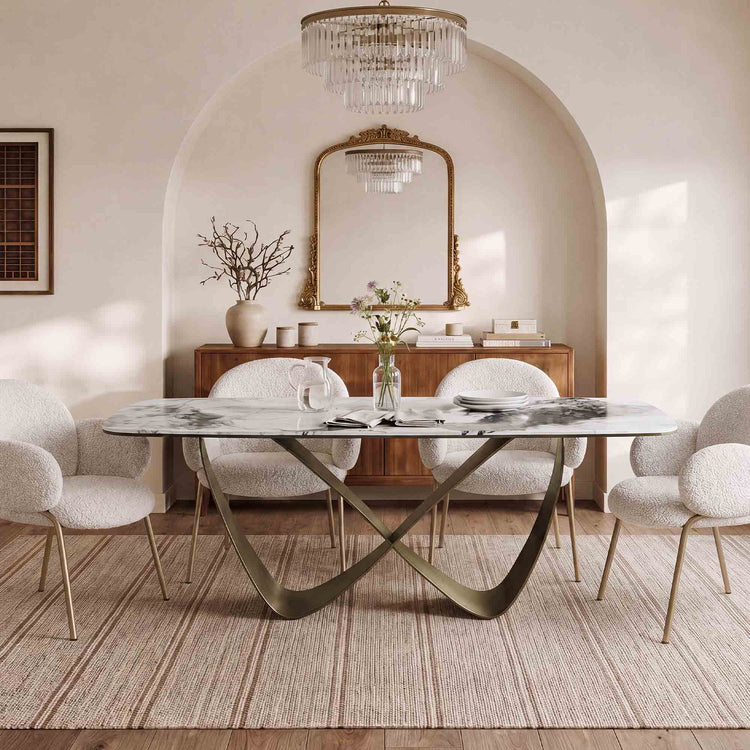
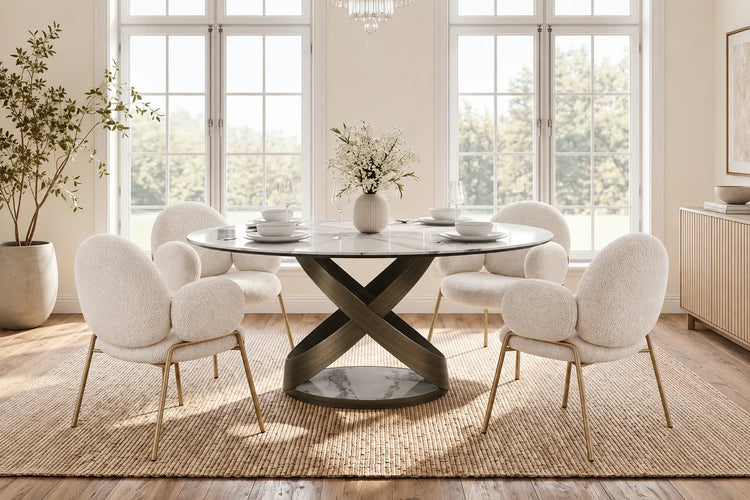









An oval dining table is the better choice for a narrow room when the tightest bottleneck is a square-corner turn at one end of the table, and a rectangular table stays the better choice when the room favors a straight footprint with no end-traffic problem. A curved end can soften that turn, but it does not shrink the space a chair needs once it is pulled out.
Before comparing shapes, measure the narrowest usable width in the room and note where people actually walk past the table. That single number, more than the tabletop shape, decides whether an oval dining table earns its keep here.
Oval vs. Rectangular Tables: Which Fits a Narrow Dining Room?
Choose the oval when the room's tightest point is an end turn and the full chair-and-walkway zone still clears; choose the rectangle when the room is straight-sided and end traffic isn't the limiting factor. Neither shape shrinks the space chairs and circulation actually need, so compare the whole zone, not just the tabletop outline.
| Decision axis | Oval table | Rectangular table | Choice condition |
|---|---|---|---|
| End-corner geometry | Curved end, no sharp corner | Square corners at both ends | Pick oval if the end turn is the tightest point |
| Chair-and-circulation zone | Same total footprint once chairs are added | Same total footprint, corners included | Tape the zone either way before deciding |
| Seating perimeter | Continuous curve; spacing shifts near the ends | Fixed straight edges; even spacing | Pick rectangle for predictable seat math |
| Main tradeoff | Smoother approach, less predictable end capacity | Predictable capacity, sharper corners | Match the shape to your traffic pattern |
If your room's problem is a person squeezing past an occupied end seat, the oval's curve is worth the trade. If the room is a clean rectangle with no end traffic at all, a rectangular table gives you a simpler, more predictable layout with the same seating math. For a broader side-by-side on shape and everyday use, our round vs rectangular tables comparison covers other room types beyond narrow spaces.
How to Plan Six or Eight Place Settings on an Oval Table
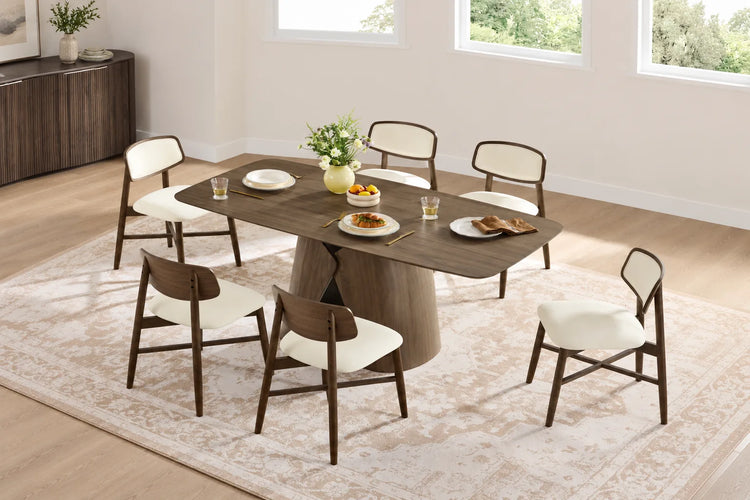
Six place settings are workable once six marked chair positions and their pulled-out zones stay clear of walls and traffic; eight is a conditional maximum that needs two more verified end or extension positions passing the same test. Start with the number you actually need for everyday meals, then treat any larger holiday count as a separate check.

A common layout reference calls for roughly 24 to 30 inches of table edge per place setting, with sitting and circulation zones marked separately from each other. Use that range only to sketch your first draft of chair positions on paper or tape; it is a starting point for dining room clearances, not a fixed seat count tied to any specific oval table.
Curved end positions deserve extra scrutiny. The taper of the oval narrows the usable width near the tips, and if a walkway runs close to that end, the chair there may not fit as cleanly as a side chair does. Six-person layouts usually avoid this problem by keeping people along the straight sides. Eight-person layouts often add the two end seats, so confirm those specific spots pass before assuming the larger count works in your room.
Pedestal Base Legroom: Check the Underside, Not Just the Shape
A pedestal base helps only when its footprint and apron stay outside every planned chair's knee and foot zone; the oval tabletop shape tells you nothing about this on its own. Removing the four corner legs of a traditional table can open some seating spots, but a wide or centrally placed pedestal can just as easily create a new obstruction in the middle.
Check every intended chair position individually, including the curved end seats where a person may need to angle their legs differently than at a straight side. Look at the base footprint, the apron depth, and the underside height before assuming the table will seat comfortably.
When accessibility is part of the brief, the U.S. Access Board sets accessible dining-surface requirements for covered surfaces, including forward-approach clear floor space, knee and toe clearance, and a tabletop height between 28 and 34 inches. Those figures apply to elements the guidance covers, not to every residential dining table, so treat them as a technical reference rather than a universal clearance rule. If a forward approach matters for your household, the Access Board's clear floor or ground space guidance describes the approach and knee/toe zones separately from ordinary chair spacing, and it is worth checking on its own terms.
Corner-Flow Test: Tape the Table and Chair Zones Before Buying
The purchase passes only when the room's tightest end or corner route stays walkable with every intended chair pulled out; the way to confirm that is a floor test with tape, not a tape measure alone against the tabletop.

- Measure the narrowest usable width in the room, including walls, door swings, and any furniture that cannot move.
- Tape the proposed tabletop footprint directly on the floor at its full length and width.
- Add each chair's footprint in both the pushed-in and pulled-out positions, using actual chair dimensions when you have them.
- Walk the tightest end turn and corner approach the way you actually would, including while an end chair is pulled out.
- Repeat the walk-through for your intended six- or eight-seat configuration, since adding end seats changes the result.
- Record the single tightest pass or fail point and let that decide the purchase, rather than the tabletop shape alone.
A curved end may feel smoother during this walk, but the table still fails the test if the complete chair zone blocks the route. If your taped end walkway pinches below comfortable passage when chairs are pushed out, choose a narrower table profile or hold your daily layout to six side seats before finalizing your order.
FAQs
How should you handle a layout where traffic passes only one end?
Treat that single active end as the governing constraint for your floor plan. Mark the pulled-out chair zone and walking turn around that specific end first, confirming that circulation remains functional during meals. If that busy path clears, the table is workable even if the opposite end sits closer to a quiet wall.
Can an oval table seat eight without placing chairs at the curved ends?
Only if the table is long enough to fit four chairs along each straight side, which usually requires a table well over eight feet long. In narrow dining rooms, eight-seat arrangements almost always rely on using both curved ends, meaning those end seats must be verified against surrounding walkways.
Does a pedestal base always provide more legroom than four table legs?
Not always. A pedestal frees up the table corners, but wide base plates, trestle spreaders, or thick central columns can collide with feet and knees where sitters naturally rest them. You must compare the manufacturer's underside dimensions against your intended chair centerlines to ensure feet and knees have clear space.
Recommended Products

More to Read
 7 Sofa Trends That Actually Improve Comfort in 2026
Upgrade your living room with furniture that supports your body. Here are 7 modern sofa features designed to maximize your daily comfort...
7 Sofa Trends That Actually Improve Comfort in 2026
Upgrade your living room with furniture that supports your body. Here are 7 modern sofa features designed to maximize your daily comfort...
 Mother's Day Gift Guide: Cozy and Stylish Furniture Picks for Modern Moms
Make Mother's Day more meaningful with furniture gifts that bring comfort, smart features, storage, and quiet luxury into her everyday routine.
Mother's Day Gift Guide: Cozy and Stylish Furniture Picks for Modern Moms
Make Mother's Day more meaningful with furniture gifts that bring comfort, smart features, storage, and quiet luxury into her everyday routine.
 Performance Fabric Reality Check: Does It Really Repel Pet Hair and Stains?
Performance fabric is often marketed as a miracle solution for homes with pets and kids, but the reality is more nuanced. It...
Performance Fabric Reality Check: Does It Really Repel Pet Hair and Stains?
Performance fabric is often marketed as a miracle solution for homes with pets and kids, but the reality is more nuanced. It...