



























An independently adjustable power headrest can reduce neck craning in deep recline, but only when it can move your head into a balanced, forward-facing position that a fixed headrest can't reach. If your TV is mounted too high, too low, or too far off to the side, no headrest motor fixes that; you still have to correct the screen's position first. Test your actual seat, recline angle, and TV setup together before you decide the feature is worth the extra cost.
Can a power headrest reduce neck craning during reclined TV viewing?
Prioritize an independent power headrest when your head moves noticeably out of a comfortable viewing line as you recline deeper, while the TV stays fixed on the wall. Independent adjustment lets you reposition head support separately from the backrest, so you can tip your head forward again even after leaning the seat back.
A fixed or synchronized headrest can be enough if you've tested the exact recline angle you plan to use and your head still lines up with the screen without tilting. Many reclining chairs synchronize the headrest with the backrest at one fixed angle, which works fine for a shallow recline but can leave your head over-tilted once you go nearly flat.
Neither headrest type solves the problem alone if the television itself is poorly placed. A power headrest changes head support, not screen location, so upgrading the chair won't fix a TV mounted too high above a fireplace or set too far across a large room.
Why does deep recline change the TV viewing angle?
Reclining changes the geometry between your eyes and the screen. As the seat and backrest tip back, your head and eyes shift into a new position relative to a television that never moves, so a line of sight that worked upright can stop working once you lean back.
In upright seating, your eyes sit roughly level with the screen. In a deep recline, your head tilts backward and your eyes point up and forward instead of straight ahead, which is a different task for your neck even before you account for comfort.

A headrest supports your head in whatever position the recline puts it, but it can't lower a screen mounted too high or bring one closer when it sits too far away. General workstation guidance from the Occupational Safety and Health Administration notes that a display placed too high or too low forces the head, neck, and shoulders into awkward, sustained postures, and that holding those postures for long periods fatigues the muscles that support the head. The same mechanics apply to a fixed TV in front of a recliner: screen height and viewing distance still have to match the position your body is in.
What actually matters is whether you can look at the screen with your head level and roughly balanced over your torso, not whether the recliner reaches a specific recline angle.
When does an independent headrest help more than fixed or synchronized support?
Independent adjustment adds the most value once recline moves your head out of line with a fixed screen; before that point, a simpler headrest may do the job just as well. The table below compares what changes mechanically in three common viewing positions and what result should drive your choice.
| Viewing scenario | What changes mechanically | What supports the choice |
|---|---|---|
| Upright viewing | Head stays near eye level with a well-placed screen | Fixed headrest works if the head stays level without tilting |
| Partial recline | Backrest angle shifts while head support may lag behind | Synchronized headrest works if the head stays supported through the recline |
| Deep recline | Head moves well behind eye level and away from the screen's original sightline | Independent adjustment matters more when it can restore a level, forward-facing head position |
In practice, only the deep-recline row usually justifies paying more for independent motors instead of a synchronized or fixed headrest. Confirm that result in your own chair and room rather than assuming the label alone guarantees it.
How can you test a recliner with your actual TV setup before buying?
Test the chair in the room and TV position you'll actually use, not in a showroom aimed at a different wall. Five steps cover the setup.
- Reproduce your real screen height and viewing distance as closely as you can, either at home or by measuring a showroom TV against your own room.
- Sit upright first and confirm your head stays level and comfortable before testing any recline.
- Recline to your intended position, then adjust the headrest independently, if the chair has that feature, until your head feels supported without tipping back or straining forward.
- Watch whether you keep tilting your head to re-center the picture. If you do, the setup still isn't right, even with the headrest adjusted.
- Check that the chair reaches that reclined position without hitting the wall; wall-hugger models publish a required clearance, and our wall-hugger clearance guide walks through measuring your space against that spec.
Keep the setup only if you can watch the screen with a level head through your normal recline range and the chair fits the room.
Which product facts matter when comparing power headrest recliners?
Confirm the headrest moves independently of the backrest, not just together with it. A power headrest label alone doesn't guarantee separate motors, so check the model's documentation for two distinct controls rather than assuming.
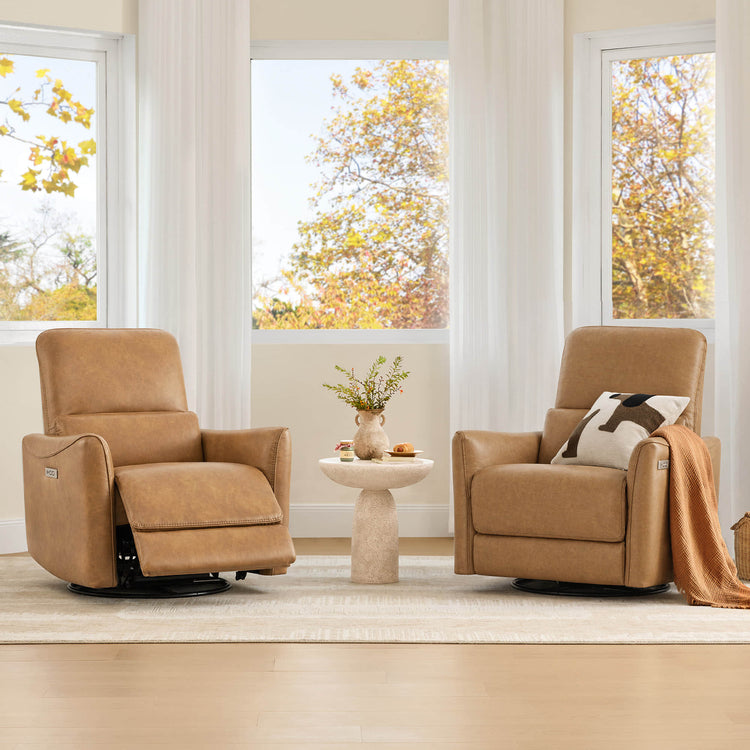
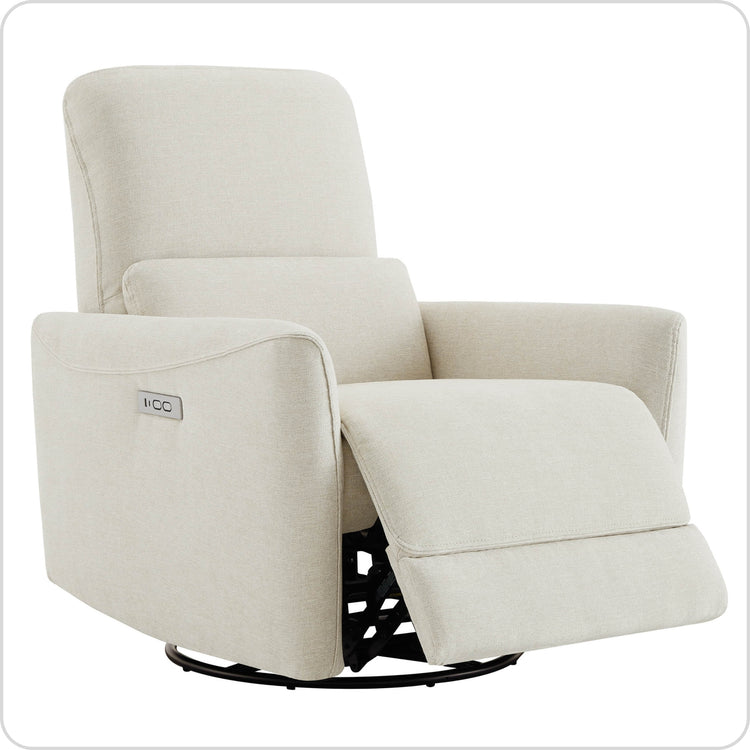
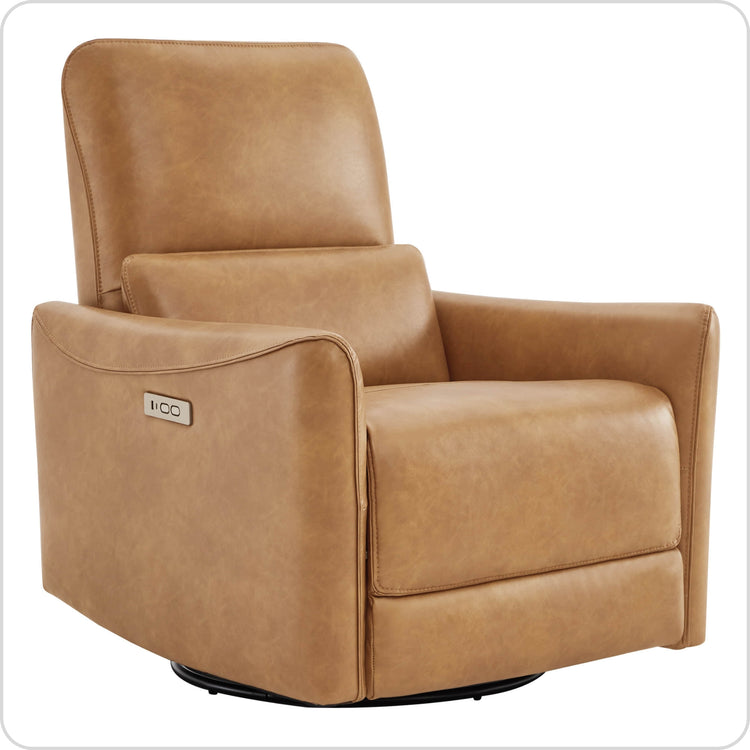
Our Isaac power headrest recliner is a documented example: it runs on dual motors, one for the reclining function and one for the power headrest, so each moves independently, and it reclines to a maximum of 135 degrees. It's built as a wall-hugger, needing about 3.0 inches of wall clearance in the Medium size or 3.7 inches in the Extra Large size, which matters if your TV wall doesn't leave much room behind the chair.

Match your body to the size chart before buying rather than assuming any recliner fits. The Medium size is built for a 5'2" to 6'1" height range and a 350-pound weight capacity, while the Extra Large size covers 5'4" to 6'4" and 450 pounds. The chair carries a one-year warranty on the furniture, mechanism, and wood frame, and its actuator, adaptor, and handset are UL-certified; that documentation tells you what's covered, not how long the motor performs after years of daily use.
When should neck discomfort not be treated as a recliner-adjustment problem?
Stop treating your chair as the fix if neck discomfort continues or gets worse after you've already corrected the screen height, distance, and headrest position. A power headrest supports posture; it doesn't diagnose or treat a neck problem.
General ergonomic guidance describes a level, forward-facing head that stays roughly in line with the torso as a reasonable target, and it recommends changing position during long sitting sessions rather than holding any single posture for hours, no matter how well-supported it feels. If you've applied that guidance, tested your setup with the steps above, and discomfort still persists or worsens, that's a signal to talk with a healthcare provider rather than keep adjusting the recliner.
Before replacing furniture, verify your screen height directly against your eye line in full recline; if the television placement checks out and you still crane your neck, test a model with independent dual motors to decide if mechanical head support solves your viewing angle.
FAQs
How can I judge a power headrest's durability before buying?
Durability can't be read from the words "power headrest" alone. Look at what's actually covered: motor and mechanism warranty length, any certification on the actuator or controls, and the manufacturer's own operating instructions. Our Isaac recliner, for example, carries a one-year warranty on the furniture, mechanism, and wood frame, and its actuator, adaptor, and handset are UL-certified; that's documentation of what's covered, not a guarantee of how the motor performs after years of daily use, so pair it with the return window in case the fit isn't right.
Are power headrests easy to use?
Ease of use comes down to reachable controls and independent movement, not the feature name. Before buying, sit in your intended recline position and try the headrest control from there: check that you can reach it without straining, and that it moves separately from the backrest rather than forcing both to shift together. If a showroom model feels awkward to reach while reclined, expect the same issue at home.
Can a power headrest treat neck pain?
No. A power headrest is a positioning feature that lets you support your head in a level, forward-facing position while reclined; it isn't a treatment for neck pain and shouldn't be used as one. If discomfort continues or worsens after you've corrected your TV height, distance, and headrest position, stop treating chair adjustments as the solution and check with a healthcare provider.
Sources
- U.S. Department of Labor, OSHA. Workstation Components — Monitors.
- U.S. Department of Labor, OSHA. Good Working Positions.
Recommended Products


More to Read
 7 Sofa Trends That Actually Improve Comfort in 2026
Upgrade your living room with furniture that supports your body. Here are 7 modern sofa features designed to maximize your daily comfort...
7 Sofa Trends That Actually Improve Comfort in 2026
Upgrade your living room with furniture that supports your body. Here are 7 modern sofa features designed to maximize your daily comfort...
 Mother's Day Gift Guide: Cozy and Stylish Furniture Picks for Modern Moms
Make Mother's Day more meaningful with furniture gifts that bring comfort, smart features, storage, and quiet luxury into her everyday routine.
Mother's Day Gift Guide: Cozy and Stylish Furniture Picks for Modern Moms
Make Mother's Day more meaningful with furniture gifts that bring comfort, smart features, storage, and quiet luxury into her everyday routine.
 Performance Fabric Reality Check: Does It Really Repel Pet Hair and Stains?
Performance fabric is often marketed as a miracle solution for homes with pets and kids, but the reality is more nuanced. It...
Performance Fabric Reality Check: Does It Really Repel Pet Hair and Stains?
Performance fabric is often marketed as a miracle solution for homes with pets and kids, but the reality is more nuanced. It...