

























Choose an L-shape sectional when your room needs an open edge for a doorway, hallway, or connection to another room. Choose a U-shape only when the room offers a broad, unobstructed seating zone where a second return will not block a path you use every day. Either way, measure the exact footprint and delivery route before you compare comfort details or specific products.
Key Takeaways
- Start with an L-shape when the room needs an open circulation edge; consider a U-shape only when the layout can support two returns without blocking a path.
- Tape the exact footprint on the floor and measure the full delivery route, then compare both against the sectional's package dimensions before ordering.
- Match seat depth, seat height, back support, fill, and frame to how your household actually sits; "deep" or "overstuffed" describes construction, not a comfort guarantee.
- Modular sectionals add flexibility only when the manufacturer documents compatible configurations for your exact line; fixed sectionals reduce configuration decisions when your layout is settled.
- Certification labels such as CPSC, TSCA Title VI, and OEKO-TEX STANDARD 100 each confirm a narrow tested scope, not overall product safety or durability.
L-Shape vs. U-Shape: Which Fits Your Room and Seating Pattern?
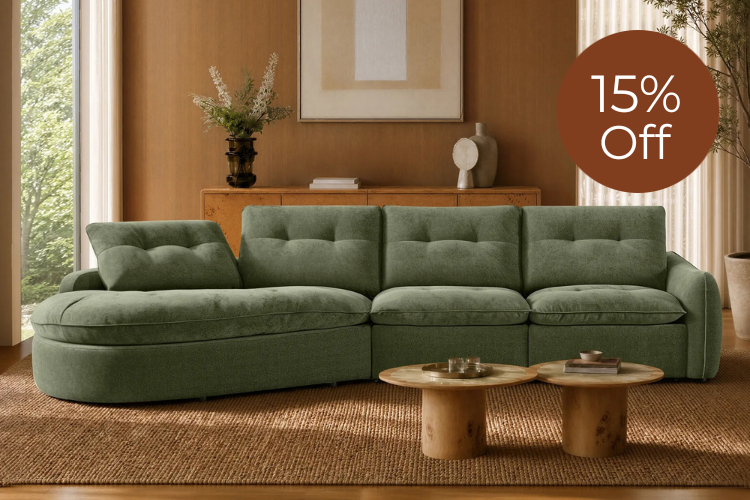
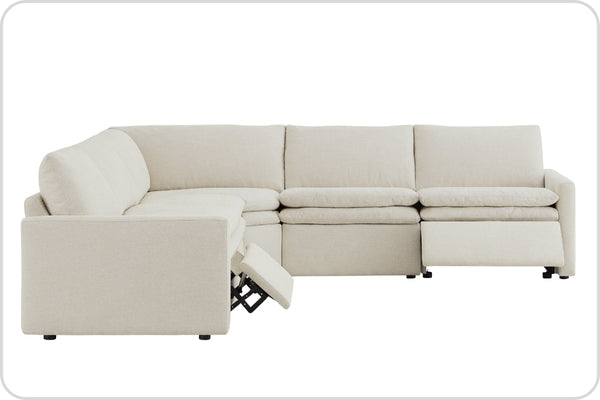
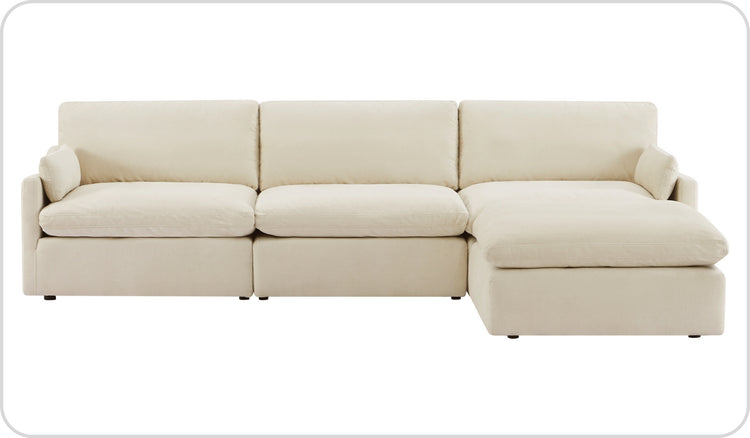
An L-shape sectional uses one corner and leaves one long side open, so it works well when a doorway, hallway, or another room needs to stay reachable. A U-shape adds a second return on the opposite end, closing off a third side of the seating area and using more floor depth on both sides. As you start browsing sectional couches for sale, use the table below to narrow the shape before you compare specific listings.
| Shape | Best fit when | Main fit tradeoff |
|---|---|---|
| L-shape | Room needs an open approach or through-route | The chaise or return still projects deep into the room, so measure it before assuming a clear opening |
| U-shape | Room has a wide, unobstructed zone that won't double as a walkway | Both ends return toward the center, using floor area on two sides and enclosing the seating zone |
Use the L-shape as your starting option whenever an open edge matters for daily movement. Reserve the U-shape for rooms where the seating area can be fully dedicated to conversation, since the second return only works when it doesn't block an essential path.
Start With Room Architecture and Circulation
Room architecture, not square footage alone, decides where a sectional can go. Walk your space first and mark which doors, windows, and paths must stay open before you compare specific shapes or sizes.
In a small or circulation-tight room, test whether the chaise or return would intrude into the only practical route between doors before you fall for a particular look. A sectional that fits the wall length can still block foot traffic if its projection eats into a hallway or a doorway's swing.
In an open-plan layout, use the sectional to define a seating zone rather than close off the connection to the kitchen or dining area. Our guide to open-plan sofa zoning walks through placing a sofa as a soft room divider without cutting off light or flow.
In a family living room, map the paths to the TV, windows, and any side tables before you assign the sectional's main wall. Once you know which wall and corner stay usable, you can measure the exact footprint that will actually fit there.

Measure the Sectional Footprint and Delivery Route
A sectional passes the fit test only when both the room footprint and the delivery route check out. Work through this order before you finalize a shape or size.
- Measure the room's usable wall length and depth, noting fixed features like windows, radiators, or outlets.
- Record the sectional's overall width, its farthest chaise or return projection, and its seat depth and orientation.
- Tape the full footprint on the floor with painter's tape, including both returns if you're considering a U-shape.
- Walk the taped outline and mark any door swing, hallway, or path that must stay clear.
- Measure the complete delivery route from the exterior entry through every door, hallway turn, stairwell, and elevator.
- Compare the largest package dimension against the tightest point on that route, not just the finished sectional's size.
- Save the exact product-page dimensions and package specs for your order record before you buy.
A room only passes when the taped footprint clears every path and the package dimensions clear every point on the delivery route.
Choose Seat Dimensions and Cushion Construction for How You Sit
Match seat depth, height, and construction to how your household actually sits, not to how deep or plush a listing sounds. A sectional built for lounging may feel too low or too soft for someone who needs to stand up easily.
Seat depth measures front-to-back inside the cushion, not the sectional's total footprint. A deeper seat suits lounging and stretching out, while a shallower seat with more upright support helps with sitting for meals, reading, or standing up without effort. Seat height works the same way: lower seats favor lounging, and taller seats make standing easier for older household members or anyone with knee or back concerns.
Back support, cushion fill, suspension, and frame are four separate construction choices, and a single word like "overstuffed" or "plush" only describes one of them. Loose feather-blend cushions move and need periodic fluffing, while foam-core cushions hold their shape longer but can feel firmer. Suspension straps or springs affect how much the seat gives when you sit down, and the frame material affects how the piece holds up under regular use over years, not just at delivery.
Upholstery fiber and cover construction should be checked separately from comfort. A removable, zip-off cover makes cleaning easier to attempt, but the manufacturer's specific care instructions, not the fabric name alone, tell you what cleaning methods are actually safe. Check the exact seat depth and height against your own measurements, and our sofa seat depth guide can help before you commit to a configuration.
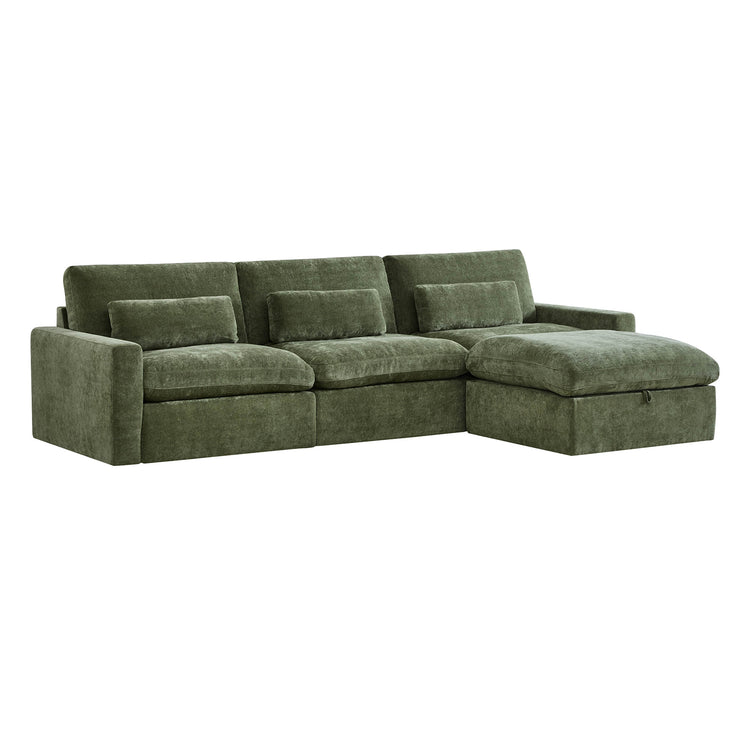
Our Liam feather sectional is one documented example of how these specifications work together: it lists deep seating cushions, loose overstuffed feather cushions built over CertiPUR-US foam, zip-off covers, a kiln-dried solid wood base, hidden metal connectors, a 16-inch minimum door-entry clearance, and a 16-inch minimum box width. Those figures describe this specific configuration only, so check the current product page against your own room and doorway measurements before assuming they apply to a different piece.
Fixed vs. Modular: Match Flexibility to Your Moving and Rearranging Plans
Choose modular when documented rearrangement or delivery flexibility solves a real problem in your room. Choose fixed construction when the layout is stable and won't benefit from extra configuration decisions.
A fixed sectional arrives with configuration and connectors already sorted, which removes one more thing to plan when the room and placement rarely change. It also means fewer seams and hardware points to maintain over time.
A modular sectional can make each piece easier to carry through a tight hallway or up a narrow stairwell, since you're moving individual sections instead of one large frame. That flexibility comes with tradeoffs: more boxes to receive, more assembly and connector alignment, and configurations that only work if the manufacturer documents them for your exact line. Our comparison of fixed vs. modular sofas breaks down how the two constructions differ in daily use and long-term flexibility.
Treat a promise of future expansion as supported only when the product documentation lists compatible modules and configurations for your exact model line. A general modular category label doesn't guarantee that a future piece will match your current sectional's connectors or fabric run.

Verify the Exact Sectional Before You Buy
Before you order, run a final pass or fail check on the exact configuration you plan to buy.
- Configuration and orientation match your measured room layout, including which side the chaise or return sits on.
- Overall dimensions and package dimensions both clear the taped footprint and the delivery route you measured earlier.
- Seat depth, seat height, cushion fill, suspension, and frame details match the current product page, not a general category description.
- Upholstery care instructions and cover-removal limits are listed for the exact fabric and configuration you're ordering.
- Modular connector and compatible-module documentation exists for your exact line if you're counting on future rearrangement.
- Required labels or certifications are present for the exact configuration you're ordering, and you understand what each one actually covers.
- Current delivery, returns, warranty, and availability details come from the product page itself, not a general collection page.
Certification labels each cover a narrow scope. The required upholstered-furniture certification statement confirms flammability testing and labeling for the cover, barrier, and filling materials. The TSCA Title VI composite-wood emissions scope applies only to specified composite-wood components used in the frame or base, not the whole piece. The OEKO-TEX STANDARD 100 textile testing scope confirms the fabric was tested for harmful substances, not that it resists stains or abrasion.
FAQs
What should I check in a sectional's care instructions before ordering?
Look for the stated cleaning method, whether covers unzip for washing, and whether those instructions apply to the exact upholstery option you're ordering, since fabric and leather often carry different rules on the same product line. A general "easy-care" description or a textile certification isn't proof that a cover is machine washable or stain resistant; only the manufacturer's specific care label confirms that.
Can a modular sectional be rearranged into every layout?
No. Modular construction means individual pieces can be repositioned, but it doesn't mean every layout is supported on every line. Confirm the exact configurations, connector system, and compatible add-on modules listed for your specific product before assuming you can expand or reshape it later.
How do I measure a sectional with a chaise or U-shaped return?
Measure the full back width across all sections, then measure the farthest point the chaise or each return projects forward from that back line. If you're considering a U-shape, measure both returns separately since they're rarely identical, and compare the sectional's largest package dimension against your delivery route before ordering.
Sources
- U.S. Consumer Product Safety Commission. Upholstered Furniture.
- U.S. Environmental Protection Agency. TSCA Title VI Formaldehyde Standards.
- OEKO-TEX®. OEKO-TEX® STANDARD 100.
Recommended Products

More to Read
 7 Sofa Trends That Actually Improve Comfort in 2026
Upgrade your living room with furniture that supports your body. Here are 7 modern sofa features designed to maximize your daily comfort...
7 Sofa Trends That Actually Improve Comfort in 2026
Upgrade your living room with furniture that supports your body. Here are 7 modern sofa features designed to maximize your daily comfort...
 Mother's Day Gift Guide: Cozy and Stylish Furniture Picks for Modern Moms
Make Mother's Day more meaningful with furniture gifts that bring comfort, smart features, storage, and quiet luxury into her everyday routine.
Mother's Day Gift Guide: Cozy and Stylish Furniture Picks for Modern Moms
Make Mother's Day more meaningful with furniture gifts that bring comfort, smart features, storage, and quiet luxury into her everyday routine.
 Performance Fabric Reality Check: Does It Really Repel Pet Hair and Stains?
Performance fabric is often marketed as a miracle solution for homes with pets and kids, but the reality is more nuanced. It...
Performance Fabric Reality Check: Does It Really Repel Pet Hair and Stains?
Performance fabric is often marketed as a miracle solution for homes with pets and kids, but the reality is more nuanced. It...