













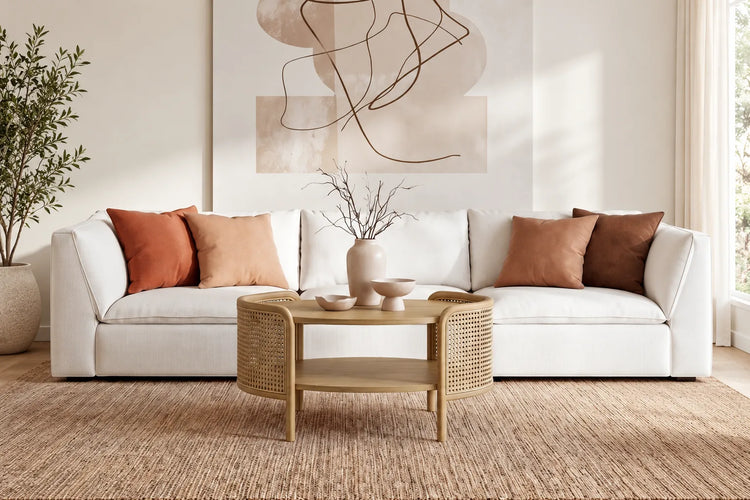
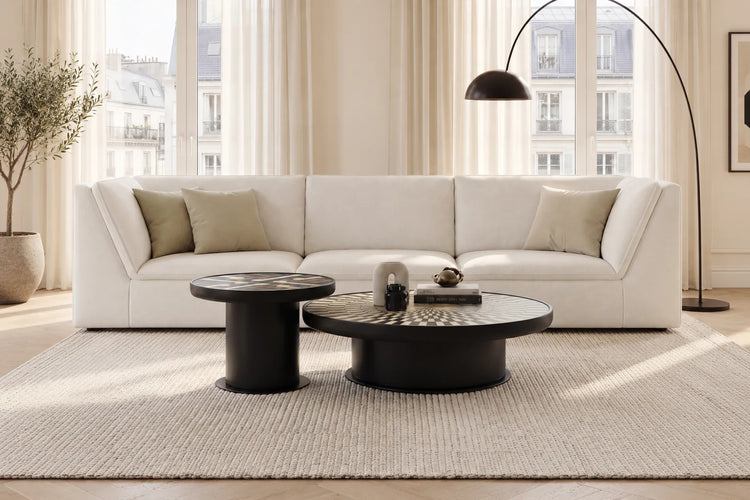









Deciding on a round vs rectangular storage ottoman for sectional seating comes down to walking paths and reach. A rectangular storage ottoman usually deserves the first look when your sectional has long, straight seating edges and you want direct footrest reach from several seats at once. A round storage ottoman works best when your sectional has a wedge, a rounded corner, or a tight entry point beside the chaise.
Either shape only works if it leaves the walking route around the chaise clear. This guide uses 18 inches as the planning minimum for that route, a target set for household layouts rather than a building code figure. Tape your sectional's full footprint and the ottoman's candidate footprint before you decide, then apply the room and geometry rules below to confirm the shape.
Round or Rectangular: Start With the Route, Not the Shape
The route beside your chaise decides more than the sectional's shape does. Test one shape first based on where your sectional's straight edges or curved access points sit.
When Rectangular Deserves the First Look
Long, straight sectional edges make a rectangular footprint worth testing first. A rectangle sitting parallel to that edge lets several seats reach the footrest at the same depth, without the tapered gaps a round shape can leave at the ends. Use this branch only when the ottoman's added length does not stretch across the walking path beside the chaise. If the straight run is short, a rectangle can still crowd the route even though it matches the edge.
When Round Deserves the First Look
Wedge or rounded-corner sectionals make a round footprint worth testing first. Rounded edges can ease entry into an L-shaped sectional because there is no squared corner to walk around when you step toward the middle seat. That advantage does not remove the need to verify the full diameter, since a wide round ottoman can crowd a narrow route just as easily as a rectangle. Check the diameter against the clearance test in the next section before you commit.
Compare Footprint and Traffic Flow
Round and rectangular ottomans create different footprint and movement patterns around the same sectional. The table below compares them on the same four questions so you can match the shape to your layout.
| Factor | Round | Rectangular |
|---|---|---|
| Footprint pattern | Even radius in every direction | Longer on one axis, shorter on the other |
| Movement around it | No corners to navigate | Squared corners can narrow the path at each end |
| Reach alignment | Similar reach from any angle | Direct reach along the long edge, less at the ends |
| Best conditional use | Wedge, curved corner, or tight entry point | Long straight run with room to spare on each side |
Neither pattern wins on its own. A round ottoman's even radius helps in a corner where every direction needs clearance, while a rectangular ottoman's straight profile helps when several seats sit along one long edge. The real test is whether the shape's footprint crosses the walking path beside your chaise. If it does, that shape loses regardless of how well it matches the sectional's outline.
Measure the Sectional, Reach, and 18-Inch Clearance
Measuring settles the shape debate that visual comparison cannot. Follow three steps: map the room, tape the candidate footprint, then test reach and clearance.

Tape the Room and Sectional First
Start by recording what is already there, not what you are planning to add.
- Mark the sectional's full outside edges, including the chaise extension and any wedge or rounded corner.
- Mark every route people actually walk, especially the path beside the chaise.
- Mark the seat positions where the ottoman needs to work as a footrest.
For a closer look at where this step usually goes wrong, see our notes on sectional measuring mistakes.
Use a Labeled Floor Diagram
Sketch the layout on paper or with tape on the floor: chaise, candidate ottoman footprint, the route beside it, and the 18-inch clearance line this guide uses as its planning target. Label that clearance line clearly so you can see at a glance whether the ottoman's edge crosses it. This distance is our supplied planning minimum for a private living room, not a building-code figure. By comparison, official accessible route guidelines specify 36 inches of continuous clear width in covered public spaces, which exceeds what a residential walking path typically requires.
Run the Reach and Pass-Fail Test
Once the diagram looks right, test it in real space.
- Tape the ottoman's full outer footprint, not just its visual center, using the exact dimensions from the product page.
- Sit in each seat that should reach the ottoman and confirm your feet land on it without leaning around a corner.
- Measure the narrowest point of the route beside the chaise; it must stay at 18 inches or more.
- Reject the footprint if either test fails, and try a smaller size or a different placement before comparing storage features.
Match the Ottoman to Sectional Geometry
Sectional geometry decides which shape earns a second look. Use the access point and open middle to break any tie left after the clearance test.
L-Shaped Sectionals
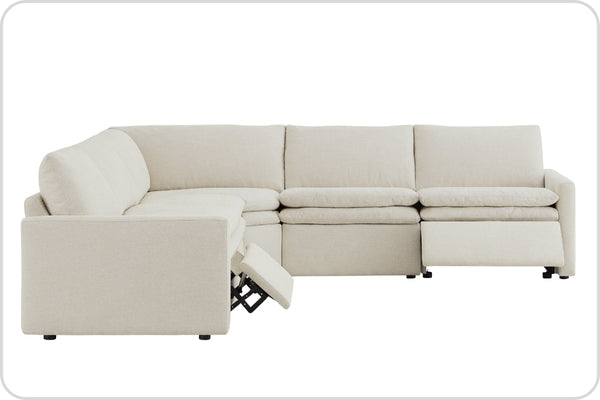
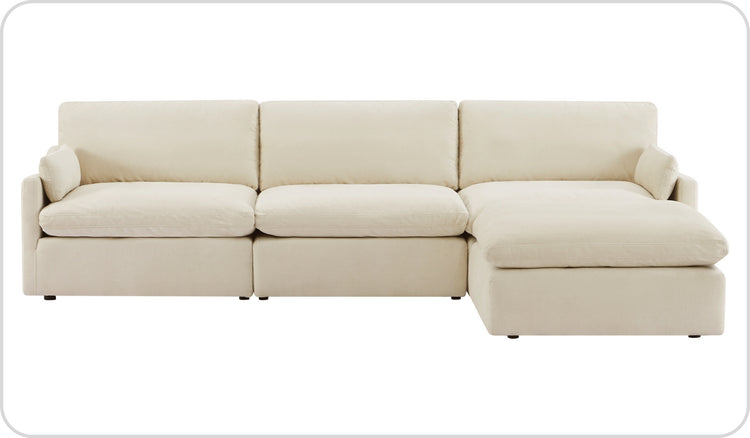
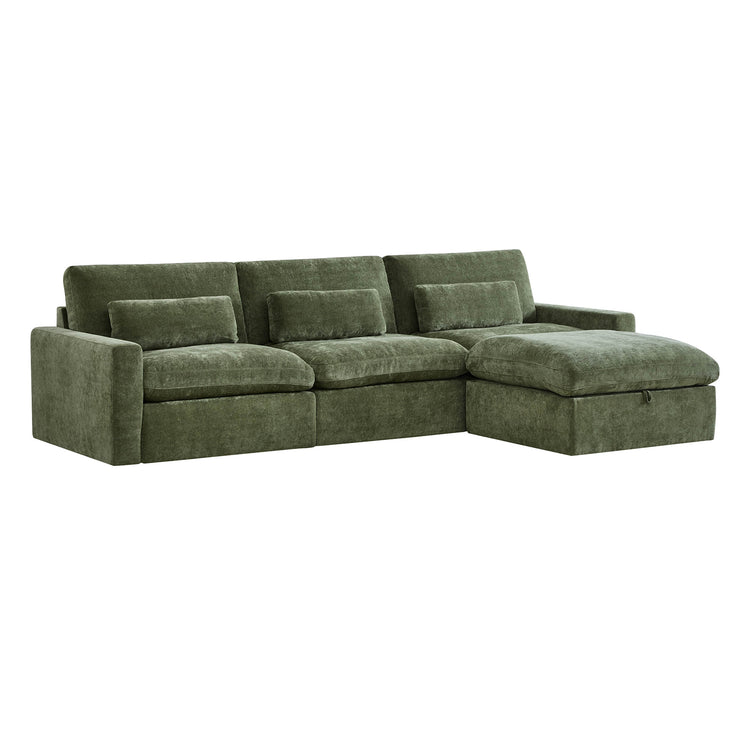
Check the open middle of the L and the path into the inside corner first. A rectangular footprint deserves extra scrutiny here, because its depth can cross that access path if it sits too close to the corner. If the rectangle's edge lines up outside the walking path, it can still work; if it reaches into the corner, test a round shape instead.
Wedge or Rounded-Corner Sectionals
A round footprint tends to follow this curved access condition more naturally, since there is no straight edge for it to align against. Verify that the diameter still leaves the required clearance around the chaise, because a wide circle can consume as much route width as a boxy rectangle. Curved geometry favors round shapes as a starting point, not a guarantee.
Long Straight Edges
A rectangle can align with a long, straight seating edge and support direct reach from several seats at once. Use it only if the added length or depth does not narrow the walking path beside the chaise. When the straight run is long enough to spare a few extra inches on each side, a rectangular ottoman usually earns its place.
Open-Concept vs Enclosed Living Rooms
Room layout changes which route matters most. Open floor plans usually make circulation the priority, while enclosed rooms give more room to optimize reach.
Open-Concept Rooms: Protect Shared Routes
Map every route that connects your seating area to a doorway, kitchen, or dining space, since an open floor plan often routes foot traffic past the sectional from more than one direction. Favor whichever shape leaves the most-used path open after the 18-inch check, even if that means giving up some footrest reach. For more layout ideas suited to shared, multi-use spaces, see our guide to small living room arrangements.
Enclosed Rooms: Use the Seating Zone Efficiently
A defined room with one main entry point gives a rectangular footprint more room to align with a long sectional edge, since fewer competing routes cross the space. Do not trade away the chaise route just because cross-room traffic is limited; that route still needs the same 18-inch check. If neither shape passes, a smaller footprint or a different placement solves the layout better than forcing a shape that does not fit.
Verify a Storage Ottoman Before Ordering
Once your taped layout passes, exact product dimensions decide the final shortlist. Compare the outer footprint first, then check storage and intended use separately.
Use Exact Outer Dimensions
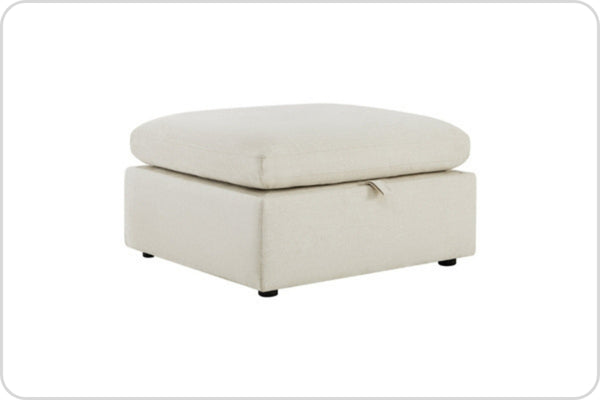
Our Grace round storage ottoman is listed at 38.2 inches in diameter and 16.1 inches high, giving you a verified round footprint to tape against your diagram. A rectangular alternative we carry lists 37.0 inches wide by 19.3 inches deep and 16.5 inches high, a useful reference footprint for the long-edge scenario described above. Neither set of dimensions proves fit on its own; transfer them to your floor and rerun the reach and clearance test before deciding.

Verify Storage and Intended Use Separately
The Grace round ottoman pairs hidden interior storage with a solid top that also works as a footrest or a coffee table surface. The rectangular option mentioned above lists a 31.5-inch by 14.2-inch interior storage compartment under a flip-top surface, useful if you want dedicated storage rather than a lid that opens the whole seat. Treat these storage details as separate facts from fit; a spacious storage compartment does not change whether the outer footprint clears your route.
Make the Final Product Check
Run through this short list before you order:
- Tape the full outer footprint from the product page, not an estimate from the photo.
- Confirm the 18-inch planning clearance still holds around the chaise with that footprint in place.
- Sit in each intended seat and test reach one more time.
- Once the footprint passes, open the ottoman's product page to confirm current stock and delivery details before completing your order.
FAQs
What if neither ottoman shape leaves 18 inches around the chaise?
If your taped footprint fails the clearance check for both shapes, do not force a choice yet. Recheck the route for a narrower point you may have missed, then try a smaller footprint or move the ottoman's position rather than lowering the clearance target. If a smaller or repositioned option still fails, hold off on ordering until the layout passes the test.
Can a rectangular storage ottoman work with an L-shaped sectional?
Yes, as long as the rectangular depth does not cross the open middle or block access into the inner corner. If the long edge aligns parallel to the main seating run without entering the walking path beside the chaise, a rectangle provides direct reach for multiple seats.
Does interior storage capacity affect ottoman clearance?
No. Interior storage volume does not alter the piece's exterior footprint or the clearance needed for walking paths. Always verify outer dimensions on the floor first to protect traffic flow before evaluating storage dimensions or lid mechanisms.
Sources
- U.S. Access Board. Chapter 4: Accessible Routes.
Recommended Products

More to Read
 7 Sofa Trends That Actually Improve Comfort in 2026
Upgrade your living room with furniture that supports your body. Here are 7 modern sofa features designed to maximize your daily comfort...
7 Sofa Trends That Actually Improve Comfort in 2026
Upgrade your living room with furniture that supports your body. Here are 7 modern sofa features designed to maximize your daily comfort...
 Mother's Day Gift Guide: Cozy and Stylish Furniture Picks for Modern Moms
Make Mother's Day more meaningful with furniture gifts that bring comfort, smart features, storage, and quiet luxury into her everyday routine.
Mother's Day Gift Guide: Cozy and Stylish Furniture Picks for Modern Moms
Make Mother's Day more meaningful with furniture gifts that bring comfort, smart features, storage, and quiet luxury into her everyday routine.
 Performance Fabric Reality Check: Does It Really Repel Pet Hair and Stains?
Performance fabric is often marketed as a miracle solution for homes with pets and kids, but the reality is more nuanced. It...
Performance Fabric Reality Check: Does It Really Repel Pet Hair and Stains?
Performance fabric is often marketed as a miracle solution for homes with pets and kids, but the reality is more nuanced. It...