























Best bedroom furniture for small bedrooms

The best bedroom furniture for a small bedroom starts with the bed footprint, not a matching set. Measure the room and delivery route, sketch the assembled bed, and choose the largest comfortable option only if the entry, closet, access to the bed, windows, and essential storage remain usable. Then choose one storage solution for the room’s biggest deficit and add only companion pieces that serve a necessary purpose. This approach helps you balance comfort, storage, and style without treating any mattress size or furniture model as universally right.

Choose Bedroom Furniture Around the Largest Bed That Preserves a Usable Walking Path
Choose the largest bed that fits your sleep needs while preserving the routes and access the room requires. A small bedroom does not have one universal bed-size rule, so the assembled footprint and the room’s fixed features determine the result.
Start by measuring the bedroom, entry door, closet, windows, and other fixed obstructions. Sketch the bed footprint on paper or in a floor-planning app before adding a dresser or nightstands. A measurement-first layout test is more reliable than choosing based on the mattress label alone. This small-bedroom measuring guide supports the same starting point: map the room before moving or ordering furniture.

Use this bed-first selection path:
- Measure the room and delivery route. Include the doorway, hallway, stairs, and elevator the furniture must pass through. A bedroom layout can work on paper even when the assembled or packaged piece cannot reach the room.
- Sketch the assembled bed footprint. Use the product’s outside dimensions, not just the mattress space. Mark the entry, closet, bed-access, window, and storage routes that must remain usable.
- Match the footprint to the sleeper. For one sleeper, compare the smallest comfortable option with the floor space it preserves. For a couple, protect sleep needs first, then keep the larger bed only if the measured layout still supports access and essential storage.
- Change one variable when a route fails. Try a different bed position, reduce another piece, or compare a smaller comfortable bed. Do not solve a blocked route by relying on a slim-looking finish.
As a bounded example, CHITA lists the Serene Queen with a 60-by-80-inch mattress space and assembled dimensions of 89.3 inches long by 74.4 inches wide by 41.1 inches high. Its listed specifications also include a solid wood frame, 16 queen slats, and six center support legs. Serene Queen bed details provide a manufacturer-stated size reference for your sketch, but those specifications do not establish fit for any particular small bedroom.
Prioritize Storage That Replaces Another Piece
Choose storage by identifying the room’s actual deficit first. Integrated bed storage can make sense when floor area is scarce, a tall dresser can work when usable wall space and drawer clearance are available, and a smaller bedside solution may be enough when closets or built-ins already handle clothing.
The useful principle is replacement: prefer one storage feature that solves the same need as another fixture, provided its drawers, doors, or under-bed access can operate in place. Avoid buying a full bedroom set when the room lacks only one specific function. Use this qualitative decision matrix before choosing a storage type:
| Room’s main deficit | Furniture choice to compare | Fit and access condition |
|---|---|---|
| Very little floor area for another case piece | Integrated bed storage | It must solve a real storage need, and under-bed access must remain workable after the bed is placed. |
| Clothing storage is missing but wall space is usable | Tall dresser | Check the assembled depth, drawer-opening area, nearby routes, and delivery path. |
| Clothing storage is covered by a closet or built-ins | Smaller bedside piece or no additional case piece | Add only the surface or small storage function the room actually lacks. |
The Ezra is one manufacturer-stated example of the first option. CHITA lists the Ezra queen footprint at 65.94 inches wide by 85.43 inches long by 50 inches high and describes it as a platform storage bed with 9.06 inches of floor clearance. Ezra storage bed details provide current product dimensions to compare with your plan. Treat storage access and other specifications as product-page details to review before ordering rather than assuming that any storage bed will be convenient or suitable for your room.
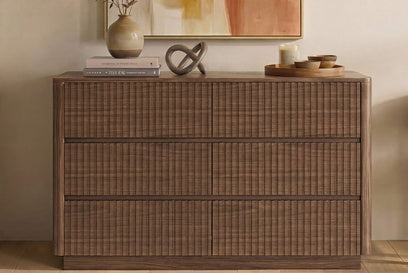
For vertical storage, CHITA lists the Irais as a five-drawer dresser measuring 29.92 inches wide, 21.65 inches deep, and 46.06 inches high. Irais dresser dimensions give you a concrete, roughly 30-inch-wide example—not a universal small-room recommendation. Confirm that the drawers can open without interfering with the bed, closet, door, or main route. Compare these choices with small-bedroom layout ideas while applying your own measured footprint.
Choose Visually Lighter Furniture for the Pieces That Remain
After physical fit and function pass, use restrained proportions, slim edges, and raised or open-looking bases to reduce perceived visual heaviness. These traits can make furniture feel less dominant, but they do not reduce assembled dimensions or create additional clearance.
Compare the bed, storage, and bedside pieces as a group. A consistent profile can make the arrangement feel less visually dominant, while styling remains a choice among pieces that already fit. Consider a slimmer-looking headboard, narrower visual edges, lighter-looking legs, or less visually dense upholstery only after the footprint works. Small-bedroom design guidance similarly treats styling as a way to maximize the sense of space, not as a substitute for measuring. Small-bedroom design ideas offer general visual context, and room-dependent layout advice reinforces that there is no single arrangement for every compact bedroom.
Use visual profile as a tie-breaker between workable options:
- Keep the piece with the more restrained silhouette when both choices preserve the same required access.
- Compare the bed and storage together instead of choosing a visually light bed that leaves an oversized dresser dominating the room.
- Do not assume a low-looking frame, a lighter finish, or open legs physically shrinks the product.
- If style and access conflict, keep the arrangement that preserves entry, closet, bed, and storage operation.
Add Only the Companion Pieces That Earn Their Floor Space
Keep a nightstand, bench, chair, mirror, or accent table only when it serves a real function and leaves the required routes usable. A small bedroom does not need every piece associated with a traditional bedroom set.
Choose the smallest bedside surface that provides a needed landing area, storage function, or charging spot. Two nightstands can be worthwhile when both serve the sleepers and do not pinch access; one shared or narrower surface is more practical when paired tables crowd the bed. Apply the same test to seating and accents:
- Nightstand: Keep it when it supports a daily bedside task. Reduce the size or use one shared surface when two pieces interfere with bed access.
- Bench: Add one only when it has a genuine seating or storage role and does not block the foot of the bed or another route.
- Chair: Keep it for regular use, not because a bedroom set seems incomplete. Remove it if it becomes a place for piled clothing or narrows access.
- Mirror or accent table: Treat it as optional. It earns space only when its location does not interfere with doors, drawers, or the delivery path.
For a rental, favor movable arrangements and avoid assuming that permanent modifications are permitted. Rental-bedroom layout ideas can provide flexible-layout context, but your own lease and room measurements control the final choice. Before ordering, walk through the planned route mentally and check every drawer, door, and under-bed mechanism in its open position. If an optional piece pinches access, omit it.
FAQs: Small-Bedroom Furniture
These answers address common last-mile decisions without applying a universal room-size rule. The right choice still depends on assembled dimensions, sleeper needs, and the routes your room must preserve.
Is a Queen Bed Too Large for a Small Bedroom?
Not automatically. Compare the queen’s assembled footprint with the entry, closet, access to the bed, window, and storage routes. For one sleeper, keep it only when the extra width improves comfort enough to justify the space; for a couple, keep it only when those routes remain usable.
What Is the Most Useful Storage Furniture for a Small Bedroom?
Match the piece to the storage gap. Choose integrated bed storage when another case piece would crowd the floor, a vertical dresser when wall space and drawer clearance work, or a smaller bedside solution when built-ins already cover clothing storage. If the gap is unclear, postpone the storage purchase until you identify what the closet does not hold.
How Do You Make Bedroom Furniture Look Less Bulky?
After confirming the physical footprint, compare restrained proportions, slim edges, and raised or open-looking bases. These choices can reduce perceived visual heaviness, but they do not change the product’s assembled dimensions. Use them only to choose between options that already preserve access.
Should a Small Bedroom Have Two Nightstands?
Only when both surfaces serve a real need and leave required routes open. For a couple who each need bedside access, two may earn their space; otherwise, test one shared or narrower surface against the bed, closet, and storage before ordering.
Recommended Products


More to Read
 7 Sofa Trends That Actually Improve Comfort in 2026
Upgrade your living room with furniture that supports your body. Here are 7 modern sofa features designed to maximize your daily comfort...
7 Sofa Trends That Actually Improve Comfort in 2026
Upgrade your living room with furniture that supports your body. Here are 7 modern sofa features designed to maximize your daily comfort...
 Mother's Day Gift Guide: Cozy and Stylish Furniture Picks for Modern Moms
Make Mother's Day more meaningful with furniture gifts that bring comfort, smart features, storage, and quiet luxury into her everyday routine.
Mother's Day Gift Guide: Cozy and Stylish Furniture Picks for Modern Moms
Make Mother's Day more meaningful with furniture gifts that bring comfort, smart features, storage, and quiet luxury into her everyday routine.
 Performance Fabric Reality Check: Does It Really Repel Pet Hair and Stains?
Performance fabric is often marketed as a miracle solution for homes with pets and kids, but the reality is more nuanced. It...
Performance Fabric Reality Check: Does It Really Repel Pet Hair and Stains?
Performance fabric is often marketed as a miracle solution for homes with pets and kids, but the reality is more nuanced. It...