
















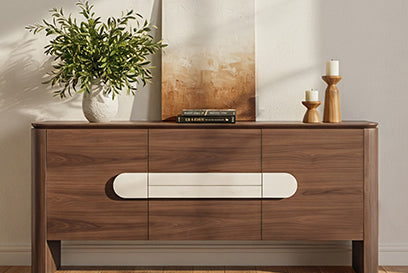








Sideboard vs. Buffet: Differences, Storage, and Room Fit

Choosing between a sideboard and a buffet starts with what you want the cabinet to do. You might need space for serving dishes, a place to set out food, or closed storage beside the living room. The name gives you a starting point; the cabinet's measurements and internal layout tell you how it will work at home.
What Sideboard and Buffet Mean
A sideboard is generally a freestanding storage cabinet with a usable top and enclosed storage below. A buffet commonly describes the same kind of piece used for dining storage and serving. The terms overlap, and a cabinet may be described using both.
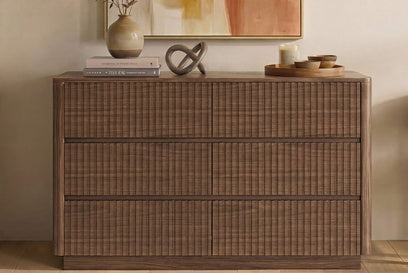
You will see short legs, tall legs, plinth bases, drawers, and open shelves across these categories. Height and leg style vary by design. A modern buffet can have clean lines; a sideboard can hold a holiday meal just as easily as everyday household items when its surface and dimensions suit the task.

Compare the Features You Will Use
| Your main use | What to compare | A check before buying |
|---|---|---|
| Serving food | Top height, depth, and finish | Try a similar-height surface at home and allow space for plates and serving utensils. |
| Storing tableware | Internal shelf width, height, and depth | Measure your largest platter and tallest pitcher. |
| Keeping small items organized | Drawer layout and usable depth | Check whether cutlery trays or dividers will fit. |
| Displaying objects | Glass doors, open shelves, and visibility | Decide which objects you want visible and which need closed storage. |
| Use in a hallway | Cabinet depth and door swing | Check the route with the cabinet doors open. |
Our Kyle display sideboard uses fluted glass doors, making it an option to consider when the contents are part of the room's display. For everyday dining storage, count the pieces you want to put away before comparing cabinet interiors. Our sideboard collection provides cabinet layouts to compare once you have listed your storage needs.

Measure Height, Storage, and Door Clearance
Choose a height you can use comfortably
Stand beside an existing table or counter and imagine serving from it. Notice how far you need to bend and whether a raised serving dish would be easy to reach. Record the height that works for the people who will use the cabinet. Compare the listed dimensions of each candidate with that measurement.
Measure inside the cabinet
Overall width includes the sides, partitions, and hardware. For a large platter, you need the usable shelf depth and width. For a pitcher, check clear height between shelves. A door opening can also be narrower than the space behind it.
Drawers are useful for table linens and small items. Shelves may suit bowls and serving dishes. If shelf adjustment matters, confirm the positions and usable space for the exact cabinet you are considering. We can help you find the cabinet interior measurements. Our sideboard storage guide for platters, linens, and stemware shows how to check usable compartments and the space needed to lift items out.

Check the cabinet while it is open
Mark its footprint on the floor. Include the room needed for doors and drawers, then walk past it as you would during a meal. Check nearby dining chairs in their pulled-out position and make sure the room's doors can open fully. Keep door and window exits clear, consistent with the U.S. Fire Administration's home escape-route guidance.
Include delivery access in the same check: the narrowest doorway, turns in the hallway, stair landings, and the package dimensions. Assembly requirements vary by model.
Choose a Cabinet for Your Room
For a dining room: Group storage around how you set the table. Keep everyday plates at a comfortable reach and larger serving pieces where you can lift them out safely. Use protection suitable for the cabinet's finish beneath hot dishes and wet serving items. For a wooden surface, the Canadian Conservation Institute's wood-furniture care guidance supports using appropriate protection against water and heat marks.
For a living room: Decide whether the cabinet will hold books, games, or electronics. Our Todd sideboard has a rounded silhouette and cylindrical base. Compare its storage layout and dimensions with the objects you plan to keep inside.
For an entryway: Start with depth and circulation. A cabinet that fits the wall can still interrupt the path through the room once its doors are open. Our sideboard and console table comparison helps you weigh enclosed storage against the depth of an entryway piece.

Follow the cabinet's assembly and wall-fixing instructions. Keep heavier stored items low, and check the top's stated load rating before placing heavy equipment on it. The CPSC's furniture anchoring recommendations call for securing furniture according to its instructions.
FAQs
Is a sideboard the same as a buffet?
The two names often refer to the same kind of storage cabinet. Buffet usually describes a cabinet used beside a dining table for serving and dish storage; sideboard also appears in living rooms and entryways. For dinnerware, choose shelves that hold your plates and serving pieces. For flatware and table linens, drawers keep smaller items separated. You can use either type for serving when its top, height, and location suit the dishes you plan to set out.
Which one is taller: a sideboard or a buffet?
Neither name guarantees a taller cabinet. Compare the assembled floor-to-top measurement. To choose a serving height, stand at a counter or table you use comfortably, measure its height, and compare that with the cabinet. Also measure any window sill or wall shelf above the intended spot. A cabinet can fit below a window yet leave too little room for a tall serving bowl or lamp on its top.
Can I use a sideboard as a TV stand?
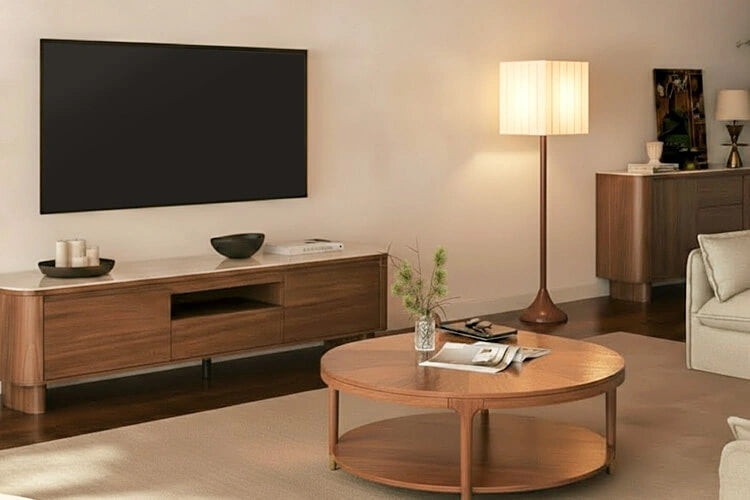
Use a cabinet explicitly intended to support a television. Its top must carry the TV and equipment within the stated load limit, and every TV foot must rest fully on the surface. Measure the TV's base or leg span, rather than its screen width. Allow cable exits and the ventilation space required by the equipment, and secure both cabinet and TV as instructed. Our sideboard-to-TV-stand suitability checks cover these measurements. If TV support and load capacity are unspecified, choose a purpose-built TV stand.
How can I check whether my dishes will fit?
Measure each large item's width, depth, and height, including lids and handles. Compare those with the usable shelf compartment and the clear opening between the doors and hinges. For example, a 14-inch-deep platter will not sit flat on a shelf with only 13 inches of usable depth, even if the cabinet's outside depth is 16 inches. Measure stacked plates as a stack, and leave room above them to lift them out without tilting into the shelf above.
How much space do I need in front of a sideboard?
Allow the full door or drawer projection plus room to stand in front of it. For example, an 18-inch drawer extension plus 24 inches for standing takes 42 inches measured from the closed cabinet front. Use those figures as a layout example, then test your own cabinet and the space you need to bend and lift dishes. In a dining room, pull out the nearest chair as if someone were getting up. Add more clearance if the open cabinet blocks that chair or the route to a doorway.
Recommended Products

More to Read
 7 Sofa Trends That Actually Improve Comfort in 2026
Upgrade your living room with furniture that supports your body. Here are 7 modern sofa features designed to maximize your daily comfort...
7 Sofa Trends That Actually Improve Comfort in 2026
Upgrade your living room with furniture that supports your body. Here are 7 modern sofa features designed to maximize your daily comfort...
 Mother's Day Gift Guide: Cozy and Stylish Furniture Picks for Modern Moms
Make Mother's Day more meaningful with furniture gifts that bring comfort, smart features, storage, and quiet luxury into her everyday routine.
Mother's Day Gift Guide: Cozy and Stylish Furniture Picks for Modern Moms
Make Mother's Day more meaningful with furniture gifts that bring comfort, smart features, storage, and quiet luxury into her everyday routine.
 Performance Fabric Reality Check: Does It Really Repel Pet Hair and Stains?
Performance fabric is often marketed as a miracle solution for homes with pets and kids, but the reality is more nuanced. It...
Performance Fabric Reality Check: Does It Really Repel Pet Hair and Stains?
Performance fabric is often marketed as a miracle solution for homes with pets and kids, but the reality is more nuanced. It...