






























Fully Assembled Sideboard vs. Flat-Pack: How to Choose

A sideboard has to fit your home twice: first through the delivery route, then into the way you store dishes, linens, and everyday essentials. How it arrives changes the work you do before that first dinner party—and the size of the piece you will carry when you move.
What changes when a sideboard arrives assembled?
A fully assembled sideboard arrives with its cabinet already built. A flat-pack sideboard arrives as panels and hardware for assembly at home. A third option, a preassembled cabinet with legs to attach, sits between the two. Read the assembly instructions for the specific model so you can arrange the right help and workspace.
| Delivery format | Work at home | Plan for |
|---|---|---|
| Fully assembled | Unpack, position, level as directed, and install the specified restraint. | Moving the complete cabinet along the delivery route. |
| Cabinet assembled; legs separate | Attach legs using the supplied instructions, then position and secure. | A protected work area and enough help to handle the cabinet. |
| Flat-pack | Build the cabinet, fit doors or drawers, then position and secure. | Tools, floor space, hardware organization, and assembly time. |
Choose fully assembled delivery when avoiding cabinet construction matters to you and the complete piece fits your route. Flat-pack can suit a home where the cartons are easier to carry or a lower purchase price leaves room for paid assembly. Compare the actual carton dimensions and weights for both options.

Compare the cabinet's construction
Assembly format describes how furniture reaches you. For build quality, examine the materials used in each part, the back panel and base, door hardware, and shelf support. A wood veneer names the surface finish; the core beneath it needs its own description. A solid-wood leg describes that component.
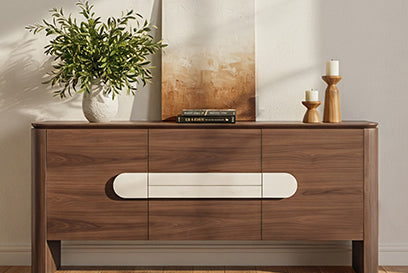
Our 71-inch Rex sideboard requires leg installation and has a matte black finish with vertical detailing and cylindrical support legs. Use the material information for each part and the shelf specifications alongside its delivery format when comparing it with another cabinet.
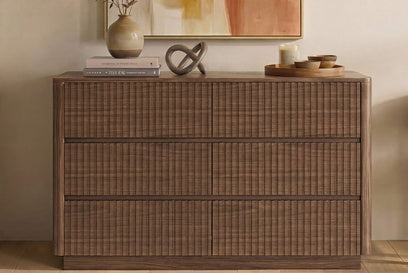
Our 63-inch Renee sideboard has woven rattan panels, three-level adjustable shelves, and cable-management holes. Its legs require installation. The adjustable shelves let you choose space for taller dishes or several shorter stacks; measure the clear opening and usable depth for the items you own.
For heavy plates or serving pieces, obtain the load rating for the shelf that will carry them. Cabinet-top and shelf ratings apply to different surfaces. Look for the usable shelf span and the support beneath it, especially if you plan to store a concentrated stack of dishes.
Measure the delivery route and daily-use space
Record the cabinet dimensions, packaged dimensions, and delivery weight. Measure the clear opening with doors fully open, including handles, trim, stair rails, and any lift opening. At a tight corner, include the space available to turn the cabinet. A doorway's width alone leaves that turn unresolved. The HSE's guidance on planning a lift recommends clearing obstacles, choosing suitable handling aids, and arranging help before carrying a heavy item.
Inside the room, mark the sideboard's footprint with painter's tape. Add the space needed for a door to swing or a drawer to open. Pull out the nearest dining chair and walk past it. This gives you a more useful view of the room than the cabinet width alone. Coordinate the sideboard's proportions and finish with your dining table.
Measure the items going inside, too. A tall pitcher needs shelf height; a serving platter needs enough clear width and depth to pass through the door opening. Adjustable shelves let you change the arrangement, while fixed partitions define the largest usable compartment. Compare the cabinet widths and layouts in our sideboard and buffet collection against the items you plan to store.

Compare the amount you will actually pay
Put the purchase price, delivery service, assembly charge, and any building access fees on one line for each option. Describe the delivery service precisely: curbside, threshold, or placement in the room you choose. A preassembled cabinet may still require you to carry it upstairs.
For a future move, ask the mover to quote the complete cabinet's dimensions and weight. For a flat-pack piece, use the assembly instructions to establish whether dismantling and reassembly are supported. Keep the return terms that apply to the item, including packaging requirements and any quoted return charges, with your order record.
The extra cost of an assembled sideboard buys a specific convenience: the main cabinet is already built. Judge the rest of its value from its storage layout, construction details, finish, and fit in your home.

Inspect and secure it after delivery
Photograph the packaging and any visible damage before discarding it. Check the corners, top, door alignment, shelves, and supplied hardware. Position the cabinet on a level surface and follow its leveling instructions. Open each door and drawer to confirm that nearby furniture leaves enough space.
Install the specified anti-tip restraint with hardware appropriate to the wall. The CPSC's Anchor It guidance recommends securing furniture to reduce tip-over risks. Keep heavy stored items low and keep objects that might attract children away from the top.
In the United States, the mandatory clothing-storage-unit rule covers qualifying furniture intended for clothing storage. The CPSC's scope description excludes dining-room and entertainment furniture. For a product sold as a bedroom dresser and a sideboard, confirm the instructions and compliance information for that exact model and intended use.
Frequently asked questions
Is a fully assembled sideboard worth paying more for?
Yes, when avoiding cabinet assembly is valuable to you and the complete piece fits your delivery route. Compare the delivered cost with the flat-pack price plus any assembly service, then choose the storage layout and construction that suit what you will put inside.
Will an assembled sideboard last longer than a flat-pack one?
There is no fixed lifespan advantage based on assembly format alone. Materials, joint design, shelf loads, hardware, and handling determine how an individual cabinet holds up. Compare those details for the two models you are considering.
Can I use a sideboard for a television?
Use a sideboard beneath a tabletop TV only when the cabinet is approved for that use and its top supports the TV's weight and entire base. For a wall-mounted TV, check the cabinet's storage and cable access separately from the wall mount's installation requirements.
Does fully assembled mean I can use it straight out of the box?
The cabinet is built, and setup still includes unpacking, placement, any specified leveling, and installing the restraint. Models described as requiring leg-only assembly have an additional installation step; our Renee sideboard is one example.
Recommended Products



More to Read
 7 Sofa Trends That Actually Improve Comfort in 2026
Upgrade your living room with furniture that supports your body. Here are 7 modern sofa features designed to maximize your daily comfort...
7 Sofa Trends That Actually Improve Comfort in 2026
Upgrade your living room with furniture that supports your body. Here are 7 modern sofa features designed to maximize your daily comfort...
 Mother's Day Gift Guide: Cozy and Stylish Furniture Picks for Modern Moms
Make Mother's Day more meaningful with furniture gifts that bring comfort, smart features, storage, and quiet luxury into her everyday routine.
Mother's Day Gift Guide: Cozy and Stylish Furniture Picks for Modern Moms
Make Mother's Day more meaningful with furniture gifts that bring comfort, smart features, storage, and quiet luxury into her everyday routine.
 Performance Fabric Reality Check: Does It Really Repel Pet Hair and Stains?
Performance fabric is often marketed as a miracle solution for homes with pets and kids, but the reality is more nuanced. It...
Performance Fabric Reality Check: Does It Really Repel Pet Hair and Stains?
Performance fabric is often marketed as a miracle solution for homes with pets and kids, but the reality is more nuanced. It...