






















Ottoman Placement With a Sectional: Layout and Spacing Guide

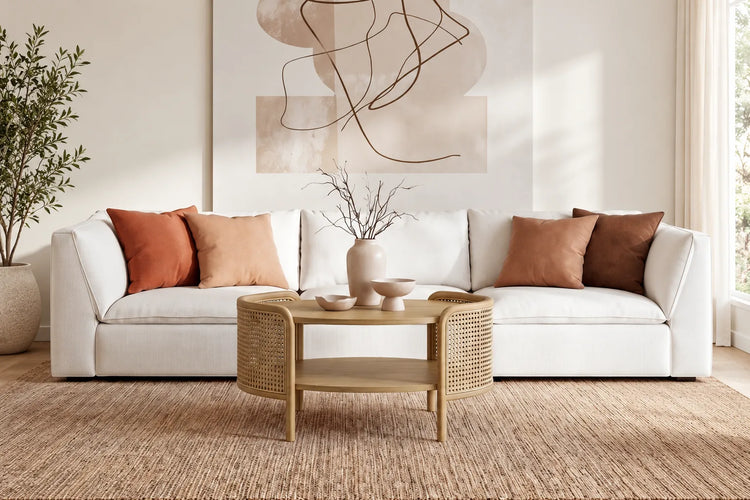
Ottoman placement with a sectional starts with a 14- to 18-inch gap for coffee-table-style use. Measure from the sectional’s usable seat edge, meaning the front of the cushions where you sit, to the nearest edge of the ottoman. Then preserve about 30 inches for ordinary walking clearance. A 36-inch width is an accessibility-oriented planning benchmark in covered accessible-route contexts, not a blanket private-home furniture rule. The final choice depends on your sectional’s shape, the ottoman’s full footprint, and whether you want a footrest, a coffee-table substitute, or both.

Where should an ottoman go with a sectional?
For coffee-table-style placement, measure from the sectional’s usable seat edge to the ottoman’s nearest edge. Use 14 to 18 inches as a starting range, then confirm that the furniture leaves about 30 inches for ordinary walking.
| Measurement or route | Supported starting point | What to verify |
|---|---|---|
| Seat-edge-to-ottoman gap | 14 to 18 inches for coffee-table-style use | Measure from the front cushion edge, not the back or arm |
| Ordinary walking clearance | About 30 inches around the furniture | Walk the marked layout before you commit |
| Accessibility-oriented route benchmark | 36 inches minimum clear width | Use it only when a generous accessible route is relevant |
Clearance checks before choosing an ottoman footprint
Use 14–18 inches from the usable sectional seat edge as a coffee-table-style starting gap; protect about 30 inches for ordinary walking, and treat 36 inches as an accessibility-oriented benchmark rather than a blanket private-home rule.
View chart data
| Category | Lower bound | Upper bound |
|---|---|---|
| Seat gap | 14.0 | 18.0 |
| Walking clearance | 30.0 | 30.0 |
| Accessible route | 36.0 | 36.0 |
These measurements solve different problems. The seat-edge gap supports legroom and reach, while the walking clearance protects movement through the room. The U.S. Access Board specifies 36 inches minimum for covered accessible walking surfaces in its accessible-route standard. Use that figure here only as a planning benchmark when the household or route makes it relevant. Reserve the walking path before finalizing the ottoman’s center position. If the footprint makes the route awkward, reduce or reposition the ottoman instead.

How does sectional shape change ottoman placement?
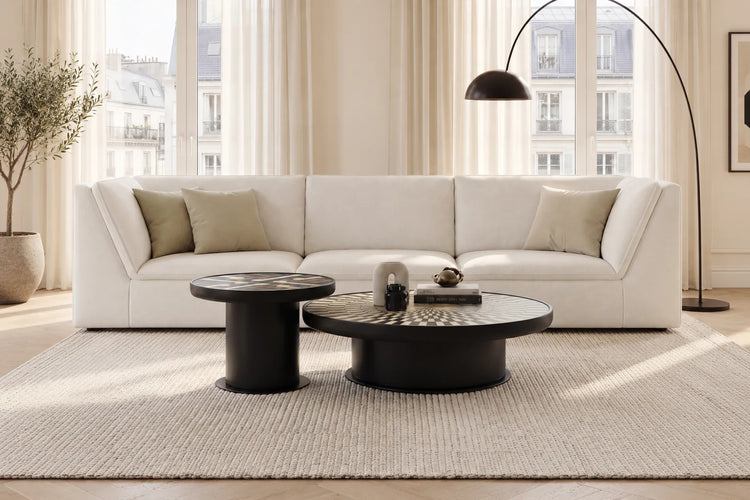
An L-shaped sectional usually requires protecting its open-side route. A U-shaped sectional requires keeping the opening into its center zone usable.
L-shaped sectional: protect the open side
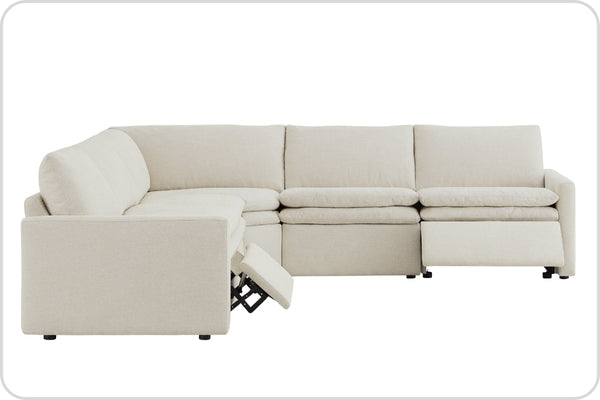
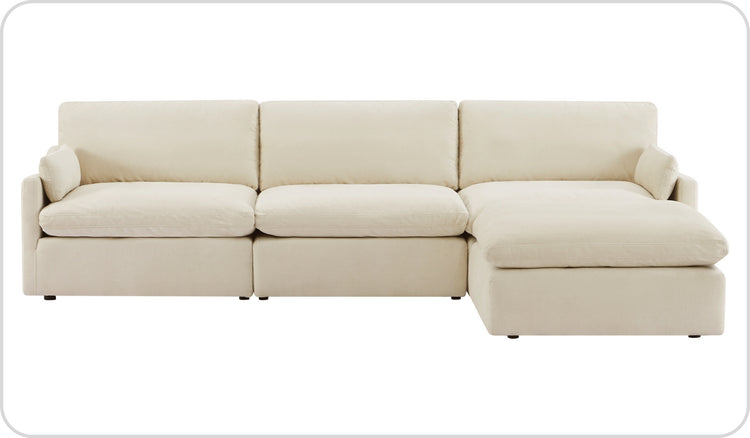
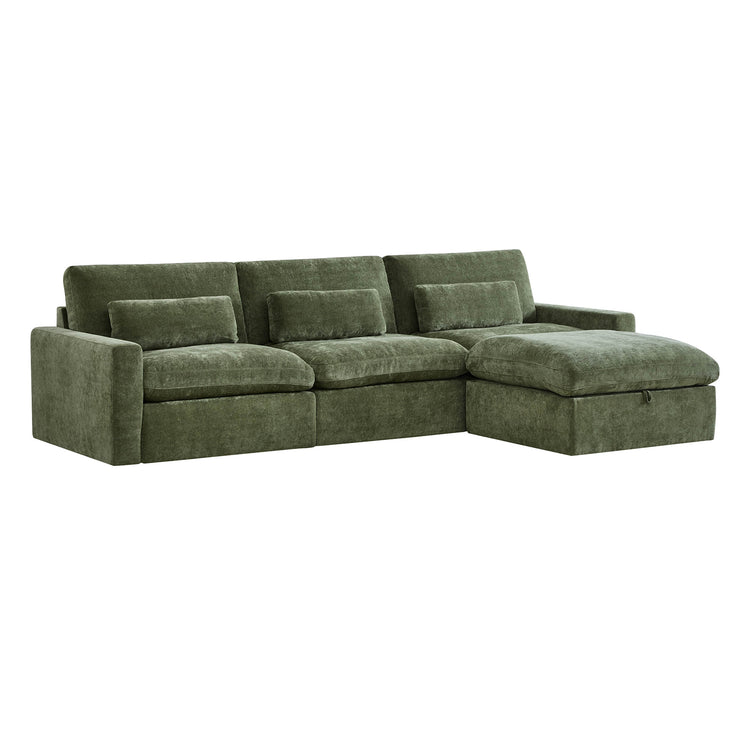
Align the ottoman with the main usable seat run, not the chaise or return, when that is the primary seating zone. Keep the open side available for entry or exit. If centering the ottoman narrows that route, offset it toward the sectional instead. Judge the full footprint, including corners and overhangs, rather than an imagined straight line across the sectional.
U-shaped sectional: keep the entry into the center usable
An ottoman can sit inside a U-shaped sectional’s center zone only when the opening into that zone remains a real access point. Mark the full footprint, including corners and overhangs, and check it against the actual opening.
A compact or round footprint may be easier to test in a tight center zone than a long rectangle, but shape alone does not establish fit. If the ottoman closes the opening, reject that placement even if the piece looks centered. When the opening must also work for a wheelchair, walker, or stroller, use the accessibility-oriented benchmark from the earlier section as a planning reference.
How should ottoman use change spacing and height?
Choose the placement based on how you will use the ottoman. Footrest use calls for a seated comfort test, coffee-table use calls for gap and height checks, and dual use must pass both tests without sacrificing the route.
Footrest-first placement
For a footrest, do not rely on a universal distance. Sit where you usually lounge and slide the ottoman until your legs rest comfortably without stretching or crowding the seat cushions. Adjust the position for your reach and comfort after the full footprint has been marked. Keep the walking route open even if that means choosing a different footrest position.
Coffee-table substitute
For coffee-table use, start with the 14- to 18-inch seat-edge gap. Then check height: the ottoman’s top can be level with the sectional’s seat cushions or 1 to 2 inches below them, according to coffee-table sizing guidance. Use roughly two-thirds of the sectional’s usable seat run as a proportion check for the ottoman’s length or diameter. Treat that proportion as a starting point, not a fixed requirement, and keep the gap and height within the tested layout.
Dual-use ottoman
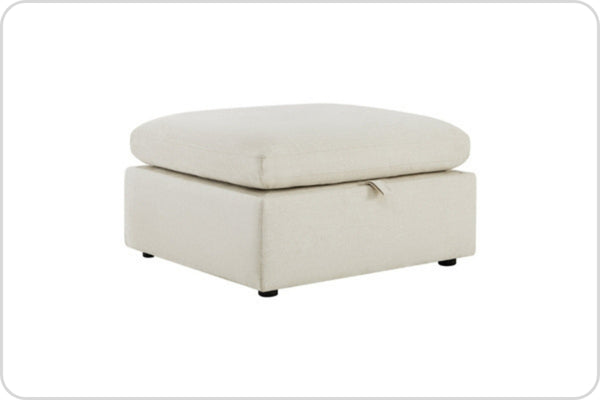
Choose a dual-use ottoman only when it passes the seated-comfort test and provides a reachable surface without blocking the route. Our Grace Round Storage Ottoman Coffee Table measures 38.2 inches in diameter and 16.1 inches high. Our product facts list it for footrest and coffee-table use, with hidden storage. Compare its full round footprint with your taped layout before buying. If that footprint closes the route, choose another size or shape.
For a longer tabletop-style footprint, our Blake Oval Storage Coffee Table with Two Drawers measures 51.18 inches wide × 29.53 inches deep × 14.96 inches high. Its rounded edges and longer surface may suit a wider seat run, but the full taped shape still needs to leave the walking route intact.
How to measure and test an ottoman placement before buying
Use a short measure, tape, walk, and adjust sequence to make a clear go-or-no-go decision before buying.
- Measure the sectional’s usable seat edge and seat height. Also measure the chaise or return projection instead of relying on the overall advertised dimensions.
- Measure the ottoman’s full width, depth or diameter, and height, including rounded overhangs.
- Mark both furniture footprints with painter’s tape or flattened cardboard. Measure the proposed seat-edge gap and the primary walking route, including door swings and nearby furniture.
- Walk your normal path through the room. Sit in each seat you use most, then test footrest reach or tabletop access.
- Move or resize the marked footprint until the route and intended use both work. If either test fails, reject that footprint before purchasing.
A painter’s-tape or cardboard floor test makes this check easier to see. You can also review common coffee-table mistakes with sectional sofas when a centered layout looks right on paper but blocks the space you use every day.
FAQs
How far should an ottoman be from a sectional?
For coffee-table-style use, start with 14 to 18 inches between the sectional’s usable seat edge and the nearest ottoman edge. Confirm that the gap also leaves your walking route usable.
Should an ottoman be the same height as the sectional seat?
For coffee-table use, the top can be level with the seat cushions or 1 to 2 inches below them. For footrest use, choose the height that passes your seated comfort test rather than matching a universal number.
Can you put an ottoman inside a U-shaped sectional?
Yes, if the opening into the center zone remains usable after you mark the ottoman’s full footprint. If the ottoman closes that entry point, choose a smaller or differently shaped piece.
How do you measure ottoman placement before buying?
Measure the sectional’s usable seat edge and the ottoman’s full footprint. Mark both with tape, then walk the route and test your usual seat and reach before you buy.
Buy only after the taped footprint passes both checks: the route stays usable, and the ottoman works for the way you plan to use it.
Recommended Products

More to Read
 7 Sofa Trends That Actually Improve Comfort in 2026
Upgrade your living room with furniture that supports your body. Here are 7 modern sofa features designed to maximize your daily comfort...
7 Sofa Trends That Actually Improve Comfort in 2026
Upgrade your living room with furniture that supports your body. Here are 7 modern sofa features designed to maximize your daily comfort...
 Mother's Day Gift Guide: Cozy and Stylish Furniture Picks for Modern Moms
Make Mother's Day more meaningful with furniture gifts that bring comfort, smart features, storage, and quiet luxury into her everyday routine.
Mother's Day Gift Guide: Cozy and Stylish Furniture Picks for Modern Moms
Make Mother's Day more meaningful with furniture gifts that bring comfort, smart features, storage, and quiet luxury into her everyday routine.
 Performance Fabric Reality Check: Does It Really Repel Pet Hair and Stains?
Performance fabric is often marketed as a miracle solution for homes with pets and kids, but the reality is more nuanced. It...
Performance Fabric Reality Check: Does It Really Repel Pet Hair and Stains?
Performance fabric is often marketed as a miracle solution for homes with pets and kids, but the reality is more nuanced. It...