






































Weight Limits on Wood TV Consoles: How to Prevent Center Sag Under Heavy Media Setups

For a TV stand for a 55-inch TV, prevent center sag by using the exact console’s documented top and shelf ratings. Add up the load on each surface before placing heavy media equipment. The sections below show how to do the math and what to check for soundbars, pedestals, and long spans.

This matters most when you add a heavy soundbar, a large TV pedestal, or a full shelf of components. A console that easily supports a 55-inch TV on its supplied feet can still be a poor fit for a concentrated center load if the top rating is unknown or too low. Before loading the console, find the manufacturer’s published top and shelf capacities for your specific model. If a listing gives only one combined capacity, treat the top rating as unresolved until you confirm how that number applies to the top surface.
What Weight Can a Wood TV Console Hold?
A “standard” wood TV console has no universal maximum weight. Capacity depends on the model’s span, materials, thickness, and construction. The only reliable number is the one listed on that model’s spec sheet, manual, or product label.
Illustrative calculation, not a universal limit: If a TV weighs 50 lbs, a soundbar weighs 15 lbs, and top-mounted accessories weigh 5 lbs, the top load is 50 + 15 + 5 = 70 lbs. Compare that result with the exact console’s documented top rating. This example does not approve a model whose applicable rating is unknown.
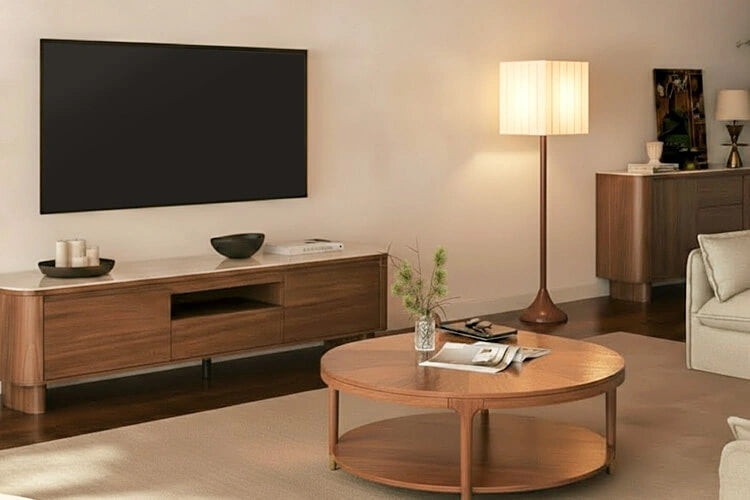
A console designed for a 55-inch television is sized for its footprint and height, not necessarily for a specific load capacity. Two consoles with nearly identical dimensions can carry very different loads because of differences in panel thickness and support design. If a listing shows only one total-capacity figure, treat it as a starting point rather than proof that the top can support your setup. A soundbar or pedestal near the center creates a concentrated load that needs surface-specific verification.
How to Calculate Top and Shelf Loads Separately
Add up equipment by the surface that supports it. Then compare each total with that surface’s documented rating instead of relying on one combined estimate.
- List every item resting on the top: the TV or TV pedestal, the soundbar, and any decor or accessories.
- Weigh each top item or check its spec sheet, then add the weights into one top-surface total.
- List every item on each interior shelf separately. Shelves can have different load limits from one another and from the top.
- Add the items on each shelf into that shelf’s own total. Do not combine shelf weight with the top total.
- Compare the top total with the model’s documented top rating. Compare each shelf total with that shelf’s rating.
- If a surface’s rating is missing from the listing, mark that surface as unresolved. Confirm the rating before loading it with a concentrated item.
As a limited comparison for shelf calculations, AWI’s shelf-span calculator treats load, span, thickness, and deflection as separate inputs. It does not certify a TV console’s top or shelf capacity. Adding each item to the total for the surface that supports it is a practical comparison, not an engineering certification. It is still the fastest way to see whether your setup fits a console you own or are considering.
Why Span, Thickness, and Supports Change Sag Risk
Center sag is a deflection problem, not a simple result of the word “wood.” The amount a panel bends under load depends on its unsupported span, thickness, construction, and whether a divider or leg interrupts that span.
Unsupported Span and Panel Thickness
A longer unsupported span and a thinner panel both increase bending under the same load. AWI’s shelf-span guidance connects load, deflection, panel thickness, and span for shelf calculations. Use that relationship as background when inspecting shelf variables, not as proof of a TV console’s safe top load or a universal limit. Inspect your console’s actual span and thickness rather than trying to calculate a universal TV-console limit yourself.
Panel and Frame Construction
The top panel, dividers, back panel, base, and connecting joints all affect how weight travels to the floor. A product description that names a wood species or construction style provides useful context, but it does not replace the finished console’s documented rating. Two consoles with similar-sounding construction can still perform differently after assembly.
Center Dividers and Support Legs
A center divider or support leg under the middle of a long top can shorten the unsupported span and change how the load reaches the base. That may reduce sag risk, but no source here supports a specific capacity increase for any leg or divider design. Do not treat an aftermarket brace or improvised leg as a documented capacity increase. Use only the manufacturer’s rating for the finished design when making your decision.
Solid Wood, Engineered Wood, and Mixed Materials
A material label tells you what a panel is made from, not what the finished console is rated to hold. The table below shows what each description can tell you and what you still need to verify before loading it.
| Material description | What it tells you | What still needs verification |
|---|---|---|
| Solid wood | Species-based stiffness and strength that vary with moisture content | The finished panel’s thickness, span, and documented rating |
| Engineered wood (plywood, MDF, particleboard) | A manufactured panel with its own stiffness profile, not tied to one species | How the panel is supported, braced, and rated in the finished piece |
| Mixed-material or veneer construction | A decorative or structural layer over a core material | Which layer bears the load and whether the core’s rating is documented |
Wood also behaves differently under load over time. Oklahoma State’s wood-strength research explains that sustained loading can leave residual sag after the weight is removed because wood has some viscoelastic memory. That is another reason to rely on a documented rating instead of judging how “solid” a panel looks. For a deeper look at how joinery affects load-bearing performance in similar case furniture, this shelf rating and sag guide uses the same verification logic.
How to Handle a Soundbar, Pedestal, or Concentrated Center Load
The right approach depends on where the heaviest item sits and whether the relevant surface rating is documented. If the rating is missing or the actual surface load exceeds it, stop loading that surface. Remove weight, reduce the load, reconfigure the setup, or choose another console.
TV on Its Supplied Feet
Treat the TV and everything else on the top, including a soundbar or decor, as one combined top-surface load. Confirm that the console is designed to hold a television and that its top rating covers everything you plan to place there, not just the TV.
Heavy Soundbar Near the Center
Include the soundbar in your top total rather than assuming its position makes it safe. A centered soundbar creates a concentrated load that must be checked against the top rating for that console. If the listing gives only a total capacity and no top-specific number, contact the manufacturer for clarification before finalizing the placement.
Large TV Pedestal
Account for the pedestal and TV together, then consider the pedestal’s footprint. A heavy pedestal resting on a small area creates a concentrated load that must be checked against the applicable top rating. TV-size compatibility does not establish this number; only the documented top rating does.
Long Console With or Without Center Support
A visible center divider or leg can shorten the unsupported span on a long top, which may help reduce deflection. The exact construction and the way the support attaches to the base still control the outcome, so do not assume a retrofit brace creates a rated capacity increase. If your console has a long unsupported center and no documented top rating, treat a concentrated load there as unverified until you obtain one.
The table below summarizes the decision for each setup without assigning a capacity number.
| Setup | Main uncertainty | Next action |
|---|---|---|
| TV on supplied feet | Whether the top rating covers the full combined load | Add the TV and accessories, then compare the total with the top rating |
| Soundbar near center | Whether a total rating applies to a concentrated center spot | Verify the top-specific rating before placing it centrally |
| Large pedestal | Footprint concentration versus total weight | Confirm the top rating; do not rely on TV-size fit alone |
| Long span with center support | Whether the support reduces the span enough for this load | Confirm the documented rating for that construction, not an assumed gain |
| Long span, no support | Unsupported span length under a heavy top load | Pause and verify before adding a concentrated item |
Stability Inspection: One Checklist Before Continued Use
Before adding anything else to a loaded console, inspect the structure. Any sign below is a reason to remove questionable weight and verify the console before continuing.
- Visible center dip or bowing on the top or a shelf. Even after you remove an item, the panel may not become fully flat again because sustained loading can leave a residual bend.
- Cracked, separated, or loose joints where panels meet the base, back, or dividers.
- A shifting base, legs, or support points when you press gently on the top or a shelf.
- Doors or drawers that no longer align, which can signal that the frame has flexed under load.
- Any wobble or tip risk when the TV is on top. CPSC’s tip-over safety guidance recommends using furniture designed to hold a television and anchoring the TV and unmounted furniture separately from any sag check. Anchoring addresses tip-over risk, not the console’s load rating.
If you see any of these signs, remove the heaviest or most concentrated items. Confirm the documented rating for the affected surface, and do not add new equipment until you have verified that the structure can support it.
How to Verify a Console Before You Buy
For a TV stand for a 55-inch TV or a heavier media setup, make the documented top and shelf ratings your purchase gate. Do not rely on the console’s total capacity or its fit for a 55-inch screen.
The Specification Check Before Purchase
- Find the exact top and shelf weight ratings on the product page or in the manual. You can also ask the retailer directly.
- Map your TV or pedestal, soundbar, and stored components to the surfaces that will hold them.
- Check whether the construction includes a center divider or support leg suited to your setup’s concentrated load.
- If the relevant surface rating is not documented, treat the console as unverified for that setup rather than assuming it fits.
How to Use a Total-Capacity Listing
Some listings give one overall number. Our 79-inch Samuel console is listed at 220 lbs total capacity with engineered-wood construction and ash veneer. Our 79-inch Aaron console is listed at 400 lbs total capacity with a plywood body and travertine-style finish. Neither listing separates the top rating from the shelf rating, so neither total should be treated as automatic clearance for a heavy center soundbar or pedestal. Use figures like these to understand how total-capacity wording works, then confirm the surface-specific number you need before loading a concentrated setup.
Our Next Step for Console Shopping
Once you know the top and shelf ratings your setup requires, browse our TV stands with storage to compare documented specifications with your calculated loads. If your screen is well above 55 inches, our sizing guide for larger TV stands explains the same weight-capacity checks for bigger screens. We recommend confirming the applicable rating for your exact setup before finalizing any purchase involving a heavy soundbar or pedestal.
FAQs
What Is the Maximum Weight Capacity for a Standard Wood TV Console?
There is no universal maximum for a “standard” wood console. Capacity depends on the model’s construction, span, and thickness. You need that exact model’s documented top and shelf ratings rather than a generic number based on wood type or screen size.
How Can I Tell If My TV Stand Is Starting to Sag?
Look for a visible dip in the center of the top or a shelf, loose or cracked joints, doors or drawers that no longer close evenly, or a wobbling base. Any of these signs means you should remove some weight and verify the structure before adding anything else.
Do Center Support Legs Really Make a Difference?
A center divider or support leg can shorten the unsupported span of a long top, which may reduce deflection risk. The result depends on the specific design and how the support attaches to the base. Treat it as a factor to ask about, not a guaranteed fix, and do not improvise a brace without confirming the finished piece’s documented rating.
References
- AWI (n.d.). AWI Shelf Span Calculator.
- Oklahoma State University Extension (n.d.). Strength Properties of Wood for Practical Applications.
- U.S. Consumer Product Safety Commission (n.d.). AnchorIt.gov.
Recommended Products




More to Read
 7 Sofa Trends That Actually Improve Comfort in 2026
Upgrade your living room with furniture that supports your body. Here are 7 modern sofa features designed to maximize your daily comfort...
7 Sofa Trends That Actually Improve Comfort in 2026
Upgrade your living room with furniture that supports your body. Here are 7 modern sofa features designed to maximize your daily comfort...
 Mother's Day Gift Guide: Cozy and Stylish Furniture Picks for Modern Moms
Make Mother's Day more meaningful with furniture gifts that bring comfort, smart features, storage, and quiet luxury into her everyday routine.
Mother's Day Gift Guide: Cozy and Stylish Furniture Picks for Modern Moms
Make Mother's Day more meaningful with furniture gifts that bring comfort, smart features, storage, and quiet luxury into her everyday routine.
 Performance Fabric Reality Check: Does It Really Repel Pet Hair and Stains?
Performance fabric is often marketed as a miracle solution for homes with pets and kids, but the reality is more nuanced. It...
Performance Fabric Reality Check: Does It Really Repel Pet Hair and Stains?
Performance fabric is often marketed as a miracle solution for homes with pets and kids, but the reality is more nuanced. It...