























What Is the 2-2-1 Rule for Sofas? Pillow Sizes & Layout

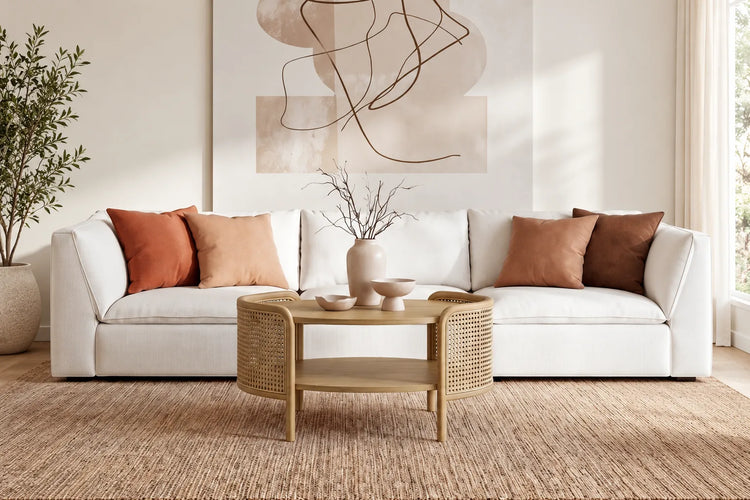
Put your pillows on the floor and sort them into two pairs and one single accent. That gives you the pieces for a 2-2-1 sofa arrangement. A useful starting set is two 22-inch squares, two 20-inch squares, and one 12-by-20-inch rectangle.
The pair at the back adds height at the sofa ends, the smaller pair sits in front, and the single pillow fills the middle. You can try the arrangement with covers you already own before choosing new ones.
Place the two pairs, then the single pillow
- Place the larger pair at the ends. Rest one against each arm and the sofa back.
- Add the smaller pair in front. Move each slightly inward so you can still see the larger pillow behind it.
- Set the single pillow near the middle. A long rectangle, often called a lumbar pillow in styling, gives the center a different shape.
- Look from the room's entrance. Bring a hidden pillow forward or adjust the ends until the arrangement looks balanced to you.
- Sit in the places you use. Move the center pillow aside or remove a layer where it crowds your back or arms.
Five pillows describe the styled arrangement. Keep a basket or nearby chair available if you like to move a pillow while sitting. A crease at the top is optional; shape each pillow in a way its filling allows.

Pillow sizes to try on your sofa
Measure covers flat from seam to seam. The filled pillow will project forward onto the seat, so hold it in position to judge both its height and the space it occupies.
| Group | Count | Cover size to try | Position |
|---|---|---|---|
| Large squares | 2 | 22 × 22 in; about 56 × 56 cm | At the outer ends. |
| Smaller squares | 2 | 20 × 20 in; about 51 × 51 cm | In front of the larger pair. |
| Rectangle | 1 | 12 × 20 in; about 30 × 51 cm | Near the center, in front. |
These are styling examples. On a low-backed or compact sofa, try 20-inch and 18-inch squares with a smaller rectangle. A broad, high-backed sofa may suit 24-inch and 22-inch squares. Check how much of the sofa back you want to leave visible.
Choose inserts using the cover's sizing and filling instructions. If your pillows are all the same size, place the back pair more upright and the front pair lower. The different positions can keep both fabrics visible.
Build the colors around one pillow
Choose one pillow you like, then repeat a color from it in the other pieces. The two pairs give you an easy way to carry a color across both ends of the sofa.
For a plain, light-colored sofa
Try two olive squares at the back, two cream-and-rust striped squares in front, and a rust rectangle in the middle. The striped pair connects the cream upholstery with the rust accent. The olive color repeats at the two ends.
For a patterned sofa
Pull a background color from the upholstery for the larger pair. Choose a quieter version of an accent color for the smaller pair, then repeat one of those colors in the rectangle. Start with mostly plain covers so you can judge the pillow shapes against the sofa's pattern.
For pillows you already own
Make two pairs using related colors or sizes, even if their fabrics differ. For example, an olive woven square and an olive velvet square can form a color pair. Place them at opposite ends, then use the remaining pair and single pillow to connect the arrangement.
Our brown leather sofa color combinations include cream, rust, blue, and green palettes. For more ways to combine the pieces, our sofa styling ideas cover pillow sizes, patterns, and textures.

Use the arrangement on different sofas
Loveseat or small sofa
Try one square at each end and a small rectangle in the middle. That three-pillow version leaves more seat space. If the rectangle gets moved every time you sit, keep the two squares on the sofa and place the rectangle nearby.
Three-seat sofa
Begin with the five-pillow layout, then have each regular user sit down. If the middle seat feels crowded, remove the center pillow. If the ends feel tight, try smaller front pillows or just one pillow at each end.
L-shaped sectional
Use the inside corner and two outside ends as placement points. One five-pillow version puts a pair in the corner, a square at each outside end, and the rectangle beside one of those outer squares: 2 + 1 + 1 + 1 = 5. Spread the colors from your original pairs across those positions.
Try the corner seat and the chaise as you normally use them. Move a pillow wherever it takes up the place you want for your legs or back.
Deep seats or smooth upholstery
On a deep seat, place a pillow behind you and assess the remaining sitting space. Our seat depth and cushion feel guide explains the measurements involved.
For a pillow that slides on leather or another smooth surface, try it more upright where the arm and back meet. Compare another cover you own in the same spot. The cover surface, insert fullness, and sofa shape affect how it rests.
Questions about the 2-2-1 pillow rule
Does 2-2-1 mean five pillows or five furniture pieces?
In this sofa-pillow arrangement, it means five pillows: two larger pillows, two smaller pillows, and one accent pillow. Furniture listings sometimes use numbers to describe a seating set, so read that listing's description separately.
Do I need exactly five pillows?
The 2-2-1 layout uses five. For a smaller sofa, try three; for an open middle seat, try four as two pairs. Keep the count that leaves the seats comfortable to use.
Do the two pillows in each pair have to match?
No. Similar sizes and related colors can make a pair. Two olive squares in different textures, for example, repeat the color while adding some variation.
Does every pillow need a different pattern?
No. One patterned pair with three plain pillows is an easy combination to try. You can also use all plain covers and vary the texture or shape.
What should I remove if the sofa looks crowded?
Remove the center pillow first and sit down again. If the ends still feel crowded, reduce the size of the front pair or use one square at each end.
Recommended Products

More to Read
 7 Sofa Trends That Actually Improve Comfort in 2026
Upgrade your living room with furniture that supports your body. Here are 7 modern sofa features designed to maximize your daily comfort...
7 Sofa Trends That Actually Improve Comfort in 2026
Upgrade your living room with furniture that supports your body. Here are 7 modern sofa features designed to maximize your daily comfort...
 Mother's Day Gift Guide: Cozy and Stylish Furniture Picks for Modern Moms
Make Mother's Day more meaningful with furniture gifts that bring comfort, smart features, storage, and quiet luxury into her everyday routine.
Mother's Day Gift Guide: Cozy and Stylish Furniture Picks for Modern Moms
Make Mother's Day more meaningful with furniture gifts that bring comfort, smart features, storage, and quiet luxury into her everyday routine.
 Performance Fabric Reality Check: Does It Really Repel Pet Hair and Stains?
Performance fabric is often marketed as a miracle solution for homes with pets and kids, but the reality is more nuanced. It...
Performance Fabric Reality Check: Does It Really Repel Pet Hair and Stains?
Performance fabric is often marketed as a miracle solution for homes with pets and kids, but the reality is more nuanced. It...